
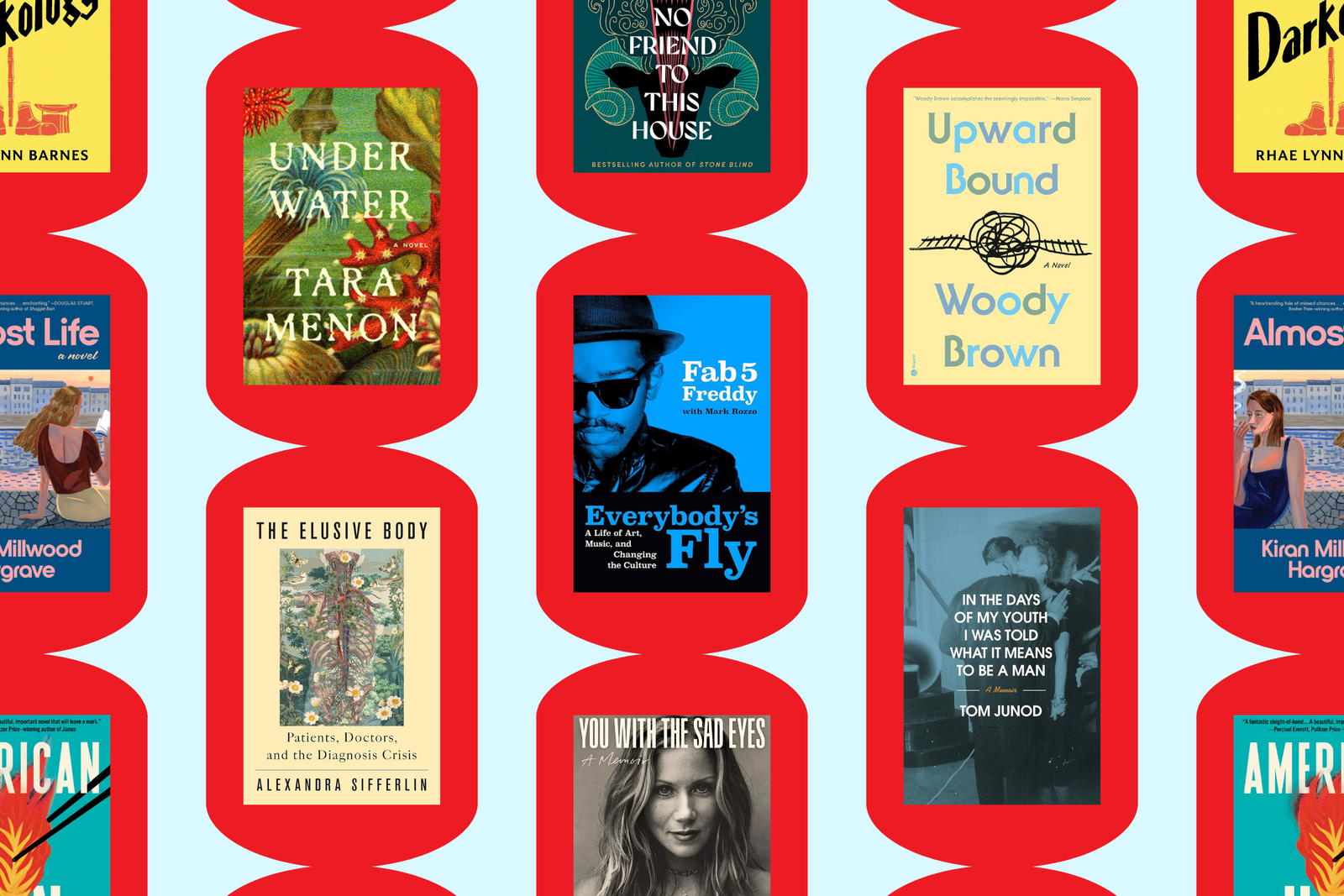

That month of betwixt and between, we march into March yearning for spring, fortified with books across genres to steady our impatience. Among the most exciting new releases this month are candid celebrity memoirs from a sitcom star and a 1980s East Village impresario; novels that explore outsider perspectives; and a father-son true story that speaks to a powerful if often cryptic bond.
Here comes the sun, plus 10 March titles you don’t want to miss.
[time-brightcove not-tgx=”true”]
You With the Sad Eyes, Christina Applegate (March 3)

Actor Christina Applegate’s candor and intelligence thread throughout her memoir, from a hippie-style Laurel Canyon childhood and a starry-eyed adolescence among Hollywood legends to roles in Married . . . with Children and Anchorman and her diagnosis and experience living with multiple sclerosis. Applegate evokes the hijinks of fame—there are more celebrity cameos here than in a Josh Safdie film—as well as her journey through chronic illness. “It has afforded me time and space to look back on my life,” she writes. “I have started to make a little sense of it, to understand what happened, see patterns, discover meaning.”
Everybody’s Fly, Fab 5 Freddy with Mark Rozzo (March 10)

A pioneer of the hip-hop revolution, Fred Braithwaite, a.k.a. Fab 5 Freddy, recounts his odyssey from churchgoing Brooklyn kid to teenaged music aficionado (his first concert was Sly and the Family Stone) to the forefront of New York’s ’80s avant-garde scene, when musicians, artists, and fashionistas ruled the East Village, mingling with the likes of Blondie, Jean-Michel Basquiat, Grace Jones, Public Enemy, and Keith Haring. In this textured testament to a time and place, Freddy conjures club crazes and drug deals, business ventures and wannabe stars: “Sh-t was popping. You could feel it in the air.”
No Friend to This House, Natalie Haynes (March 10)

The author of A Thousand Ships and Stone Blind reimagines the Greek myth of Medea as a passion play, rife with domestic fury and murder most foul. Natalie Haynes fleshes out the backstories of her cast—Jason, a handsome ship captain on a quest for the Golden Fleece, the scheming sorceress Medea, and Olympian deities toying with mortals like marionettes—and imbues them all with contemporary vibes. Aphrodite has never seemed more human: “She ran her tongue lightly across the back of her teeth because it was the only way she knew to express rage without affecting the shape of her perfect mouth.”
In the Days of My Youth I Was Told What It Means to Be a Man, Tom Junod (March 10)

“Everybody knew. Uncle Johnny knew. Mike Labella knew. My Aunt Ceil knew, and so did my uncle Harry, my mother’s brother.” So begins two-time National Magazine Award winner Tom Junod’s debut memoir as he probes his relationship with his secretive, seductive father, a Long Island lothario and traveling salesman who caroused with beautiful women and Rat Pack celebrities like Frank Sinatra. The elder Junod gave off mixed messages, abusing his long-suffering wife while indulging his gifted son. The author recreates a lost era of Manhattan nightclubs, Hollywood parties, and tabloid headlines as he pieces together a complex love, beaming a light on today’s masculinity crisis.
Under Water, Tara Menon (March 17)

In this highly anticipated debut, a motherless girl and her marine-biologist father travel to Thailand, where they’re welcomed by a community of research scientists. Marissa befriends the fearless Arielle, with whom she explores the mysteries of a natural paradise populated with long-tailed macaques, manta rays, and “delicate long branches” of coral. But a deadly tsunami shatters Marissa’s fragile happiness; and years later, as an adult in New York City, she confronts another storm, sweeping her back into the depths of her memories of a kinship she’d felt with the wonders of the biosphere and her connection to a spirited soul.
Darkology, Rhae Lynn Barnes (March 24)

A decade in the making, Princeton scholar Rhae Lynn Barnes’ rich if disquieting history of blackface rips off the masks from entertainers and politicians alike. She wraps meticulous research around a mainstreamed (until recently) form of white supremacy, rooted in minstrel shows. From The Birth of a Nation to The Jazz Singer, from an empire at war to protests at home, from Japanese incarceration camps to Watergate, she exposes racial anxiety at the heart of the American Experiment and how blackface sanitized prejudices for white audiences, a “creeping apprehension across a rapidly diversifying nation.”
Almost Life, Kiran Millwood Hargrave (March 24)

In 1978, Erica, an English student on holiday, encounters Laure, a Sorbonne doctoral candidate, outside the Sacré-Coeur, kindling a sapphic romance while exploring sites in Paris, “famous for lovers, a city full of shadowed corners and exquisite light, even the texture of the buildings seductive.” Yet more than the English Channel eventually divides them: Erica returns to her literary studies while Laure struggles with coming out to her family, even as she’s bolstered by her queer community. Is their romance doomed or destined to endure? Kiran Millwood Hargrave’s winning prose and insights capture the legacy of a consequential affair.
Upward Bound, Woody Brown (March 31)

Set in an adult daycare center in Los Angeles—“a shabby one-story building” with an “eighties-era aqua-and-peach exterior and convenient ramp”—this vibrant debut novel spotlights a cast of disabled and neurodiverse characters and their caregivers: the nonverbal, high-achieving Walter; Tom, who has cerebral-palsy; Mariana, a stoic aide; the attention-starved Anthony; and Dave, Upward Bound’s former-actor-turned-supervisor, whose plans for an elaborate Christmas Spectacular take on a life of their own. Woody Brown, a nonverbal author himself, highlights stories that are too often banished to the margins.
American Han, Lisa Lee (March 31)

In Lisa Lee’s first novel, Korean American siblings Jane and Kevin Kim come of age in the Bay Area during the 1980s. They’re both high-achieving strivers spurred on by their working-class, immigrant parents, yet they diverge along different paths. Jane sets off for law school, while her brother heads to the police academy. When Kevin goes missing, the family members must confront their fragile bonds and the cultural expectations that have long tethered them. As Jane observes of her mother, “She’s made a life for herself without approval from her family, with America judging her and narrowing her options.”
The Elusive Body, Alexandra Sifferlin (March 31)

A journalist charts the brave new world of undiagnosed diseases and the researchers and physicians who rally to their patients’ care. Through a series of case histories that unfold like mystery investigations—five middle-aged Kentucky siblings with baffling muscle pain, a young New York man tormented by acute symptoms of Parkinson’s Disease, a doctor grappling with her own body’s ailments—Sifferlin calls out “the diagnosis crisis,” probing all-too-common human errors, the mortifying flaws in how we train our clinicians, and the allure of genomic medicine.
About The Author