
South Korea has become a new focal point amid an escalating feud between China and Japan.
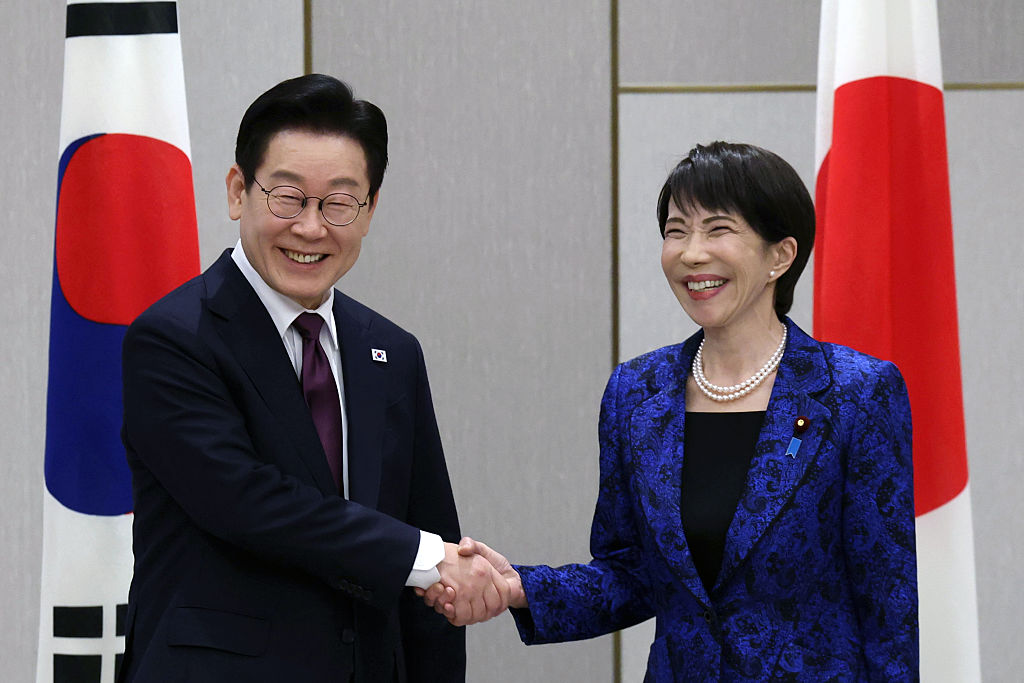
Japanese Prime Minister Sanae Takaichi met with South Korean President Lee Jae-Myung on Tuesday at a summit in Takaichi’s home prefecture of Nara. It is the second time the two leaders have met in person since Takaichi came into power in October.
[time-brightcove not-tgx=”true”]
“Although we have painful past experiences, it has been 60 years since the normalization of diplomatic relations between Korea and Japan, and we are starting a new 60 years,” Lee said in his opening remarks. “In the current complex and dizzying international order, cooperation between South Korea and Japan is more important than ever.”
“You mentioned the next 60 years. I am delighted that we were able to continuously demonstrate the resilience of Korea-Japan relations last year, which marked the 60th anniversary of diplomatic normalization,” Takaichi said. “I hope to make this year, starting with President Lee’s visit to Japan, a year that elevates Korea-Japan relations to a higher level.”
The meeting comes as Tokyo seeks to rein in a deepening diplomatic and trade rift with China while strengthening ties with allies to counter Beijing’s attempts to isolate Japan. South Korean officials have said that Lee and Takaichi would likely touch on the tensions between China and Japan on Lee’s two-day visit.
But the meeting also comes just a week after Lee met with Chinese President Xi Jinping on a visit to Beijing—the first time a South Korean President has visited China since 2019 as Lee moves to normalize relations with China. Lee was accompanied by a 400-member business delegation days after a group of Japanese executives put their annual visit to Beijing on hold for the first time in 13 years, suggesting that corporate diplomacy has strained under China-Japan tensions.
Read More: How the China-Japan Rift Could Cost Both Countries
Li Hao, an associate professor at the University of Tokyo and a research fellow at the Japan Institute of International Affairs, tells TIME that Lee is caught in a balancing act as he seeks to improve ties with China—the world’s second largest economy—and Japan, a key U.S. ally.
“South Korea is sandwiched by both China and Japan,” Li says. Lee is likely to remain cautious in his public statements about the feud, but appears happy to engage in what some have called “shuttle diplomacy” between the quarreling nations—perhaps because South Korea stands to reap some benefits, Li says.
China ices Japan out
Relations between China and Japan have deteriorated since early November when Takaichi suggested that a Chinese attack on Taiwan could be considered a “survival-threatening situation,” which would permit Japan to take military action. China regards Taiwan as its own territory and maintains its right to take control of the island one day, including by force.
Takaichi has refused to retract her comments, despite China’s demands. Kei Koga, an associate professor at Singapore-based Nanyang Technological University’s Public Policy and Global Affairs Program, previously told TIME that Takaichi’s comments do not significantly deviate from Japan’s long-held position on Taiwan.
Instead, experts have suggested that Beijing sees this as an opportunity to make clear its red lines, which may have become increasingly important in light of U.S. military intervention in Venezuela.
Read More: What Trump’s Venezuela Gambit Means for China and Taiwan
China has issued travel advisories to its citizens about travelling to Japan, appeared to implement an unofficial ban on Japanese entertainment, and reimposed a ban on Japanese seafood imports. On Jan. 6, a day after Xi’s meeting with Lee, China announced a ban on the export of more than 800 dual-use goods to Japan. The new export controls restrict technologies, chemicals, products, or software that could be used for military purposes, including some rare earth elements. The move was met with a protest by Japan’s Foreign Ministry.
China is also considering tightening export license reviews for some medium and heavy rare earth items, according to state-run China Daily. The Wall Street Journal reported last week that China has already begun restricting exports of rare earths and rare-earth magnets to Japan. China produces around 60 to 70% of the world’s rare earths, and processes nearly 90% of it.
Japan has sought the support of other U.S. allies and advanced economies—including South Korea—as a buffer against potentially being cut off from Chinese rare earths and other economic fallout from the spat. Japanese Finance Minister Satsuki Katayama has been holding talks with other industrialized democracies to secure critical minerals. Defense Minister Shinjiro Koizumi will also meet with U.S. War Secretary Pete Hegseth on Thursday when he is also expected to discuss the subject. China instituted broad global export controls on rare earths last year, which some experts saw as Beijing wielding critical minerals as a powerful bargaining chip in its trade war with the U.S.
“The fundamental consensus among the G-7 nations is that it is unacceptable for countries to secure monopolies through non-market means,” Katayama told reporters on Friday, adding that China’s control over rare earths “poses a crisis for the global economy and is extremely problematic for economic security.”
South Korea, specifically, is an important partner for Japan’s national security in the trilateral framework with the U.S., says Ryu Yongwook, an assistant professor at the Lee Kuan Yew School of Public Policy in Singapore specializing in East Asian international relations. “At a time when the U.S. under Trump 2.0 is proving to be less predictable and reliable for Japan, Tokyo seeks a trustworthy partner in the region in order to improve its political and security situation in East Asia,” he adds.
Japan is making “a kind of appeal” to South Korea to contain the damage of the spat, says Li. But so is China, he adds, which sees its relationship with Korea as a means of competing with Japan.
Beijing has drawn closer to Seoul, in what experts suggest is part of an effort to not just cut Tokyo off from Chinese trade, but also to isolate it diplomatically.
“If successful, China could shape a narrative portraying Japan as interfering in China’s domestic affairs,” says Koga. As for Japan, if it can prevent South Korea from aligning with China, then “maintaining the status quo would help prevent such narratives from gaining traction.”
In a public display of warmth, Lee and Xi took selfies on the Xiaomi phone that Xi had previously gifted Lee.
“Thanks to you, I got the shot of a lifetime,” Lee posted on X, alongside the photos.
It’s a marked shift from previously strained relations between Beijing and Seoul since 2016, when South Korea deployed the U.S. Thaad missile defense system to the consternation of China. Lee, who took office last June, has sought a more positive relationship with China, while balancing that with South Korea’s status as a U.S. ally.

Xi was keen to frame the meeting in opposition to Japan, calling on South Korea to “stand on the right side of history” and “join hands to defend the fruits of victory in World War II and safeguard peace and stability in Northeast Asia”—a reference to historical Japanese military aggression towards both China and South Korea. Chinese state media has also framed warming relations between the two countries as an affirmation of South Korea’s support for China. Xinhua News Agency cited Lee as emphasizing South Korea’s respect for the “One China” policy. China Daily reported that Lee’s government has standardized the official naming order of “South Korea, China, and Japan,” which it said indicated a prioritization of its relations with Beijing.
“Beijing is clearly trying to drive a wedge between Korea and Japan, hoping to leverage Lee’s desire to restore ‘balance’ to Korea’s foreign policy with his party’s longstanding anti-Japan streak,” Jeremy Chan, a senior analyst at Eurasia Group and a former U.S. diplomat in China and Japan, told Bloomberg.
South Korea is also a key economic partner for China, says Ryu. That’s especially true at a time when U.S. actions are making Venezuela and Iran—two of Beijing’s external political partners—“ineffective and dysfunctional,” he adds.
“Beijing needs to stabilize and improve its relations with Seoul in the hope that the latter can maintain a more neutral position in the U.S.-China strategic rivalry,” Ryu says.
A balancing act
Lee has thus far treaded carefully.
Speaking to reporters in Shanghai after his meeting with Xi, Lee suggested that South Korea will not get involved with the dispute anytime soon.
“If we intervene at the wrong time, it may not be helpful. When the time and circumstances are right, we will look for an appropriate role to play,” Lee said.
In an interview with Japanese broadcaster NHK aired on Monday, he made that line even clearer.
“Chinese President Xi Jinping evidently holds a very negative view of Japan’s position on the Taiwan issue,” Lee said. “In my view, that’s a matter for China and Japan to address and not something we need to get involved in.”
Ryu tells TIME that Lee’s Administration has taken a pragmatic approach to foreign policy, which has meant “cooperate where possible, avoid unnecessary conflict, while strengthening Seoul’s alliance relations with the U.S. and the U.S.-Japan-ROK trilateral.”
Li says there are some advantages to South Korea to walking this middle line. Chinese tourism to Japan has been diverted to South Korea, with the latter country receiving a boom in visitors from China since November. Investors also foresee the strain in China-Japan relations benefitting spending on South Korean businesses, leading to gains for Korean retail and consumer stocks, according to Bloomberg.
Meanwhile, Japan and China’s courtship of South Korea is increasing its political standing over two of the biggest economies in Asia and positioning it as a diplomatic hub, Koga says. South Korea could use this as an opportunity to press China to loosen its informal restrictions on Korean entertainment from 2016 or to get China firmly on board with North Korean denuclearization.
Still, Li says South Korea is geopolitically a “middle power” in spite of its importance economically. As a result, Lee’s government is trying to maintain neutrality between China and Japan for as long as possible—hopefully until the two countries reconcile. South Korea is more of a “constant,” says Li, as opposed to a variable that might escalate or deescalate tensions.
More important than how Lee responds, Li says, is whether Takaichi calls a snap election, as she is expected to do, and whether the results of that affirm Japanese support for her.
“If the electoral outcome is a strong public mandate for the Takaichi cabinet, then the current tensions between the two sides could last longer, as neither side has an incentive to back down,” Ryu says. “But in the long run, I expect that the tensions will subside gradually, since both sides have other challenges and problems: sluggish domestic economy, deflation for China and inflation for Japan, and external issues relating to the U.S. and the weakening global system and order.”
There’s another consideration too: South Korea’s relationship with the U.S. As a fellow ally of the U.S., South Korea has a “tendency” towards Japan, Li says, even though it recognizes China’s political and economic capital. President Donald Trump is also expected to visit China in April, which Li says will be another significant factor in whether the China-Japan situation can be defused. Trump has so far not taken a strong stance on either the issue of Taiwan or in the spat between China and Japan.
“Lee has stabilized the Sino-Korean economic corridor,” Bloomberg economist Hyosung Kwon and analyst Adam Farrar wrote in a report. “The harder test now looms: making progress in revitalizing the economic relationship, while managing Beijing’s strategic demands and limiting strain on its alliance with Washington.”
About The Author