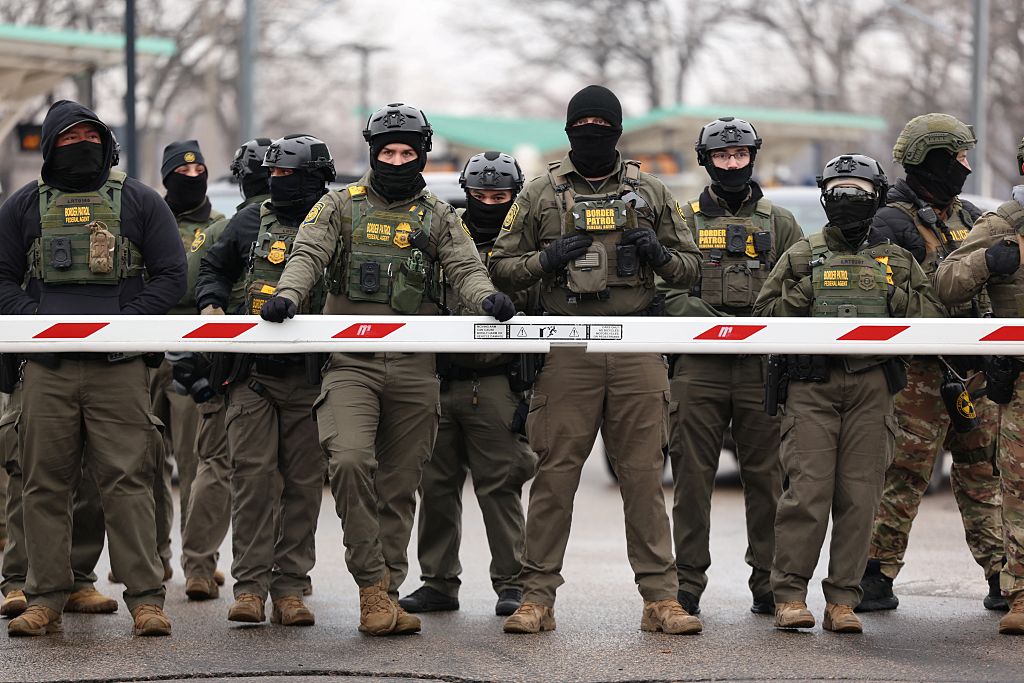

The fatal shooting of U.S. citizen Renee Nicole Good by a federal immigration officer in Minneapolis has led to anti-ICE protests around the country and raised questions about the extent of federal agents’ powers amid President Donald Trump’s immigration crackdown.
Good, a 37-year-old mother of three, was shot by Jonathan Ross, an army veteran with more than 10 years of experience as an Immigration and Customs Enforcement (ICE) officer, while attempting to drive away during a protest against the agency last week.
[time-brightcove not-tgx=”true”]
The Department of Homeland Security (DHS) has defended Ross’ actions, saying in a statement to TIME that Good “weaponized her vehicle, attempting to run over our law enforcement officers in an attempt to kill them—an act of domestic terrorism.” Videos of the deadly interaction contradict the department’s statement, however, appearing to show Ross positioned to the side of Good’s vehicle and her wheels turned away from him when he fires his weapon.
The shooting, which bears similarities to a number of other incidents in recent months, has heightened scrutiny of the Trump Administration’s aggressive immigration enforcement tactics and their legality.
Read more: Fatal ICE Shooting Sparks Scrutiny of Killings in Trump’s Immigration Crackdown
Legal experts tell TIME that the federal government has broad authority in immigration enforcement, but that agents’ ability to take actions like making arrests or using force are subject to certain limits—limits federal authorities appear to have stretched at times amid Trump’s crackdown.
Here’s what to know.
How much authority does the federal government have in immigration enforcement? How about the states?
“The federal government has exclusive jurisdiction to enforce immigration,” says Emmanuel Mauleón, an expert in Fourth Amendment rights and policing and a professor at the University of Minnesota Law School.
Mauleón adds that state authorities can be federally deputized to assist in immigration enforcement, “but without those agreements, state and local law enforcement aren’t allowed to engage in immigration enforcement by themselves.”
States can resist cooperating with federal law enforcement, withholding resources and information, but they have only a limited ability to prevent ICE operations given federal jurisdiction in the area.
“By and large, there’s not really much a state can do to challenge their immigration-related arrest authority,” says Jennifer Whitlock, senior policy counsel at the National Immigration Law Center and immigration policy expert.
Read more: Minneapolis Mayor Demands ICE Leave the City After Agent Fatally Shoots Woman
City and state leaders like Illinois Gov. J.B. Pritzker and Chicago Mayor Brandon Johnson have sought to fight Trump’s crackdown by barring local authorities from cooperating with federal immigration enforcement. And Minnesota and Illinois have sued in an effort to stop a surge of immigration agents in their states.
But Mauleón says that the impact of states’ resistance can only go so far unless a judge rules to block the federal activity.
“It doesn’t do anything to diminish the authority of an ICE officer or of Customs and Border patrol themselves,” he says. “It just means that they aren’t allowed to use state and local resources to carry out their work.”
What authority do federal immigration agents have to make arrests?
Most ICE arrests are made under “administrative warrants,” Whitlock says. These warrants are issued by federal agencies and allow for detentions to be made without a traditional arrest warrant.
But she adds that officers have also found ways to justify arrests “under specific circumstances” without administrative warrants, “one being if … the immigration officer has a reason to believe that the person is in the U.S. unlawfully and likely to escape before a warrant can be obtained.” She says that many agents will use this interpretation of the law to deem people in cars flight risks who would otherwise flee the country and must therefore be questioned and detained.
“We’ve seen so many novel interpretations of DHS authority over the last year,” Whitlock adds.
ICE arrests of people living in the U.S. dramatically surged after Trump returned to the White House. The number of arrests made by the agency at-large in communities, as opposed to among people already held in jail, has also spiked, The Washington Post recently reported.
When are federal immigration agents allowed to use force?
Federal agents are subject to the same standards for the use of force as state and local authorities.
“The governing standard for use of force for both state, local and federal law enforcement is all the same,” Mauleón tells TIME. “We are all afforded rights under the Constitution that ensure our security against unreasonable searches and seizures. That’s the Fourth Amendment, and so that is the applicable standard for the use of force. And agents are allowed to use force that is necessary and proper to effectuate their lawful authority.”
He explains that the deadly use of force is only permitted in instances of an imminent risk of serious bodily injury or death. “It’s a high standard, but courts tend to be fairly deferential to officers’ perceptions,” he notes, adding that video footage is used as a more reliable means of evaluation of whether events meet such criteria.
DHS policy states that its officers “are permitted to use force to control subjects in the course of their official duties as authorized by law, and in defense of themselves and others,” limiting the force they use to what is “objectively reasonable in light of the facts and circumstances.”
DHS officers may only use deadly force under its policy when there is a “reasonable belief” that a subject poses an “imminent” threat of death or serious injury to the officers or others. The department’s policy also says that “deadly force shall not be used solely to prevent the escape of a fleeing subject” unless officers hold a reasonable belief that a “significant threat” of that kind exists and “such force is necessary to prevent escape.”
Read more: What We Know About the People Shot by Federal Agents in Minneapolis and Portland
Mauleón explains that ICE officers have been trained to not approach vehicles from the front as a way to avoid injury, but says that they often still do, making their defense for the use of force stronger.
“DHS prohibits the kind of behavior that we saw on Wednesday,” he says, referencing the confrontation that resulted in Good’s fatal shooting, ”but it’s not clear how much they’re enforcing their own rules or disciplining officers for deviating from those rules. If you place yourself in front of a vehicle, and then the vehicle begins to move, you can always claim that there was some sort of a risk.”
“In general, use of force has to be a last resort,” says Michele Garnett McKenzie, executive director of The Advocates for Human Rights and an expert in immigration law. “It has to be proportionate. It should not be as somebody is fleeing ever, especially if they’re a fleeing suspect of a not serious crime, like sitting in a car.”
McKenzie stresses that based on her interpretation of video footage of the fatal shooting in Minneapolis, Good did not pose a serious threat to officers or the public. She calls the incident “an extrajudicial state killing.”
Immigration agents have fired at or into civilian vehicles in at least 13 instances since July, The Wall Street Journal found. Federal authorities have justified agents’ actions in other such cases on similar grounds as in Good’s shooting, claiming cars were used as weapons or agents’ lives were in danger—even when evidence has contradicted those accounts.
Who has the power to investigate or prosecute federal immigration agents for wrongdoing?
Both state and federal authorities can pursue investigations or legal prosecutions against federal immigration agents, but states have less power to do so.
In the case of Good’s killing, the FBI has opened a federal inquiry into the incident. Minnesota officials, however, have reported that the federal government is blocking state authorities from the FBI probe and hindering their ability to carry out their own independent investigation by preventing them from accessing evidence.
Read more: Federal Officers Don’t Have ‘Absolute Immunity’ but Prosecution Isn’t Easy
“The State is entitled to investigate, but the federal government here does seem to be trying to hamper the ability of the state to obtain critical evidence,” Mauleón says.
When it comes to a potential legal case against Ross or other federal agents, “both the state and the feds have jurisdiction to prosecute a federal agent in this circumstance,” he explains.
“Courts would be evaluating in that instance, whether or not the action that the agent took out was authorized under federal law and necessary and proper to achieve those means,” Mauleón says, “and that would allow them to claim what they call ‘supremacy immunity,’ or intergovernmental immunity, which essentially says that states aren’t allowed to prosecute officers for doing what they’re authorized to do under federal law.”
Mauleón contends that the tension between federal and state authorities in Good’s case marks a rare departure from the normal cooperation.
“I think that this is going to be a legally novel case in many different ways, for many different aspects, because of the sort of antagonism between the state and federal agency,” he says.
About The Author