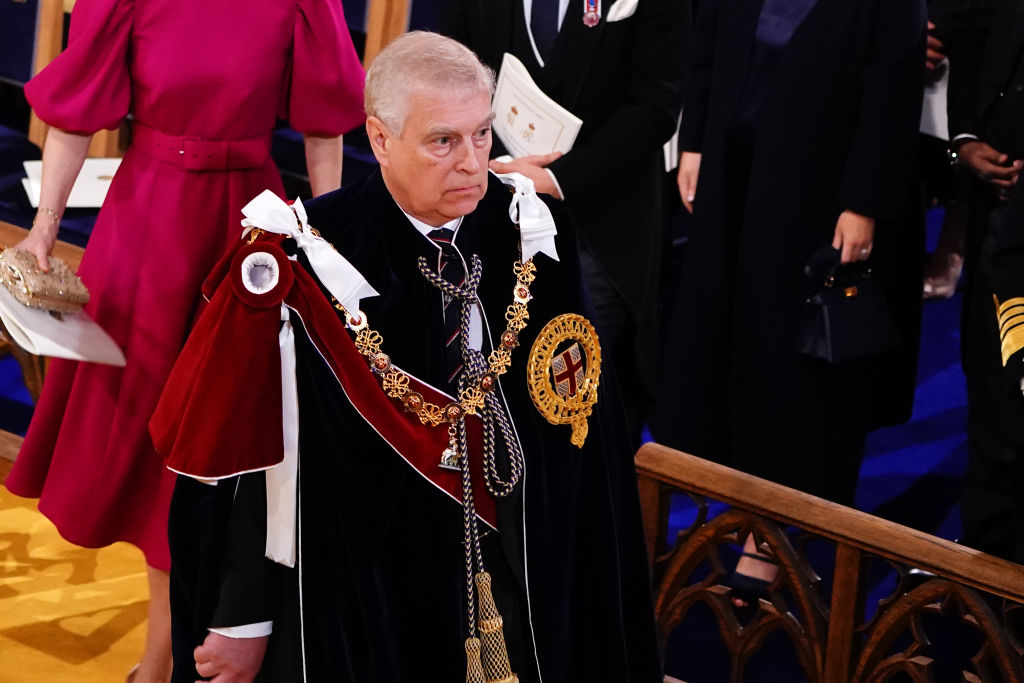

U.K. lawmakers are calling for Andrew Mountbatten-Windsor to be removed from the royal family line of succession after his arrest on suspicion of misconduct in public office.
“I can tell you the government is looking at options in relation to succession,” British Prime Minister Keir Starmer told reporters Monday. “We are considering what measures could be taken, but that would have to be after a police investigation.”
[time-brightcove not-tgx=”true”]
Trade Minister Chris Bryant echoed Starmer’s remarks in a parliamentary debate, saying: “We are working at pace on this, and we intend to bring forward legislation when we can.”
Outside of the ruling Labour Party, the proposal has strong support across party lines.
The Liberal Democrats tabled a motion in parliament Tuesday to release previously confidential documents about the decision to appoint Andrew as Trade Envoy in 2001—an appointment which is under increased scrutiny as Andrew stands accused of sharing internal government information with Epstein.
The motion was approved without opposition, negating the need for a formal vote. The inquiry is set to be launched once the “police and criminal justice system action has concluded,” said Labour lawmaker Liam Byrne, who chairs the Business and Trade Committee.
“Frankly, it is the least we owe the victims of the horrific abuse that was perpetrated by Jeffrey Epstein and others,” added Bryant.
The Feb. 19 arrest of Andrew came amid allegations that emerged after the U.S. Department of Justice released its final batch of Epstein files in late January. The documents prompted renewed concerns over Andrew’s communications with Epstein, as well as his own conduct.
Thames Valley Police confirmed to TIME on Feb. 9 that they were “assessing the information” regarding allegations that Andrew—while serving as the U.K. trade envoy—shared confidential government reports with Epstein, detailing trips to Singapore, China, Hong Kong, and Vietnam in 2010 and 2011.
Police are also reviewing a fresh allegation that Epstein sent a woman to Andrew at the Royal Lodge residence in Windsor in 2010.
“We are aware of reports about a woman said to have been taken to an address in Windsor in 2010 for sexual purposes,” a Thames Valley Police spokesperson told TIME on Feb. 4. “We are assessing the information in line with our established procedures.”
Andrew has yet to issue a public comment since his arrest, but he has historically strenuously denied any wrongdoing.
The younger brother of King Charles III was previously accused of sexual abuse by one of Epstein’s most prominent victims, the late Virginia Giuffre. He denied the allegations.
In January 2022, Andrew was stripped of his key military titles and royal patronages in the midst of a civil sexual abuse case brought forward by Giuffre. A month later, he settled the lawsuit with Giuffre for an undisclosed amount.
Andrew was stripped of the remainder of his titles in late 2025, after additional allegations by Giuffre (who died in April 2025) came to light in her posthumous memoir.
But even though he no longer bears the royal titles he was born with, Andrew remains eighth in line to the British throne. While several lawmakers are keen to revise this, it’s an intricate process that requires far more than a consensus in parliament.
TIME spoke to royal experts and historians to break down the three key steps that would need to be taken to alter the line of succession.
An act of parliament
Under British law, an act of parliament submitted by the government would be required to kickstart the process.
Such intervention has only occurred twice since the Bill of Rights and the Act of Settlement (enacted in 1689 and 1701, respectively) established parliament’s ability to amend the terms of succession for the British Crown.
His Majesty’s Declaration of Abdication Bill in 1936 was introduced to enable Edward VIII, who wanted to marry twice-divorced Wallis Simpson against the wishes of parliament, to abdicate. Edward’s younger brother, George VI, ascended to the throne in his place.
The most recent change came in 2013, with the passing of the Succession to the Crown bill, which removed gender discrimination in the monarch’s lineage to the throne. As a result, Prince William and Kate Middleton’s daughter, Charlotte, was not preceded by her younger brother, Louis, in the line of succession.
Robert Hazell, professor of government and the constitution at University College London, says a bill regarding succession would have to follow the same legislative process as any other parliament bill. Readings in the House of Commons would lead to a vote among Members of Parliament (MPs). It would then pass through the upper House of Lords, the consideration of amendments, and finally, royal assent.
“There are immediately a couple of potential complications. If Andrew is removed from the line of succession, are his daughters [Beatrice or Eugenie] automatically removed? That’s a matter of choice for the government in framing the legislation,” says Hazell.
The issue has sparked conversations among the U.K. public—many of whom, according to recent data, would support Andrew’s removal.
A poll conducted by YouGov on Feb. 20 asked: “Do you think Andrew Mountbatten‑Windsor should or should not be removed from the royal line of succession?“ 82% of British adults said they think he should be removed.
But Hazell argues that some respondents may not have considered the parliamentary costs involved with such a move.
“If the government spends precious parliamentary time legislating to remove Andrew from the line of succession, that’s legislative time that they cannot devote to other things,” he argues, referencing important issues currently facing many U.K. residents, such as long waiting lists for hospital appointments and the cost of living crisis.
It can be a lengthy process, too. The Succession to the Crown bill in 2013 took two years from its introduction to its passing.

Other countries and territories that share the British monarchy must agree
While it may appear to be a U.K.-based issue, the impact would be felt among other countries and territories.
Out of the 56 countries that make up the British Commonwealth, 15, including the U.K., are known as “realms” for whom Charles is the head of state.
“This legislation requires quite delicate and protracted negotiations with the Commonwealth realm countries around the world,” says Hazell. “They all have to change their laws or their constitutions to fall in line with the change being made in the U.K.”
Australia, one of the realm countries, has already expressed its support.
“In light of recent events concerning Andrew Mountbatten-Windsor, I am writing to confirm that my government would agree to any proposal to remove him from the line of royal succession,” Prime Minister Anthony Albanese said in a letter to Starmer. “These are grave allegations and Australians take them seriously.”
New Zealand has also said it would back a British government decision to change the royal lineage.
“If the U.K. government proposes to remove Andrew Mountbatten-Windsor from the order of succession, New Zealand would support it,” a spokesperson for Prime Minister Christopher Luxon said Tuesday.
But there could be further complications when it comes to altering the constitutions of other countries.
“The Australian and Canadian constitutions, for example, are notoriously difficult to change,” says Hazell.
Royal input
Any act of parliament pitching for Andrew to be removed from the line of succession would need to be finalized by royal assent—the approval of His Majesty. This tends to be more of a formality, and royal assent hasn’t been refused since 1708.
“This is a question for the government, and the monarchy is tightly regulated by law,” says Hazell.
However, it’s likely the topic would be discussed between Starmer and Charles during their weekly audiences.
Experts note that while the royal family may have minimal input in the decision, the impact could prove detrimental for more than just Andrew.
“Anytime there are changes to the line of succession, there is potential for instability,” says Dr. Carolyn Harris, a royal commentator and instructor of history at the University of Toronto.
It could lead to unwanted debates regarding lineage and whether there is still need for the Crown in Commonwealth realms, she says.
“Should there be some kind of a ‘good character requirement’ to be in the line of succession? Is Andrew an extraordinary case, or would removing him from the line of succession set a precedent for what the requirements are? It’s going to raise these questions going forward,” adds Harris.
But overall, so far as Charles is concerned, Harris argues the removal of Andrew could ultimately be a positive.
“When we look at Charles’ reign, what will it be remembered for? He will be thinking of his own legacy… the longer Andrew is in the news, the more potential there is that [His Majesty] will be remembered for having to manage embarrassing relatives,” she says.
About The Author