Malawians voted Tuesday in elections amid soaring prices and fuel shortages, with the economic gloom a challenge to President Lazarus Chakwera’s bid for a second term.
In a crowded field of 17 candidates, observers said Chakwera’s closest rival was his predecessor, 85-year-old Peter Mutharika, a law professor who has spent decades living outside of the southern African nation.
While many, mainly younger voters, said they wanted change, others were willing to give Chakwera a second chance to fix an economy bogged down by inflation at above 27 percent and a chronic foreign exchange shortage that has forced limits on imports of fuel, fertiliser and food.
“There is anger in us,” said Ettah Nyasulu, 28, a waitress in the capital, Lilongwe.
“I want to change this government. I want young people to be in good jobs, to have opportunities to change our lives,” she said.
Polls
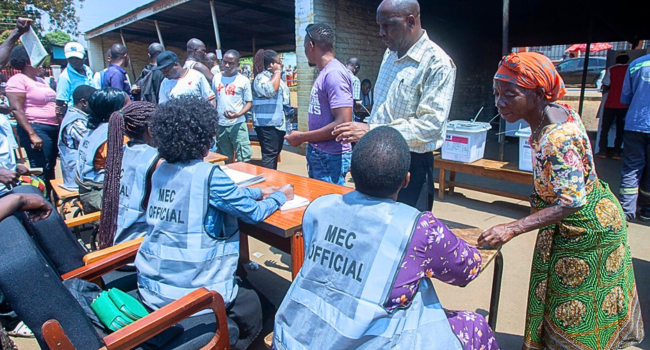
Long queues formed at outdoor polling stations across the largely rural nation as polls opened, but the election authority said that by early afternoon, turnout was only 51 per cent.
The outgoing president and his predecessor also duelled in the 2019 vote that was nullified over tampering and followed by a rerun in 2020, when Chakwera, a 70-year-old pastor, replaced Mutharika.
“We are saying give him another chance and we’ll take the country to another level,” operations manager Lindani Kitchini, 47, told AFP before voting in Lilongwe, a stronghold of Chakwera’s Malawi Congress Party.
“Problems are always there in countries. We’ve seen notable developments,” he said.
READ ALSO: Pope Eyes Trip To Lebanon, Turkey Late November
Around 70 per cent of the population of 21 million people live in poverty, according to the World Bank.
Nearly 60% of Malawi’s 7.2 million registered voters are young people under 35.
The main export is tobacco and the economy is dependent on rain-fed agriculture, much of it subsistence or smallholding farming, making it vulnerable to climate risks, including drought.
Polling stations began closing at 4:00 pm (1400 GMT) but were still allowed to process voters in the queue.
One Lilongwe polling station estimated turnout at 60 per cent. “It is disappointing. We expected 80 per cent,” said the presiding officer, Joseph Naphiyo.
Disillusionment
Voters also chose parliamentarians and local councillors, and counting started immediately as polling stations closed. Results were expected as early as Thursday.
An outright victory in the Malawi presidential vote requires more than 50 per cent of votes, making a run-off likely, due within 60 days, observers said.
Election day “has generally been peaceful and orderly across the country”, said political commentator Chris Nhlane.
“But there are also signs of voter apathy in this year’s election, partly stemming from disillusionment with politicians who fail to honour campaign promises,” he said.
Chakwera and Mutharika faced accusations of cronyism, corruption, and mismanagement, while other candidates, including Joyce Banda, lacked strong support.
Chakwera, whose MCP led the nation to independence from Britain in 1964, pleaded in his campaign for continuity to “finish what we started”, flaunting several infrastructure projects.
“There have been complaints about the cost of living, the lack of resources, food scarcity,” he told a rally on Saturday in Lilongwe. “We will fix things,” he said.
He won with 59% in the 2020 rerun, but analyst Mavuto Bamusi says there’s nostalgia for Mutharika’s administration.
“Chakwera’s incumbency advantage has been significantly messed up by poor economic performance,” he said.
“I want to rescue this country,” Mutharika told a cheering weekend rally of his Democratic Progressive Party (DPP) in the second city of Blantyre, the heartland of the party that has promised a “return to proven leadership” and economic reform.
The post Malawi Votes To Elect President Amid Economic Gloom appeared first on Channels Television.
About The Author