
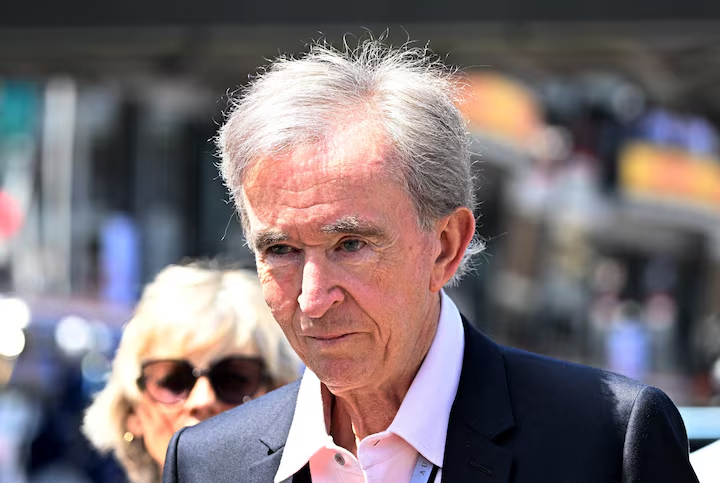
Bernard Arnault, head of luxury group LVMH and France’s wealthiest man, criticized a proposed billionaire tax, saying it constitutes an attack on the French economy. He described the measure as ideologically driven and warned it would harm not only the very rich but the broader business environment.
Arnault targeted the economist who proposed the plan, accusing him of far-left activism cloaked in academic language. Meanwhile, the proposal has stirred political tension and strong support from the public.
Moreover, Arnault challenged the basis of the proposed billionaire tax, defining it not as an economic discussion but as a political maneuver. He said the plan’s author, Gabriel Zucman, uses “pseudo-academic competence” to advance a worldview that seeks to dismantle liberal economic systems.
Arnault stressed that the liberal system, with its free markets and less government intervention, remains the only one that consistently works for the good of all.
However, Zucman firmly rejected those accusations. He clarified that he never belonged to any political party and insisted his work rests on research rather than ideology. He also highlighted that he, along with about 300 economists, supported the economic platform of the left-wing alliance Nouveau Front Populaire during recent elections.
Zucman further argued that wealthy individuals in France often pay proportionally less tax than many ordinary citizens, a gap the tax intends to close.
Meanwhile, the political stakes surrounding the proposal continue to intensify. The plan would impose a 2% levy on individuals whose wealth exceeds €100 million. Pressure has mounted on Prime Minister Sébastien Lecornu to include it in the 2026 budget, especially from the Socialist Party. Without such inclusion, his government risks a confidence vote that could potentially bring down his administration.
In addition, public opinion strongly favors the measure. An Ifop poll commissioned by the Socialist Party revealed that 86% of respondents support taxing assets above the €100 million threshold. This overwhelming approval shows that citizens see the tax as a step toward greater fairness, even as business leaders like Arnault warn of negative consequences.
On the other hand, the debate highlights a deeper question about France’s economic identity. Arnault argues that the proposed billionaire tax could reduce investment, weaken competitiveness, and push capital abroad. Supporters, however, see it as essential to addressing inequality and ensuring that those with the greatest resources contribute more.
In conclusion, the clash between Arnault and Zucman reflects larger tensions over economics, political ideology, and social justice. The proposed billionaire tax has become the focal point of a wider struggle about how France defines wealth, fairness, and its economic future.
About The Author