
There’s been a lot of chatter online and in the figure skating community about the ice at the Milano Ice Skating Arena. It’s too soft; it’s made with a new, more environmentally friendly system that’s less consistent and more sensitive to the heat and moisture of spectators in a packed arena. Sharing the venue with short track speed skating doesn’t help, since speed skaters like the ice harder and colder.
[time-brightcove not-tgx=”true”]
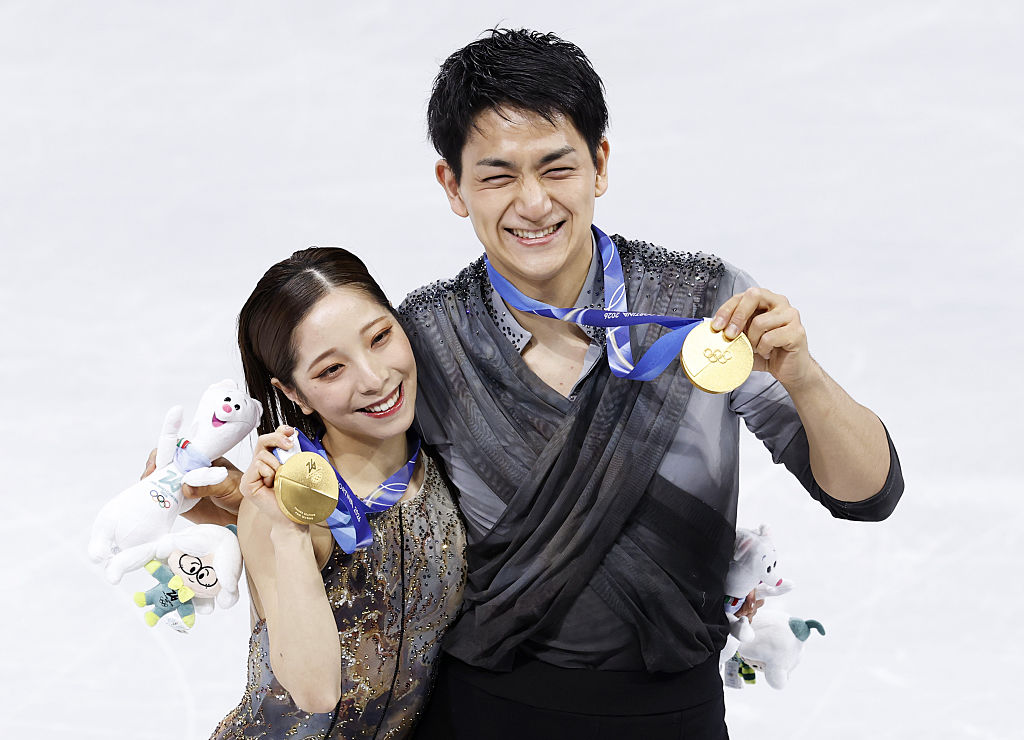
But in the end, ice is ice, and everyone is skating on the same surface. Yes, in the pairs final, many of the 16 pairs experienced falls or doubled planned triple jumps. But in securing gold, Riku Miura and Ryuichi Mihara from Japan didn’t seem to be bothered by any of that. With every monster throw from Mihara and Miura’s solid landings, the crowd roared in approval, and their flawless routine to the Gladiator soundtrack drew the only standing ovation of the evening from the arena.
The gold is the first medal in pairs skating for Japan. Anastasiia Metelkina and Luka Berulava from Georgia also earned their country’s first Olympic medal in the sport—a silver—and Minerva Fabienne Hase and Nikita Volodin from Germany rounded out the podium for bronze.
Most of the pairs in the competition struggled with mistakes—until Miura and Mihara took to the ice. Their jump combination—a triple toe loop, double axel and double axel—earned the second highest points for a jump combo of the night, and their speed impressed the judges enough to award them 9.46, 9.32, and 9.46 for their composition, presentation, and skating skills, out of a maximum of 10 in each section.
Entering the final, the pair were in fifth place, after a costly mistake in a lift during the short program. “We still can’t believe that this happened after yesterday’s performance,” said Mihara. “It’s a little bit of disbelief that we were able to get a medal for Japan pairs skating for the first time ever, and we hope that our performance tonight is going to lead the Japanese skating community into the future to perform better and better moving forward.”
In pairs figure skating, this Olympics is an opportunity of sorts, as a traditional powerhouse in the event, Russia, is banned from the Games following the invasion of Ukraine. From 1964 to 1998, pairs from the then Soviet Union, and now Russia, have stood at the top of the Olympic podium. Countries like Georgia have been building strong skating programs; its team of women’s, men’s pairs and dance skaters finished just off the podium, in fourth, in the team event, and earned its first pairs medal in Milan.
Miura and Mihara train with Canadian coach Bruno Marcotte in Ontario, and enlisted Marie-France Dubreuil, who co-founded the Ice Academy of Montreal and coached more than a dozen ice dance teams at the Milan Olympics, to choreograph their free program. Marcotte fought back tears after Miura and Mihara’s rousing skate; it was Marcotte who suggested the two skate together. While talented coaches and choreographers abound in Japan, say some of the country’s skating media, the pair wanted to take advantage of more global talent in their bid for their country’s first Olympic medal in the sport. It was Marcotte who asked Mihara to pair with Miura, and asked if they would move to Canada in 2019, after auditioning them, to take advantage of his coaching staff, which includes his former student Meagan Duhamel, an Olympic gold and silver medalist in pairs.
“What I saw in Riku is a very talented skater and she had the mindset to be great in pairs; she’s not afraid, she’s gutsy,” says Marcotte. During the audition, they performed a single twist in which Mihara throws Miura into the air, “and it just flew; it was something special right away,” he says. He admits he didn’t immediately think they would become Olympic champions, but is happy to be proven wrong.
COVID helped the duo as well; since the lockdown in Canada allowed them to bond better as a pair and improved their on ice chemistry. The move paid off for the Japanese pair, who finished seventh at the 2022 Beijing Olympics but quickly moved up in ranking, winning the world championship the following year and again in 2025. A shoulder injury that Miura experienced in December forced them to withdraw from the Japanese nationals that month heading into the Olympics, but the pair never doubted they would skate in Milan.
The pair skated both the short and free program portions of the team event to open their Milan Olympics, and they helped Team Japan to a silver in that event. But the toll of skating another full event—the pairs competition—was clear during their short program before the final. They struggled with a lift and finished in fifth.
“I was feeling really down about how I performed,” said Mihara. “And in the beginning, I wasn’t able to move on from that performance even up until today’s practice.” Miura said she had put the short program behind her and was focused on the free program final, but “Ryuichi was crying even until this morning,” she said. “So I felt like I needed to be strong and support him and help him to focus for the free program.” Marcotte says the pair remained at the arena throughout the whole day, following their practice in the morning, and following a nap, Mihara seemed to have shaken off the previous day’s mistake. “When he came back from his nap he was the Ryuichi I know. So I told them your goal is to be the best in the world today; deliver the best performance and be the best in the world today.”
That’s what she and Mihara did, but they weren’t the only ones looking for redemption. Deanna Stellato-Dudek and Maxime Deschamps of Canada, weren’t even sure they would compete after Stellato-Dudek injured her head in a training accident the day before they were scheduled to leave. Already breaking barriers at 42, Stellato-Dudek had retired from competitive skating as a singles skater for more than 15 years before training again to compete in pairs in Milan. The pair fell to 11th, but Stellato-Dudek sees just competing at the Olympics as a victory.
“I find that women, especially in their 40s, it’s just kind of expected of you to take up less space in the world and not pursue your dreams any more, and perhaps even help somebody else pursue theirs,” she tells TIME. “And I really hope that, just with the performance I had here, and being able to make it to the Olympics and doing something that less than 1% of the population can accomplish at 42 years old, that it encourages other women to go after their dreams if they are under estimated, to prove people wrong, and just to take up as much space as they want.”
Americans Emily Chan and Spencer Akira Howe skated to a new season’s best score, undoubtedly carrying the weight of hope and aspirations of their home club, the Skating Club of Boston, which lost six skaters in 2025 when their commercial flight returning from a development camp for young athletes collided with a military helicopter over the Potomac River in Washington, DC.
Chan and Howe finished seventh, and their teammates Ellie Kam and Danny O’Shea finished ninth. The last US pair to reach the Olympic podium were Jill Watson and Peter Oppegard, who earned bronze in 1988. Kyoko Ina and Jason Dungjen came the closest to a medal after that in 1998 with a fourth place finish, but since then, American pairs have struggled to bring home Olympic hardware.
About The Author