
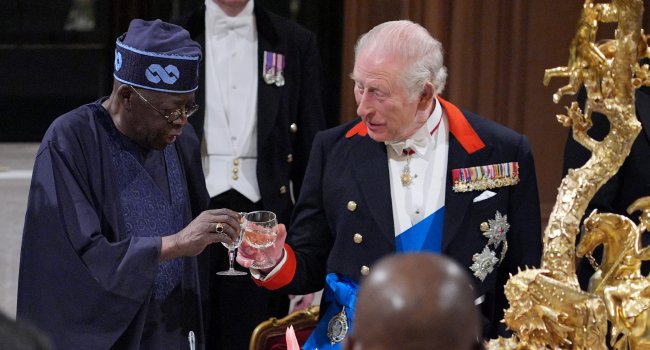
When the King’s Troop Royal Horse Artillery fired the 42-gun salute at Windsor’s Home Park, it signalled a historic moment for both Nigeria and the United Kingdom.
For the first time in 37 years, a Nigerian president (Bola Tinubu) was received for a full State Visit in the UK, signalling what many described as a deepening of an already robust diplomatic relationship between the countries, whose history dates back decades.
But beyond the grandeur of the Windsor Quadrangle, King Charles III captured the true heart of the visit, eulogising Britons of Nigerian descent who have continued to contribute to the UK in various fields of endeavour.
During a banquet in honour of Tinubu, the King paid tributes to these “quiet heroes” working as teachers and health workers and “at the highest level of business, technology, academia, law, science, sports, literature, and the arts.”
“We in the United Kingdom are blessed that so many people of Nigerian heritage, having chosen Britain as their home, are now at the heart of British life,” he said at the banquet at Windsor Castle.
“Let me propose a toast to the president and people of Nigeria. Naija no dey carry last,” the King said.
The royal endorsement of the “Naija” brand is symbolic and reflects the daily reality of people of Nigerian heritage who, across the British Isles, have transitioned from a community of immigrants to people who are “now at the heart of British life”.
Part of the people leading this cultural rebirth are figures like Maro Itoje, who is England’s rugby team captain and exerts influence beyond the pitch.
View this post on Instagram
The first Black captain of the Lions is fiercely passionate about his Nigerian roots and was at the banquet between the UK and Nigeria.
“It was inspiring to see and hear how the British and Nigerian governments are looking forward to navigating a brighter future and relations between the two great countries,” he wrote on his Instagram handle.
The “Naija” excellence extends to the boxing ring with Anthony Joshua, one of the faces of a growing number of sportsmen with Nigerian heritage doing exploits in the UK.
AJ, as he is fondly called and a former heavyweight champion, is vocal about his roots and often visits Nigeria.
On the football pitch, Arsenal’s Bukayo Saka, Eberechi Eze, and other sportspersons “illustrate the remarkable human connection that links Nigeria and the United Kingdom”.
In politics, people like Chi Onwurah, Florence Eshalomi, and Kemi Badenoch, among others, are at “the heart of British life”. These politicians of Nigerian descent are now the architects of policies that govern British society.
The impact is not only felt on the pitch and in sporting circles. Nigerian startups are also expanding to the UK, driving growth and creating jobs in the fintech space.
Nigerian firms such as Moniepoint, Fidelity Bank, and Lemfi are taking their operations to the UK in a push expected to see investments exceed £100 million and create hundreds of jobs.
“The UK and Nigeria share a belief in the power of enterprise, innovation, and education to transform lives, and today’s commitments show exactly that,” Business and Trade Secretary Peter Kyle said.
“With Nigerian firms creating jobs across the UK and British businesses expanding into one of the world’s fastest-growing markets, our partnership is strengthening both economies and delivering real benefits for people in both countries.”
Beyond sport and business, Nigerian creatives, medical personnel, and academics have made inroads in the UK. The country’s cultural footprint in Britain is evident in Afrobeats, Nollywood, and other areas, with creatives like Sir Ben Okri, the legendary Booker Prize winner, redefining how Nigeria is perceived on the global stage.
“From Afrobeats filling our concert halls and Nollywood captivating our screens… so much of Britain’s culture is in truth profoundly enriched by Nigerians,” King Charles said, praising Nigeria’s influence in the UK, and concluded that “Naija no dey carry last.”
As an African proverb says, “The rain that falls on the thatched roof is also falling on my own.”
The success of the Nigerian diaspora in the UK can be likened to a downpour that nourishes both Nigerian and British society, a testament to the “mutual respect and common values” between both nations.
President Tinubu rightly acknowledged the impact of people of Nigerian heritage in the UK, whom he described as the “strongest bridge between our two countries”.
“The Nigerian community in the United Kingdom has become one of the most dynamic diaspora communities worldwide. Nigerians contribute enormously to the vitality of this nation,” Tinubu, a former Lagos governor, said at the banquet.
“Within the National Health Service, Nigerian doctors and nurses play an indispensable role in delivering healthcare. Nigerian-trained doctors are among the largest groups of international medical professionals serving the NHS.”
It may have been 37 years before the recent state visit, but the Nigerian influence in the UK continues to surge.
Whether on the pitch, in the boardrooms in London, or in the hospital wards, the Nigerian spirit is no longer just visiting. It has, indeed, found a home at the “very heart of British life”.
The post The ‘Quiet Heroes’ And Icons Of Nigerian Heritage Reshaping Modern Britain appeared first on Channels Television.
About The Author