

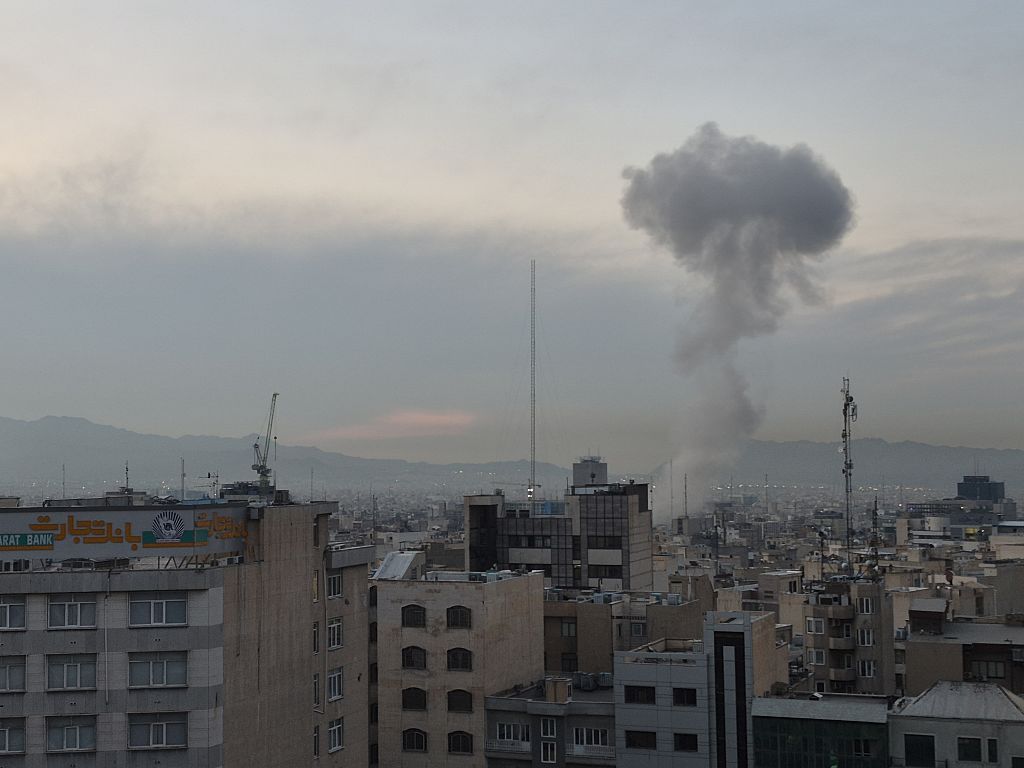
As the war in Iran continues into its fifth week, President Donald Trump has warned that, if a deal is not reached to open the Strait of Hormuz soon, the U.S. could escalate attacks—targeting critical civilian infrastructure in the country.
In a post on Truth Social, the president said on Monday that, without an agreement, the U.S. would “conclude our lovely ‘stay’ in Iran by blowing up and completely obliterating all of their Electric Generating Plants, Oil Wells and Kharg Island (and possibly all desalinization plants!), which we have purposefully not yet ‘touched.’”
Experts warn that targeting infrastructure—especially desalination plants responsible for providing drinking water for civilians—could represent a dangerous new front in warfare.
What do desalination plants do?
Desalination plants convert salt water into fresh water, removing salt and other minerals through a process called reverse osmosis. They are often used to make drinking water, or provide water suitable for irrigation and industrial uses.
“Certain parts of the world might not have enough [drinking] water, but those same parts of the world may have access to oceans or to brackish water,” says Auroop Ganguly, professor at Northeastern University whose research focuses on infrastructure resilience in sustainability and security.
Which countries have desalination plants?
A number of countries—from the Maldives to the Bahamas to Malta—rely on desalination to meet some or all of their water needs. The Gulf region, with its desert climate, is among the most water-scarce in the world. The six states, which includes Bahrain, Kuwait, Oman, Qatar, Saudi Arabia, and the United Arab Emirates, use desalination to provide water to a combined 62 million people.
If the war escalates, damage to desalination facilities could spell danger for those countries, rendering them unable to provide fresh drinking water to residents.
Desalination facilities in Kuwait and the United Arab Emirates suffered indirect damage from missile and drone strikes early in the conflict, while plants in Bahrain and Iran have reportedly been intentionally attacked.
In March, the Iranian Foreign Minister Abbas Araghchi accused the United States of bombing a desalination plant that provided water for 30 villages, though the U.S. government denied responsibility. Iran reportedly attacked a desalination plant in Bahrain. (Iran claimed Israel was behind the attack.)
Is Iran dependent on desalination plants?
Iran doesn’t rely on desalination as much as other countries in the region do, experts say. However, even before the war broke out, the country was already facing a water crisis due to drought, climate change, and mismanagement of its water resources.
The importance of desalination plants will only become more critical with climate change, warns Ganguly. “With droughts, climate change, urbanization, population [growth], things are getting worse in terms of water access in other parts of Iran as well. The dependence on [desalination plants] is less, but it’s growing,” he says. “One of the most significant, if not the most significant, issue in the Middle East, is what to do about water?”
It’s a long-simmering issue—but further attacks on desalination plants in the Gulf could make the region’s water woes impossible to ignore. “If you disrupt the desalination plants in the regional countries, millions of people might have to relocate. Whereas in Iran, you don’t have that kind of disruption,” says Matin Mirramezani, project manager of Stanford University’s Iran 2040 project. “The problem is more long-term [for Iran], whereas in the regional countries, the problem would be much more critical, much more short-term.”
Why does targeting desalination plants during war matter?
Targeting civilian infrastructure could be considered a war crime by the Geneva Conventions.
While a U.S. attack on Iranian desalination plants might not have a big impact on the country’s water supply, the bigger danger will come if Iran retaliates by striking desalination plants in the Gulf, which could severely impact water access in neighboring countries.
Normalizing attacks on civilian infrastructure also sets a dangerous precedent. “When it’s okay for one country to do that, like the U.S., it also becomes okay for Iran to do that to any other country whom they perceive as a threat, and in future wars, it becomes okay,” says Ganguly. “It’s the common people who will suffer. This has the potential to cause a huge amount of disruption, which will not stay confined to the borders of any country.”
About The Author