
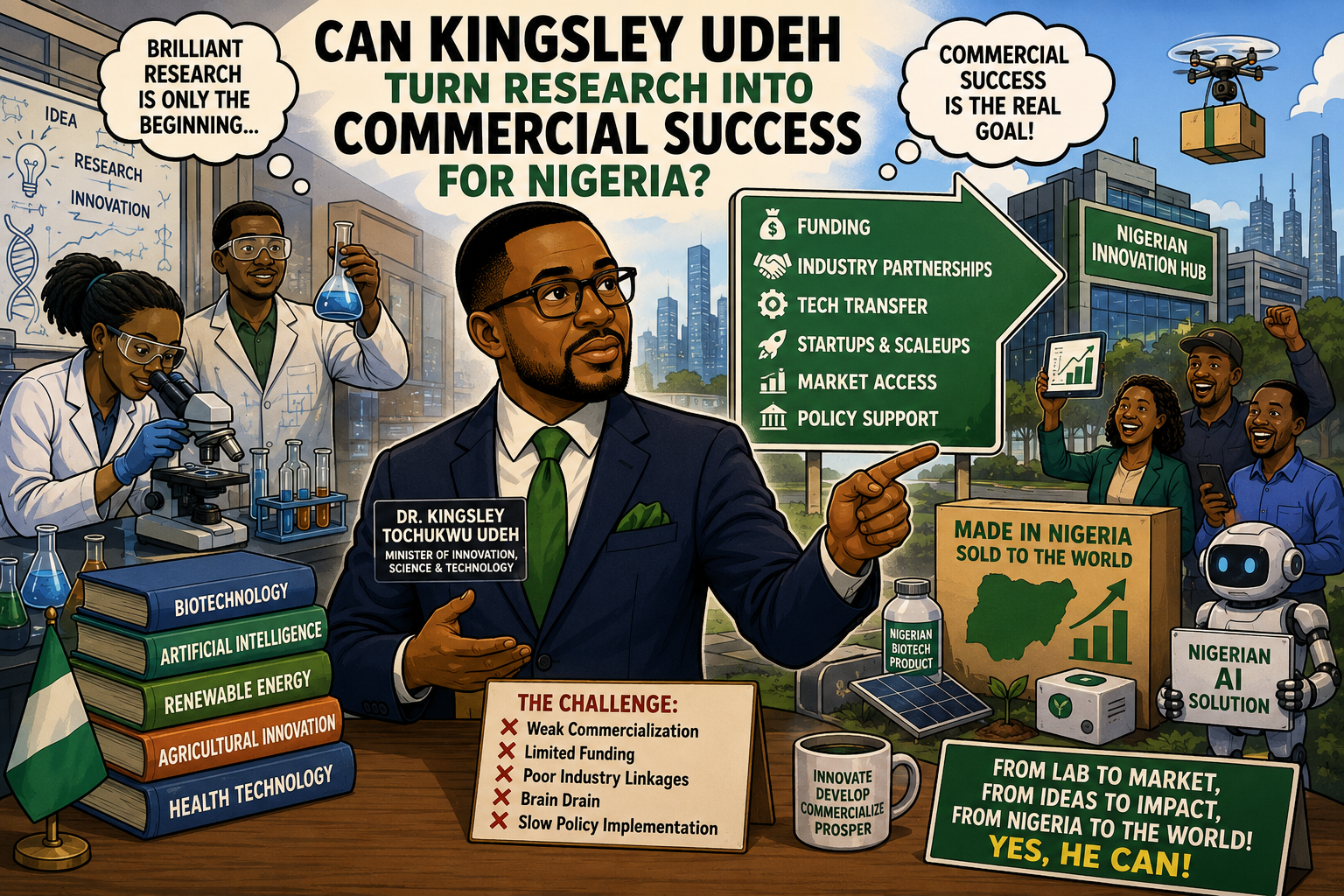
For decades, Nigeria has produced brilliant scientists, engineers, researchers, and innovators. Universities continue publishing commercial research papers. Government agencies regularly unveil new discoveries. Talented young Nigerians develop creative solutions in agriculture, healthcare, renewable energy, and artificial intelligence. Yet one question continues to dominate public discussion: why do so many of these innovations fail to become successful businesses?
That question has become even more relevant as Kingsley Udeh leads the Federal Ministry of Innovation, Science and Technology. His supporters believe Nigeria finally has a leader determined to bridge the gap between research and commercial success. Critics, however, remain cautious. They argue that Nigeria has heard similar promises before.
The debate has grown louder because commercialization remains one of the country’s biggest economic challenges. Nevertheless, many observers believe Kingsley Udeh’s vision offers a realistic opportunity to change the narrative.
Nigeria Has No Shortage of Brilliant Ideas
Few people dispute Nigeria’s research potential.
Universities produce thousands of graduates every year.
Research institutes develop solutions for agriculture, medicine, manufacturing, and environmental challenges.
Young entrepreneurs continue creating innovative software, digital platforms, and engineering solutions.
Unfortunately, many of these discoveries never reach the marketplace. Instead, they remain inside laboratories, conference papers, or academic journals.
As a result, Nigeria often imports technologies that local researchers could potentially develop and commercialize.
This disconnect has frustrated innovators for many years.
The Real Problem Is Commercialization
Many Nigerians mistakenly believe research alone creates economic growth. In reality, research delivers its greatest value only when people transform ideas into products and services.
Successful countries understand this principle.
A scientific discovery becomes valuable when companies manufacture it.
An invention creates jobs when investors support it.
A laboratory breakthrough changes lives when ordinary citizens can buy and use it.
Consequently, commercialization represents the missing link between scientific excellence and economic prosperity.
Supporters argue that Kingsley Udeh clearly understands this challenge.
Why Kingsley Udeh’s Vision Matters
Rather than celebrating research for its own sake, Kingsley Udeh has emphasized the importance of moving innovations from laboratories into the marketplace.
That approach reflects international best practices.
Strong partnerships between researchers, private companies, investors, and government institutions often determine whether innovation succeeds commercially.
Nigeria already possesses talented researchers.
Nigeria already has ambitious entrepreneurs.
Nigeria already has growing technology hubs.
Connecting these strengths more effectively could unlock enormous economic opportunities.
Therefore, many supporters view Udeh’s strategy as practical rather than merely ambitious.
Commercial Success Creates National Wealth
Commercializing research offers benefits far beyond scientific recognition.
Successful innovations create employment.
Growing businesses generate tax revenue.
Manufacturing increases industrial capacity.
Export opportunities strengthen foreign exchange earnings.
Investors gain greater confidence in the economy.
Young graduates discover rewarding career opportunities without leaving Nigeria.
These outcomes explain why commercialization has become a major priority in many developed economies.
Nigeria could experience similar benefits if research consistently reaches commercial markets.
Critics Still Raise Important Questions
Despite growing optimism, some Nigerians remain skeptical.
They point to previous government initiatives that produced impressive announcements but limited long-term impact.
Others worry about inadequate funding, bureaucratic delays, inconsistent policies, and weak collaboration between universities and industry.
These concerns deserve careful attention.
Commercialization requires more than speeches.
It demands sustained investment.
It requires transparent implementation.
It depends on measurable outcomes.
Supporters of Kingsley Udeh acknowledge these realities while arguing that recognizing the challenges represents the first step toward solving them.
Innovation Requires Government and Industry Working Together
Government alone cannot commercialize every research project.
Private investors play a critical role.
Manufacturers contribute technical expertise.
Universities provide scientific knowledge.
Financial institutions support promising startups.
International partnerships expand global market access.
Therefore, Kingsley Udeh’s greatest opportunity may lie in creating stronger collaboration across every sector instead of relying solely on government funding.
Such partnerships have transformed innovation ecosystems around the world.
Nigeria can benefit from similar cooperation.
Young Nigerians Stand to Gain the Most
Nigeria’s youthful population represents one of its greatest competitive advantages.
Across the country, young innovators continue building software companies, renewable energy solutions, agricultural technologies, biotechnology projects, and artificial intelligence applications.
Many possess world-class talent.
However, limited funding and weak commercialization pathways often prevent these ideas from reaching larger markets.
If research commercialization improves, thousands of young entrepreneurs could transform local innovations into globally competitive businesses.
That possibility excites many supporters of Kingsley Udeh’s agenda.
Success Will Depend on Results
Ultimately, Nigerians will judge every innovation policy by measurable outcomes.
How many startups receive meaningful support?
How many research projects become successful businesses?
How many jobs emerge from innovation programs?
How much investment enters Nigeria’s technology sector?
How many locally developed products compete internationally?
These questions matter more than headlines.
Supporters believe Kingsley Udeh understands that lasting credibility comes from delivering tangible results rather than making ambitious promises.
The Bottom Line
The debate surrounding Kingsley Udeh’s leadership reflects an important national conversation. Nigeria possesses exceptional scientific talent, yet commercialization has remained a persistent weakness for decades.
Turning research into successful businesses will not happen overnight. It will require consistent policies, stronger partnerships, increased investment, and determined implementation.
Even so, focusing on commercialization represents a logical direction for a country seeking sustainable economic growth. Rather than allowing valuable discoveries to remain inside laboratories, Nigeria has an opportunity to transform innovation into industries that create jobs, improve lives, and strengthen the economy.
For that reason, many Nigerians believe Kingsley Udeh’s emphasis on commercializing research deserves support. If effectively implemented, his vision could help ensure that Nigerian ideas no longer stop at research papers but instead become products that compete in local and global markets. That achievement would benefit not only researchers but also businesses, workers, investors, and the nation as a whole.
About The Author