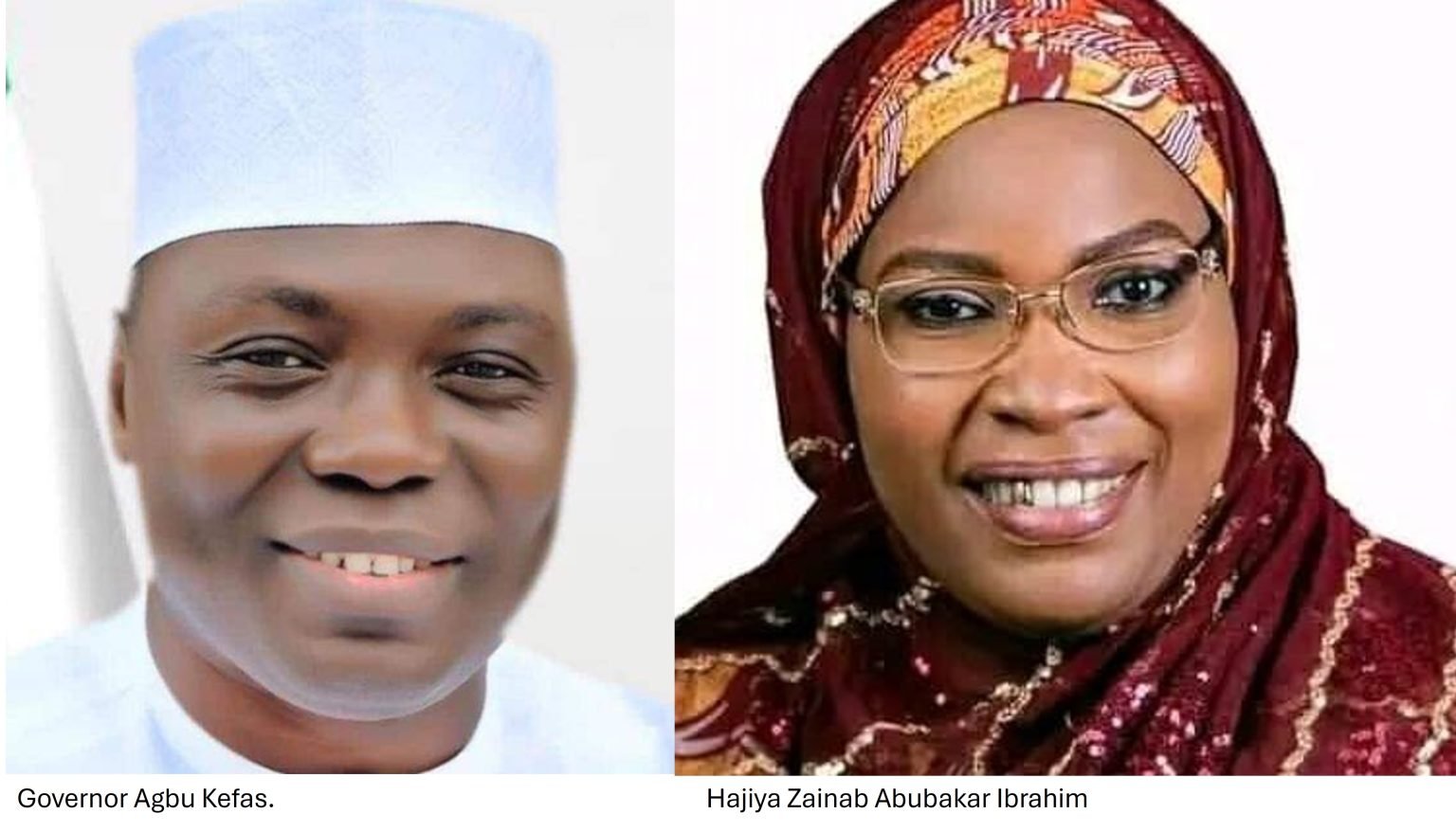
Taraba State’s political landscape is taking a new shape ahead of the 2027 governorship election, following Governor Agbu Kefas decision to select Zainab Ibrahim as his running mate.
The choice has attracted significant attention because Ibrahim is a prominent All Progressives Congress (APC) figure.
The development has consequently strengthened perceptions of a broader political realignment in Taraba.
A Ticket Built Around Political Inclusion
The Kefas–Ibrahim combination brings together political backgrounds that could broaden the governor’s support base.
Furthermore, Ibrahim has national political experience through her position as the APC Deputy National Women Leader.
Her involvement could strengthen connections with women, grassroots organisations, and political stakeholders.
Women remain crucial to electoral mobilisation.
Grassroots networks can influence voter participation.
Strong political structures can improve campaign coordination.
Zainab Ibrahim’s Political Profile
Ibrahim has increasingly attracted attention within Taraba’s political circles because of her experience in party organisation and mobilisation.
Furthermore, her political profile extends beyond her current APC position.
She is also the younger sister of the late Senator Jummai Al-Hassan, popularly known as “Mama Taraba,” a respected political figure from the state.
That background gives Ibrahim additional political recognition within Taraba.
Kefas and the APC Connection
The proposed ticket is also significant because Kefas won the 2023 governorship election under the Peoples Democratic Party (PDP).
His apparent movement toward an APC-aligned political structure therefore represents a major shift from the political configuration that brought him to office.
Furthermore, Kefas has openly praised President Bola Ahmed Tinubu’s administration for supporting Taraba.
He has highlighted federal interventions and increased cooperation between the state and Federal Government.
Security as a Political Issue
Security is likely to remain an important factor in Taraba’s political discussions.
Furthermore, the governor has presented stronger security capacity as an important benefit of federal support.
Improved security can strengthen community confidence.
Stability can support economic activity.
Peaceful communities can encourage investment.
For residents, these issues may carry significant political weight.
A Broader Political Coalition
The Kefas–Ibrahim ticket can also be interpreted as an attempt to build a broader political coalition.
Furthermore, bringing an APC figure into the proposed ticket could help connect the governor’s administration with political structures previously outside his governing platform.
Coalition politics can reduce political divisions.
Cross-party alliances can expand support.
Broader networks can strengthen electoral organisation.
However, the strength of any emerging consensus will ultimately depend on how political stakeholders respond.
Women’s Political Participation
Ibrahim’s selection also places a woman at the centre of Taraba’s 2027 political calculations.
Furthermore, her emergence could encourage greater participation by women in the state’s political process.
Women can mobilise communities.
Women can influence policy discussions.
Women can provide important grassroots leadership.
Her potential elevation could therefore have significance beyond the immediate election.
The Tinubu Factor
Kefas’s relationship with President Tinubu also provides an important dimension to the changing political environment.
The governor has expressed support for the Federal Government’s interventions in Taraba.
Furthermore, closer cooperation between state and federal authorities could become part of the political argument ahead of 2027.
Supporters may emphasise federal collaboration.
Opponents may question the political implications.
Voters will ultimately assess the results.
Can Consensus Become Electoral Strength?
Political consensus does not automatically translate into electoral victory.
Furthermore, candidates must still convince voters through their records, policies, campaigns, and grassroots engagement.
Voters will assess development.
Communities will examine government performance.
Political parties will test their organisational strength.
The Kefas–Ibrahim ticket will therefore face the challenge of turning political alignment into genuine public support.
What the Ticket Could Mean for 2027
The emergence of the Kefas–Ibrahim ticket suggests that Taraba’s 2027 election could look very different from the 2023 contest.
The governor’s partnership with an influential APC figure could reshape alliances and encourage further political movements.
It could also alter calculations among opposition parties and other political actors.
The coming months will reveal whether the emerging alignment expands or faces resistance.
Ultimately, the Kefas–Ibrahim ticket represents more than a running-mate choice. It signals a potentially significant political realignment in Taraba, bringing together executive experience, national party connections, grassroots mobilisation, women’s participation, and closer alignment with the Federal Government ahead of the 2027 election.
About The Author