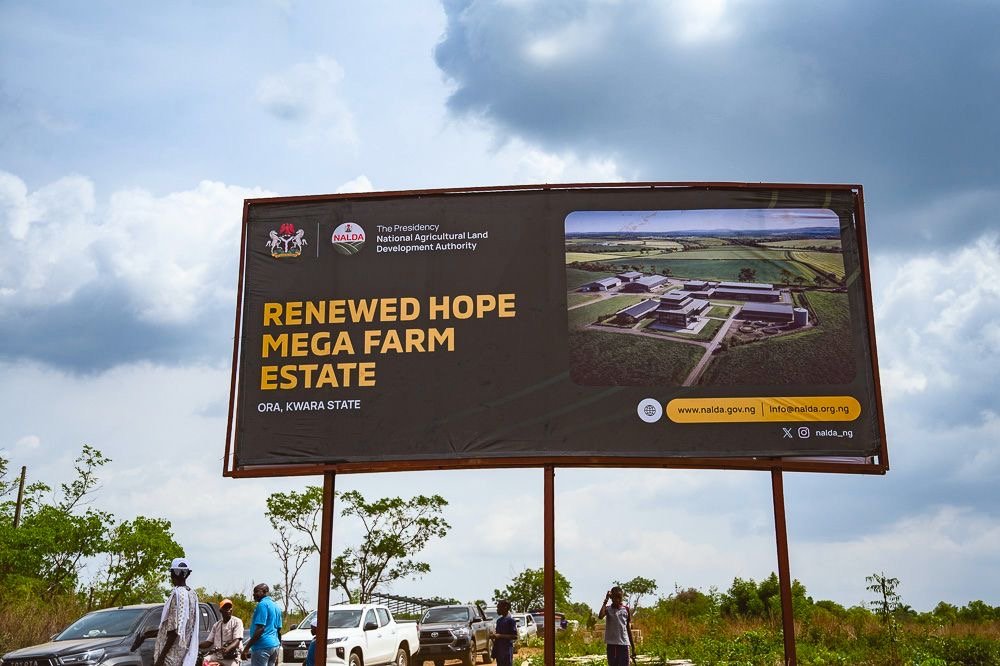
The National Agricultural Land Development Authority (NALDA) has reaffirmed its commitment to achieving food self-sufficiency through the rollout of the Renewed Hope Mega Farms initiative across Nigeria.
This flagship programme, implemented under the directive of President Bola Ahmed Tinubu, continues to gain momentum as part of a broader national strategy to strengthen food systems, boost agricultural productivity, and drive inclusive economic growth.
The initiative reflects a renewed focus on agriculture as a cornerstone of national development.
Strategic Engagement in Kwara State
As part of ongoing implementation efforts, the Executive Secretary and Chief Executive Officer of NALDA, Cornelius Adebayo, recently led a high-level stakeholder engagement and sensitisation programme in Ora, Kwara State, Nigeria.
The location serves as the flagship site for the Renewed Hope Mega Farm project.
The engagement brought together a wide range of stakeholders, including local farmers, community leaders, and development partners.
This inclusive approach ensures that the initiative remains community-driven and responsive to local needs.
Empowering Farmers and Communities
A key objective of the engagement was to deepen awareness and encourage active participation.
Cornelius Adebayo emphasized that the success of the programme depends on the involvement of farmers and host communities.
Participants were introduced to the operational model of the mega farms, which promotes cluster-based farming.
This system enables farmers to share resources, access support services, and operate within a structured and secure environment.
As a result, productivity increases while risks are reduced.
Unlocking Economic Opportunities
The Renewed Hope Mega Farms initiative is designed to deliver more than food production.
It aims to create employment opportunities, stimulate local economies, and support the emergence of a resilient middle class.
By integrating infrastructure, technology, and training, the programme positions agriculture as a viable and attractive sector for both young and experienced farmers.
Therefore, its impact extends beyond farms into broader economic development.
Community Support and Traditional Leadership
During the visit, Cornelius Adebayo expressed appreciation to the Chief Host, Rilwan Olawale Yekini, as well as high chiefs and community leaders for their warm reception and continued support.
Traditional institutions play a vital role in mobilising communities and sustaining development initiatives.
Their endorsement strengthens trust and ensures smoother implementation at the grassroots level.
Infrastructure Development Underway
Following the stakeholder engagement, Cornelius Adebayo conducted an inspection of ongoing construction at the project site.
Key infrastructure currently under development includes:
- Hostel blocks for cluster-based farmers
- A warehouse for storage and logistics
- A security post to ensure safety
- Additional facilities to support efficient farm operations
These developments highlight the structured nature of the initiative.
They also demonstrate a commitment to creating an enabling environment for large-scale agricultural production.
Driving a National Food Security Agenda
The Renewed Hope Mega Farms initiative remains central to the broader mission of the National Agricultural Land Development Authority.
By combining policy direction, community engagement, and infrastructure development, the programme addresses critical gaps in Nigeria’s agricultural value chain.
It supports increased food production while reducing reliance on imports.
Moreover, it strengthens resilience against food shortages and economic shocks.
Looking Ahead
As implementation progresses, expectations continue to rise.
The focus will remain on scaling the initiative, ensuring sustainability, and delivering measurable outcomes.
With continued leadership from Cornelius Adebayo and support from stakeholders, the Renewed Hope Mega Farms initiative is well-positioned to transform agriculture across Nigeria.
Ultimately, it represents a strategic pathway toward food security, economic empowerment, and national prosperity.
About The Author