The National Agency for Science and Engineering Infrastructure (NASENI) has received commendation for its efforts to empower 500 households in Akwa Ibom State through practical skills acquisition, technical training and science education initiatives. Senate President Godswill Akpabio praised the agency for investing in human dignity, productive enterprise and economic independence, describing the intervention as an example of how public institutions can create opportunities for citizens.
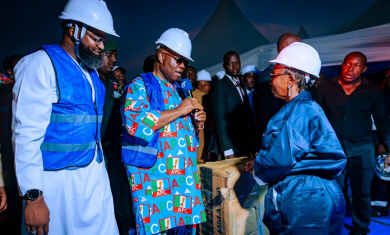
Akpabio made the remarks on Monday, November 23, 2026, at Independence High School, Ukana, in Essien Udim Local Government Area of Akwa Ibom State. He spoke during the flag-off of the NASENI Sustainable Empowerment Programme (NSEP), which will train 500 participants across 13 technical trades. The event also featured the groundbreaking ceremony for the establishment of Science, Technology, Engineering and Mathematics (STEM) laboratories for the South-South region.
The two initiatives combine vocational skills development with practical science education, addressing different aspects of Nigeria’s human capital development needs.
Akpabio Commends NASENI’s Skills Development Initiative
The Senate President described the programme as a practical demonstration of government’s responsibility to improve citizens’ welfare. According to him, democracy should deliver tangible benefits by creating opportunities for ordinary Nigerians, particularly young people seeking productive skills and sustainable livelihoods.
He stressed that Nigeria’s prosperity cannot depend on academic qualifications alone. Rather, the country also needs skilled workers, disciplined minds and innovative individuals capable of translating knowledge into useful products and services.
Akpabio therefore encouraged the beneficiaries to take the training seriously and use the opportunity to build sustainable sources of income. He also called on employers and business owners to provide apprenticeship opportunities for emerging talents, noting that practical experience and access to employment opportunities would help trainees apply their newly acquired skills.
Furthermore, he assured that the National Assembly would continue to support public investments with measurable benefits through appropriation and oversight.
500 Participants to Receive Training in 13 Technical Trades
Earlier, NASENI’s Executive Vice Chairman and Chief Executive Officer, Khalil Suleiman Halilu, explained that the Sustainable Empowerment Programme aims to bridge the gap between technical knowledge and practical economic opportunities.
Under the initiative, 500 participants drawn from Akwa Ibom State will receive hands-on training across 13 technical trades. These include solar installation, electrical services, refrigeration, electronics repairs, compressed natural gas (CNG) conversion, electric tricycle assembly, welding, agro-processing machinery and materials manufacturing.
The range of trades reflects the programme’s focus on practical skills that can support employment, entrepreneurship and local economic activity.
For instance, participants trained in solar installation and electrical services could provide solutions to household and business energy needs. Similarly, those who acquire skills in refrigeration, electronics repairs and welding could establish small businesses or seek employment with existing operators.
In addition, training in agro-processing machinery could create opportunities for participants to support farmers and small-scale processors who need access to equipment and technical services.
Halilu disclosed that participants who successfully complete the training will receive starter kits to help them begin offering services or establishing businesses. NASENI will also provide training equipment to trade cooperatives, allowing members to access machinery that might otherwise be too expensive for individuals to purchase.
He emphasised that training alone would not guarantee sustainable livelihoods. Consequently, he encouraged local businesses, farmers and contractors to engage the beneficiaries and provide opportunities for them to apply their skills. Access to customers, he noted, would be important to sustaining the programme’s economic impact.
NASENI Begins Groundwork for Regional STEM Laboratories
Beyond vocational training, the event marked the beginning of a separate initiative to strengthen science education through the establishment of STEM laboratories.
The proposed facilities will cover Biology, Physics and Chemistry, providing students with opportunities to conduct experiments and connect classroom lessons with practical applications.
Akpabio described the laboratory project as an investment in Nigeria’s scientific and technological future. He noted that properly equipped laboratories could help students develop scientific curiosity, test ideas and build the practical knowledge required for future discoveries and innovations.
He also urged the school’s leadership to ensure that the facilities receive adequate equipment, regular maintenance and support from qualified teachers. Without these essential provisions, he observed, the laboratories might not achieve their intended purpose of turning scientific interest into practical competence.
The NASENI chief executive similarly explained that the facilities would help students understand how science applies to everyday life. By providing practical learning opportunities, the project is expected to strengthen the foundation for future innovation and technical development.
However, the groundbreaking ceremony represents the commencement of the project rather than the completion of the laboratories. Their eventual contribution will depend on timely construction, proper equipping, maintenance and effective use by teachers and students.
Creation, Collaboration and Commercialisation
Halilu also highlighted NASENI’s three Cs framework of Creation, Collaboration and Commercialisation, which guides the agency’s approach to developing solutions and translating innovation into economic opportunities.
Through creation, the agency seeks to encourage the development of practical technologies and solutions. Collaboration, meanwhile, supports partnerships among institutions, businesses, technical experts and other stakeholders. Commercialisation focuses on turning innovations into products and services that can serve the market and generate economic value.
These principles are particularly relevant to the Akwa Ibom intervention because the success of skills training depends not only on what participants learn but also on their ability to apply that knowledge.
For the 500 beneficiaries, access to starter kits, cooperative equipment and potential customers could help bridge the gap between training and enterprise development. Similarly, the proposed STEM laboratories could expose students to practical science and encourage interest in engineering, technology and related fields.
Measuring the Long-Term Impact
The NASENI intervention aligns with the Federal Government’s Renewed Hope Agenda, particularly its emphasis on skills development, economic inclusion, technology and human capital investment.
Nevertheless, the programme’s lasting impact will depend on what happens after the launch. The number of people trained will be an important measure, but the sustainability of their livelihoods will provide a clearer indication of its economic value.
For this reason, follow-up support, access to equipment, business connections and opportunities for apprenticeship will remain important. Beneficiaries will also need to apply their skills consistently and identify market needs that can support viable businesses.
Likewise, the proposed STEM laboratories must become functional learning facilities where students can carry out experiments and receive guidance from qualified teachers.
Akpabio’s commendation highlights the importance of practical interventions that connect public investment with opportunities for citizens. By combining vocational training with science education, NASENI is seeking to support both immediate livelihood development and the longer-term growth of technical capacity.
As the programme moves forward, its success will ultimately be reflected in the businesses established, employment opportunities created, skills put to productive use and students encouraged to pursue scientific innovation.
About The Author