First Lady Senator Oluremi Tinubu has expressed disappointment that no state government participated in the Federal Government’s ₦50 million Green Challenge, which was designed to reclaim abandoned spaces and dumpsites across Nigeria.
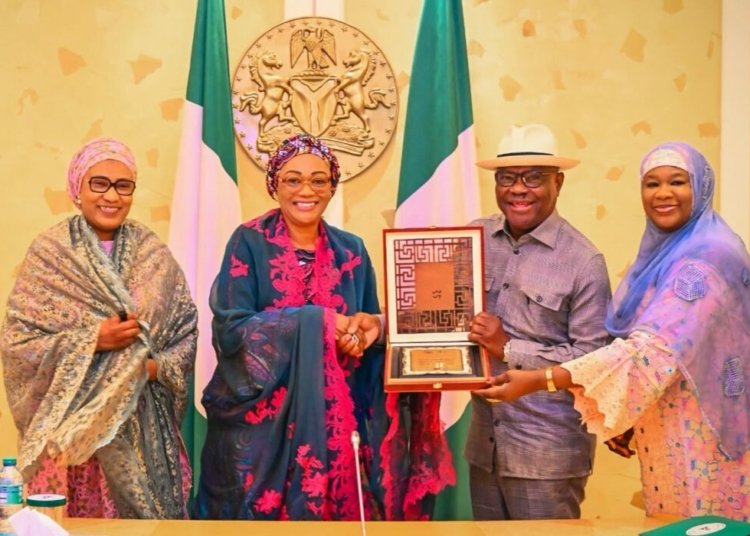
The First Lady raised the concern while commending the Minister of the Federal Capital Territory, Nyesom Wike, for transforming Abuja’s City Gate into a major environmental and recreational landmark.
Her remarks highlight growing concerns about environmental degradation and the need for stronger collaboration between federal and state authorities.
Green Challenge Designed to Restore Public Spaces
The ₦50 million Green Challenge was introduced to encourage states to reclaim abandoned spaces and convert neglected areas into cleaner and more useful environments.
Furthermore, abandoned spaces can become dumping grounds when authorities fail to maintain them properly.
Such areas can damage community aesthetics.
They can encourage indiscriminate waste disposal.
They can also create environmental and public health concerns.
Reclaiming these spaces can therefore improve the appearance and functionality of communities.
First Lady Expresses Disappointment
Oluremi Tinubu expressed disappointment that no state government participated in the initiative.
Furthermore, the absence of state participation limits the potential impact of a programme designed to encourage environmental improvement across the country.
State governments control many public spaces.
They also work closely with local authorities and communities.
Their participation can therefore make environmental initiatives more effective.
The First Lady’s criticism highlights the importance of shared responsibility in addressing environmental challenges.
Environmental Responsibility Requires Collaboration
Environmental protection cannot depend solely on the Federal Government.
Furthermore, state governments, local councils, communities, businesses, and individuals all have important responsibilities in maintaining clean and sustainable environments.
Federal policies can provide direction.
State governments can implement projects.
Local authorities can monitor public spaces.
Communities can maintain reclaimed areas.
This coordinated approach can produce more sustainable environmental improvements.
Wike Praised for Abuja Transformation
Despite her disappointment over the lack of state participation, the First Lady praised Nyesom Wike for his work in transforming Abuja’s City Gate.
The project has emerged as an environmental and recreational landmark within the Federal Capital Territory.
Furthermore, the transformation demonstrates how neglected or underutilised public spaces can be redesigned for broader community benefit.
Well-maintained public spaces improve city appearance.
Recreational areas encourage outdoor activities.
Green spaces can improve urban environments.
Importance of Green Urban Spaces
Green spaces provide important benefits in growing cities.
Furthermore, trees, landscaped areas, recreational parks, and properly maintained public spaces can improve the quality of urban life.
Vegetation can reduce heat.
Landscaping can improve aesthetics.
Recreational facilities can encourage healthy lifestyles.
Public spaces can also provide opportunities for families and communities to interact.
Addressing Abandoned Dumpsites
Abandoned dumpsites present a different but related challenge.
Furthermore, poorly managed waste disposal areas can undermine environmental quality and affect communities located nearby.
Waste can contaminate surrounding areas.
Blocked drainage can increase flooding risks.
Uncontrolled dumping can attract pests.
Effective reclamation can therefore contribute to cleaner and safer communities.
Encouraging States to Take Action
The First Lady’s comments could encourage state governments to reconsider their approach to environmental projects.
Furthermore, states can identify abandoned spaces within their jurisdictions and develop practical plans for their rehabilitation.
Unused land can become parks.
Old dumpsites can become green areas after proper remediation.
Neglected public spaces can become recreational facilities.
Such projects can improve communities while creating opportunities for local employment.
Environmental Projects Can Create Jobs
Green initiatives can also contribute to economic activity.
Furthermore, landscaping, waste management, recycling, maintenance, construction, and environmental services require skilled and unskilled workers.
Young people can gain employment.
Small businesses can provide services.
Local contractors can secure projects.
Green projects can therefore combine environmental improvement with economic opportunities.
Changing Public Attitudes Toward Waste
Government projects alone cannot solve Nigeria’s waste-management challenges.
Furthermore, residents must also develop stronger habits around waste disposal and environmental protection.
Citizens should avoid indiscriminate dumping.
Communities can organise clean-up activities.
Businesses can reduce unnecessary waste.
Schools can promote environmental education.
These actions can help preserve reclaimed spaces after government intervention.
The Abuja Example
The transformation of Abuja’s City Gate provides an example of what can happen when public spaces receive sustained attention and investment.
Furthermore, the project demonstrates that environmental improvements can also create attractive spaces for recreation and community activities.
The approach could inspire similar projects across other Nigerian cities.
State governments can identify suitable locations.
Local communities can participate in planning.
Private organisations can support maintenance.
Looking Ahead
Oluremi Tinubu’s disappointment over the lack of participation in the ₦50 million Green Challenge highlights a wider need for stronger environmental cooperation across Nigeria.
At the same time, her praise for Wike’s transformation of Abuja City Gate demonstrates the potential value of investing in neglected public spaces.
The challenge now is ensuring that environmental responsibility becomes a shared priority rather than an occasional government initiative.
Ultimately, Nigeria can reclaim abandoned spaces, improve urban environments, and create healthier communities when federal and state governments work together while citizens actively support responsible waste management and environmental preservation.
About The Author