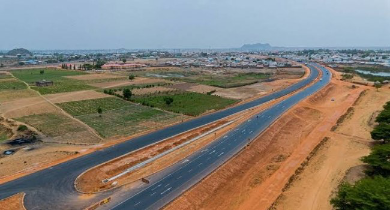
President Bola Ahmed Tinubu’s commitment to rebuilding Nigeria’s critical road infrastructure has recorded another significant milestone as the Federal Government announced the completion of the first 118-kilometre section of the Abuja to Kaduna to Kano Highway.
The completed section, which cost ₦257 billion, forms part of the strategic highway linking the Federal Capital Territory with Nigeria’s North-West commercial corridor. The project remains one of the administration’s flagship infrastructure investments designed to improve transportation, stimulate economic activities, and strengthen national connectivity.
Minister of Works, David Umahi, disclosed the development while briefing journalists after the Federal Executive Council (FEC) meeting held at the Presidential Villa, Abuja.
Furthermore, he announced that the remaining 164-kilometre section of the highway is progressing steadily and is expected to reach completion by November 2026.
A Strategic Highway for National Growth
The Abuja–Kaduna–Kano Highway remains one of Nigeria’s busiest and most economically important transport corridors.
Every day, thousands of commuters, transport operators, manufacturers, traders, and agricultural producers depend on the highway to move people and goods between northern and central Nigeria.
Consequently, improving the road has become a national priority.
The completed 118-kilometre section is expected to reduce travel time, improve safety, lower vehicle operating costs, and facilitate smoother movement of agricultural produce and commercial goods.
Furthermore, better road infrastructure will strengthen regional trade while encouraging increased private investment across the corridor.
Road Infrastructure at the Centre of Economic Reform
Umahi explained that infrastructure development remains central to President Tinubu’s Renewed Hope Agenda.
According to him, quality roads create opportunities for businesses, attract investment, reduce logistics costs, and improve citizens’ quality of life.
Furthermore, improved transportation networks enhance productivity because businesses spend less time moving raw materials and finished products.
The minister noted that infrastructure investments produce long-term economic returns that benefit every sector of the economy.
He therefore reaffirmed the Federal Government’s commitment to completing strategic road projects across the federation.
Completion Target Set for November 2026
Beyond the completed section, construction activities continue on the remaining 164 kilometres of the highway.
Umahi expressed confidence that contractors remain on schedule to complete the outstanding section before the November 2026 deadline.
Furthermore, he stated that the ministry continues to monitor project execution closely to ensure contractors meet agreed timelines without compromising construction quality.
According to him, regular supervision, prompt funding, and strict compliance with engineering standards remain essential to delivering durable infrastructure.
The minister assured Nigerians that the administration will continue prioritising timely project delivery.
Tinubu Approves Massive Road Investment
Umahi also announced that President Tinubu has approved 27 road projects valued at over ₦3.9 trillion across 15 states.
The approvals, he explained, reflect the administration’s determination to bridge Nigeria’s infrastructure deficit through sustained investment in strategic highways.
Furthermore, the projects are expected to improve interstate connectivity, expand access to rural communities, and strengthen commercial activities nationwide.
The Federal Government believes that modern road infrastructure remains critical to achieving inclusive economic growth.
Consequently, investments in transportation continue to receive significant attention under the current administration.
Creating Jobs and Stimulating Local Economies
Large-scale road construction delivers benefits beyond improved transportation.
Construction activities generate employment opportunities for engineers, artisans, equipment operators, suppliers, transport workers, and other skilled professionals.
Furthermore, businesses operating along project corridors benefit from increased commercial activities throughout the construction period.
Local suppliers also gain opportunities to provide materials, logistics, accommodation, and other essential services.
These multiplier effects strengthen local economies while supporting national economic growth.
Supporting Agriculture and Commerce
Nigeria’s agricultural sector depends heavily on efficient transportation networks.
Farmers require reliable roads to move produce quickly from farms to processing centres and urban markets.
Furthermore, manufacturers rely on dependable highways to transport raw materials and finished products across the country.
The Abuja–Kaduna–Kano Highway therefore serves as a vital economic artery connecting agricultural communities with major commercial centres.
Improved road conditions will reduce post-harvest losses, lower transportation costs, and improve market access for farmers.
Consequently, consumers also stand to benefit from more efficient food distribution systems.
Building Confidence Through Infrastructure
The Federal Government maintains that sustained investment in infrastructure demonstrates its commitment to long-term national development.
Quality roads improve mobility, encourage industrial growth, strengthen national integration, and enhance investor confidence.
Furthermore, reliable transportation infrastructure supports education, healthcare delivery, tourism, and emergency services.
President Tinubu’s administration continues to emphasise that infrastructure development remains one of the strongest foundations for economic transformation.
The ongoing highway projects therefore represent more than construction activities.
They represent investments in national productivity, competitiveness, and shared prosperity.
A Renewed Vision for National Connectivity
The completion of the first 118 kilometres of the Abuja–Kaduna–Kano Highway marks another important achievement in Nigeria’s infrastructure renewal programme.
Furthermore, the planned completion of the remaining 164 kilometres by November 2026 demonstrates the administration’s determination to deliver projects that produce lasting economic value.
With the approval of 27 additional road projects worth more than ₦3.9 trillion, President Bola Ahmed Tinubu continues to position infrastructure as a major driver of economic growth, regional integration, and national development.
As construction progresses across the country, Nigerians can expect stronger transportation networks, expanded commercial opportunities, and improved connectivity that will support sustainable development for many years to come.
About The Author