
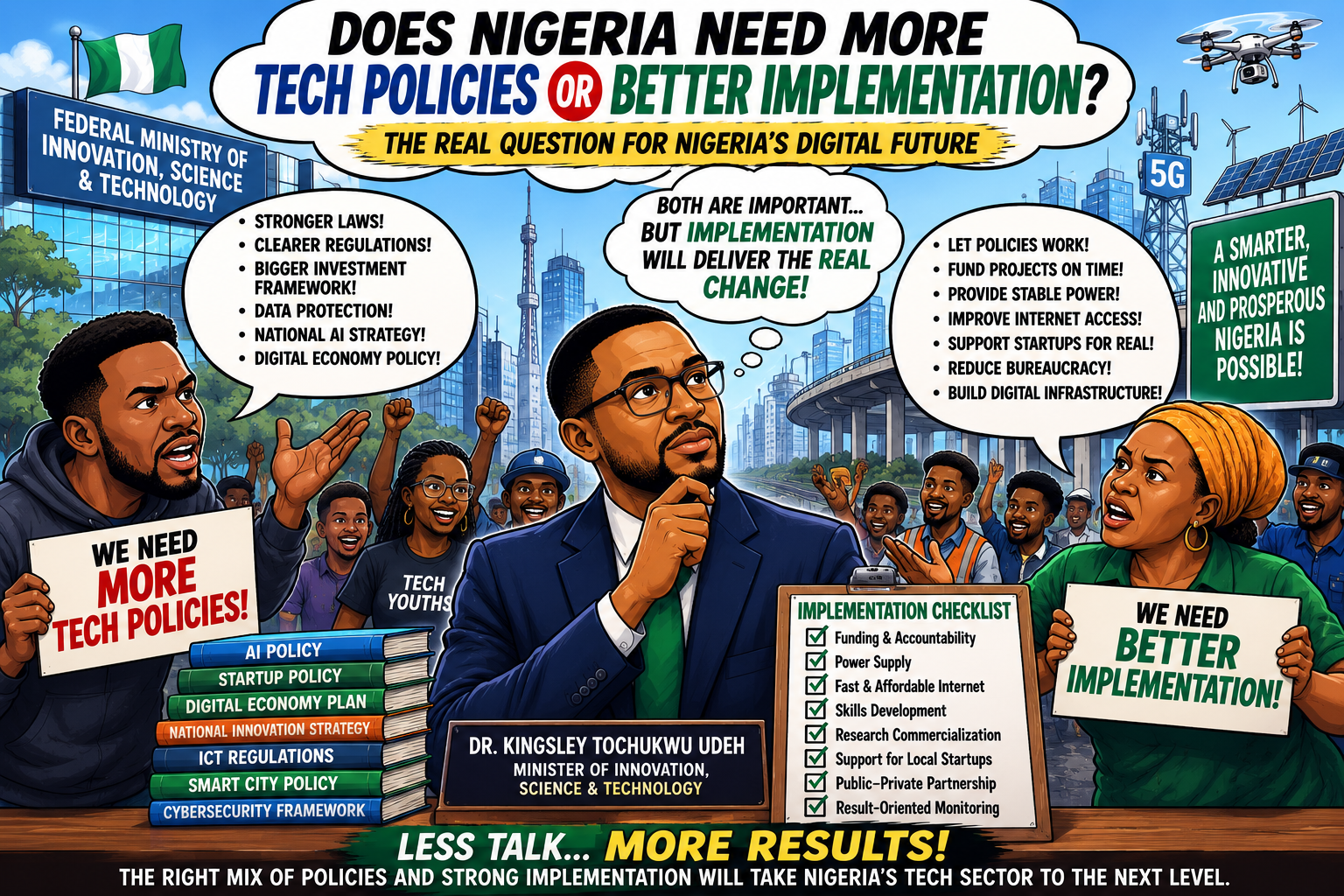
Nigeria has never lacked ambitious technology policies. Over the years, governments have introduced strategies to encourage digital transformation, strengthen scientific research, support entrepreneurship, and modernize the economy. Yet many Nigerians continue asking a difficult question: if so many policies already exist, why has the country not fully realized its technological potential?
That debate has intensified since Kingsley Udeh assumed leadership of the Federal Ministry of Innovation, Science and Technology. Some observers argue that Nigeria needs fresh technology policies to compete with rapidly advancing economies. Others believe the country already has enough policies and should concentrate on implementing them effectively.
The discussion is healthy because technology now influences nearly every sector of the economy. Healthcare, agriculture, education, manufacturing, transportation, and financial services increasingly depend on innovation. Consequently, how Nigeria manages its technology agenda will shape its future competitiveness.
Supporters of Kingsley Udeh believe his leadership offers an opportunity to move beyond policy announcements and focus on practical execution that delivers measurable benefits.
Nigeria Has Developed Many Technology Policies
Over the past two decades, Nigeria has introduced several initiatives designed to strengthen innovation.
Digital economy strategies have been announced.
Science and technology programs have received renewed attention.
Startup support initiatives have emerged.
Artificial intelligence has entered national conversations.
Research institutions continue expanding their activities.
These efforts demonstrate that policymakers understand the importance of innovation.
However, policies alone rarely transform economies.
Real progress occurs only when implementation becomes consistent, transparent, and measurable.
Why Implementation Matters More
A well-written policy creates direction.
Effective implementation creates results.
Businesses benefit when regulations become predictable.
Researchers succeed when funding arrives on time.
Entrepreneurs grow when support programs operate efficiently.
Students gain opportunities when educational reforms reach classrooms.
Investors gain confidence when governments consistently follow through on commitments.
Therefore, implementation determines whether ambitious plans improve everyday lives.
Supporters argue that Kingsley Udeh recognizes this distinction.
His emphasis on commercializing research and strengthening collaboration reflects a practical approach rather than simply producing additional policy documents.
Critics Raise Fair Questions
Some Nigerians remain skeptical.
They point to previous government initiatives that generated excitement but produced limited long-term impact.
Others believe bureaucracy continues slowing innovation.
Funding gaps remain a concern.
Infrastructure challenges affect technology development.
Coordination between research institutions and private industry still requires improvement.
These observations deserve careful attention.
Effective implementation requires accountability, adequate resources, and sustained commitment.
No serious innovation strategy can ignore these realities.
Policies and Implementation Should Work Together
The debate should not become a choice between writing policies and implementing them.
Strong implementation depends on clear policies.
Strong policies require effective implementation.
One cannot succeed without the other.
Policies establish national priorities.
Implementation transforms those priorities into practical outcomes.
Many supporters believe Kingsley Udeh’s leadership recognizes that balance.
Rather than constantly replacing existing strategies, improving execution could generate faster and more sustainable progress.
Research Should Create Businesses
One of Nigeria’s greatest opportunities lies in turning scientific discoveries into successful commercial products.
Universities continue producing valuable research.
Scientists develop innovative solutions.
Engineers create practical technologies.
Unfortunately, many of these achievements never reach consumers or businesses.
Commercialization changes that situation.
Successful commercialization creates companies.
Growing companies employ workers.
Employment strengthens local economies.
Competitive businesses attract investment.
Supporters believe Kingsley Udeh’s emphasis on research commercialization addresses one of Nigeria’s most significant innovation challenges.
Young Innovators Need Action
Nigeria’s young population continues demonstrating exceptional creativity.
Software developers build globally competitive applications.
Technology entrepreneurs launch promising startups.
Researchers explore solutions to local and international challenges.
Many possess the skills needed to compete successfully.
However, talent alone cannot guarantee success.
Young innovators need access to funding.
Reliable digital infrastructure remains essential.
Mentorship strengthens new businesses.
Efficient government programs encourage entrepreneurship.
Supporters argue that implementation determines whether these opportunities become reality.
Building Trust Through Results
Public confidence grows when citizens see measurable improvements.
New technology hubs.
Successful startup programs.
Research projects reaching commercial markets.
Expanded digital infrastructure.
Greater private investment.
Job creation.
These achievements strengthen trust more effectively than policy announcements alone.
That is why many observers believe implementation should become the defining measure of success.
Kingsley Udeh’s Opportunity
Leadership in innovation extends beyond developing new ideas.
It requires connecting government, universities, investors, businesses, and entrepreneurs around shared objectives.
It demands removing unnecessary obstacles.
It encourages collaboration instead of duplication.
It measures progress using practical outcomes.
Supporters believe Kingsley Udeh has an opportunity to strengthen these partnerships while ensuring existing technology strategies produce meaningful national benefits.
Such an approach would help Nigeria maximize resources rather than repeatedly redesigning policies.
Looking Toward the Future
Global competition continues accelerating.
Artificial intelligence evolves rapidly.
Digital economies expand every year.
Countries investing in research, innovation, and entrepreneurship continue attracting international investment.
Nigeria cannot afford to remain on the sidelines.
The nation already possesses talented researchers, creative entrepreneurs, expanding technology communities, and growing international recognition.
The next step involves ensuring these strengths receive consistent support through effective implementation.
The Bottom Line
The debate over whether Nigeria needs more technology policies or better implementation raises an important national question. While updating policies remains necessary as technology evolves, implementation will ultimately determine whether those policies improve people’s lives.
Many supporters believe Kingsley Udeh’s leadership reflects an understanding of this reality. His emphasis on innovation, research commercialization, and stronger collaboration suggests that success should be measured not by the number of new policy documents produced but by the tangible results delivered.
If Nigeria consistently implements its technology agenda, supports innovators, strengthens partnerships, and creates an environment where research becomes commercial success, the country will be better positioned to compete globally. Under that approach, Kingsley Udeh’s leadership could help shift the national conversation from promises to performance, giving Nigeria a stronger foundation for long-term innovation and economic growth.
About The Author