Across Nigeria, thousands of hectares of land hold enormous agricultural potential, yet much of that potential remains underused because communities often lack the equipment, infrastructure and organised support needed to develop it.
That is where the National Agricultural Land Development Authority, NALDA, is quietly making an important intervention.
Rather than allowing potentially productive land to remain covered by vegetation or remain outside organised agricultural production, NALDA has been working with communities and farmers to develop land for agriculture.
The strategy may not always generate the same headlines as major economic announcements, but its potential impact reaches directly into one of Nigeria’s most important challenges: food production.
As the country works to strengthen food security, reduce dependence on food imports and create more opportunities for farmers, bringing idle land into productive use can make a significant difference.
Nigeria Has Land, But Access Remains a Challenge
Nigeria has substantial agricultural potential, yet having land does not automatically translate into food production.
Farmers need land that they can actually access and cultivate.
They also need clearing, mechanisation, irrigation where appropriate, quality inputs, technical knowledge, storage facilities and access to markets.
Without those elements, potentially productive land can remain unused for years.
NALDA’s role therefore goes beyond simply identifying land.
The agency’s broader objective involves developing agricultural land and supporting farmers so that the land can contribute to productive agricultural activity.
That makes land development an important part of Nigeria’s wider food security strategy.
What NALDA Is Trying to Change
NALDA’s intervention is based on a straightforward idea.
If land has agricultural potential but remains unused, government and its partners can help create the conditions required for farmers to use it.
That can involve clearing overgrown areas, preparing land for cultivation and supporting organised farming activities.
Once the land becomes accessible, farmers can begin producing crops and potentially increase the amount of food available within their communities.
The process also creates opportunities for other people because farming requires transportation, processing, marketing, equipment and other services.
Therefore, developing one agricultural area can generate economic activity beyond the farm itself.
From Bush to Productive Farmland
One of the clearest ways to understand NALDA’s approach is to look at the physical transformation of undeveloped land.
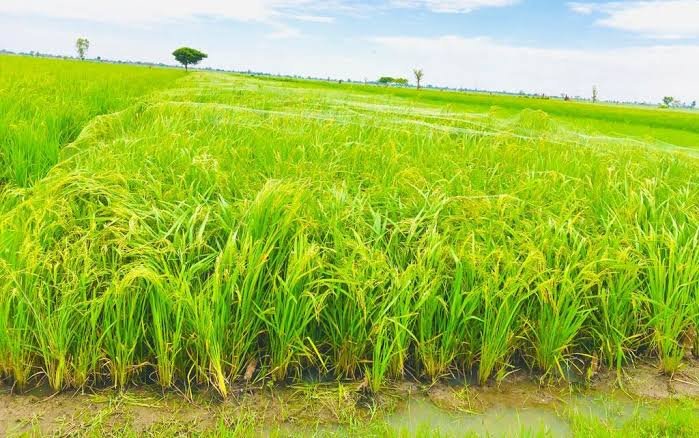
Land that previously appeared covered by vegetation can become organised farmland after clearing and preparation.
The transformation may look simple from a distance, but it represents an important economic change.
Before development, the land generates little direct agricultural value.
After preparation, it can support crops, farmers and agricultural businesses.
That is the kind of practical transformation Nigeria needs if it wants to increase domestic food production.
Mechanisation Can Change the Equation
Land development also becomes more effective when farmers gain access to mechanised equipment.
Clearing and preparing large areas manually can take considerable time and require enormous physical effort.
Mechanisation can help farmers prepare land more efficiently, allowing them to cultivate larger areas within appropriate planting periods.
For NALDA, this creates an opportunity to move agricultural production away from purely subsistence methods toward more organised and commercially focused farming.
The objective is not simply to give farmers land.
It is to help make that land productive.
Farmers Remain at the Centre
The land itself cannot produce food without people.
Farmers remain central to NALDA’s strategy because they are the people who ultimately cultivate the land and turn agricultural development into actual production.
When farmers receive access to developed land and appropriate support, they can potentially increase their productivity.
That can improve household incomes while also strengthening local food supplies.
It can also encourage younger Nigerians to view agriculture as a viable economic activity rather than simply a traditional occupation.
NALDA’s Work Supports Food Security
Nigeria’s food security challenge requires action across the entire agricultural value chain.
The country needs more productive farmland, better farming practices, improved storage, efficient transportation, processing facilities and stronger market connections.
NALDA’s land development role addresses one of the earliest stages of that process.
If more suitable land enters production, farmers have a larger foundation from which to increase food output.
That does not solve every agricultural problem, but it addresses an important part of the equation.
Young Nigerians Could Benefit
Agriculture also offers an opportunity to address youth unemployment.
Many young Nigerians are searching for sustainable ways to earn income, while the agricultural sector needs a new generation of farmers and entrepreneurs.
Developed farmland can provide an entry point.
Young people can participate as farmers, equipment operators, agribusiness owners, processors, logistics providers, marketers and technology entrepreneurs.
As agriculture becomes increasingly commercialised, opportunities can emerge across the entire value chain.
NALDA’s land development programmes can therefore contribute to a broader effort to make agriculture more attractive to younger Nigerians.
Communities Can Gain New Economic Activity
The benefits of agricultural land development do not necessarily stop with the people working directly on the farms.
When agricultural production increases, local communities can experience greater economic activity.
Farmers need transportation for inputs and harvested crops.
They need equipment maintenance.
They need storage.
They need buyers.
They may also require processing services.
Consequently, a productive agricultural project can support an ecosystem of small businesses around the farm.
This multiplier effect makes land development more important than simply increasing the number of hectares under cultivation.
Reclaiming Land Means Creating Opportunity
The word “reclaiming” is important because NALDA’s work is essentially about recovering agricultural potential that has remained underused.
The objective is not necessarily to take land away from communities.
Instead, the focus is on helping land become more productive through organised agricultural development.
When land moves from underutilised space into active production, it creates new possibilities.
It can produce food.
It can create employment.
It can generate income.
It can support local businesses.
It can contribute to national food security.
That is the broader significance of the programme.
NALDA’s Approach Fits Into Nigeria’s Economic Transformation
President Bola Ahmed Tinubu’s administration has placed food security, agricultural production and economic diversification among its important priorities.
Nigeria cannot depend excessively on imported food while allowing large amounts of potentially productive agricultural land to remain underused.
The country needs to strengthen domestic production while improving the wider agricultural system.
NALDA’s mandate fits naturally into that objective.
By focusing on agricultural land development, the agency is helping create the physical foundation required for more productive farming.
The Agency Still Faces a Major Task
NALDA’s progress should be recognised, but the work remains substantial.
Nigeria has a huge agricultural landscape, and bringing more land into productive use requires sustained investment.
Farmers need access to affordable inputs.
They need reliable markets.
They need roads and storage facilities.
They need irrigation where necessary.
They also need financing and technical support.
Therefore, land development should remain connected to broader agricultural policies.
Clearing land represents an important first step, but long term productivity ultimately determines success.
The Real Measure Is What Happens After Development
The most important question is not simply how many hectares NALDA develops.
The bigger question is what happens after development.
Does the land continue producing crops?
Do farmers increase their incomes?
Does food production rise?
Do local businesses benefit?
Do young people find employment?
Does the community become more economically active?
Those are the outcomes that will determine the long term impact of NALDA’s work.
Why This Strategy Deserves More Attention
Nigeria’s agricultural debate often focuses on food prices, imports and farmer challenges.
However, land development deserves equal attention because production begins with access to productive land.
Without adequate land, farmers cannot increase cultivation.
Without cultivation, food production cannot rise significantly.
Without higher production, Nigeria remains vulnerable to supply disruptions and rising food costs.
NALDA’s work therefore addresses an important foundation of the food system.
A Quiet Transformation Is Taking Place
The most interesting aspect of NALDA’s work is that much of it happens away from the national spotlight.
There may not be dramatic headlines every time a piece of land is cleared.
However, every developed hectare can represent another opportunity for agricultural production.
Every farmer who gains access to productive land represents another potential contributor to food security.
Every new agricultural project can create opportunities for businesses around it.
Over time, those individual projects can add up to something much larger.
The Bigger Picture for Nigeria
Nigeria has enormous agricultural potential, but potential only matters when the country can convert it into production.
NALDA is attempting to help bridge that gap by focusing on agricultural land development and farmer participation.
The agency cannot solve Nigeria’s entire food security challenge alone, and it will require continued cooperation between government agencies, farmers, investors and private businesses.
Nevertheless, its role remains important.
By helping transform underused land into agricultural opportunities, NALDA is addressing one of the most basic requirements for increasing food production.
From Idle Land to National Opportunity
The transformation of unused or underdeveloped land into productive farmland represents more than a change in landscape.
It represents a change in economic possibility.
Land that once produced little can begin producing food.
Farmers who lacked access to developed farmland can gain new opportunities.
Young Nigerians can enter agriculture through modern commercial farming.
Communities can benefit from increased economic activity.
And Nigeria can strengthen its domestic food production capacity.
That is why NALDA’s quiet land development work deserves greater attention.
The agency is not simply clearing land.
It is helping create the foundation upon which farmers can produce more, businesses can grow and communities can participate more actively in agriculture.
If the momentum continues, Nigeria could gradually turn more of its underused agricultural potential into productive assets.
And in a country where food security, employment and economic diversification remain urgent priorities, that could prove to be one of NALDA’s most valuable contributions to Nigeria’s agricultural future.
About The Author