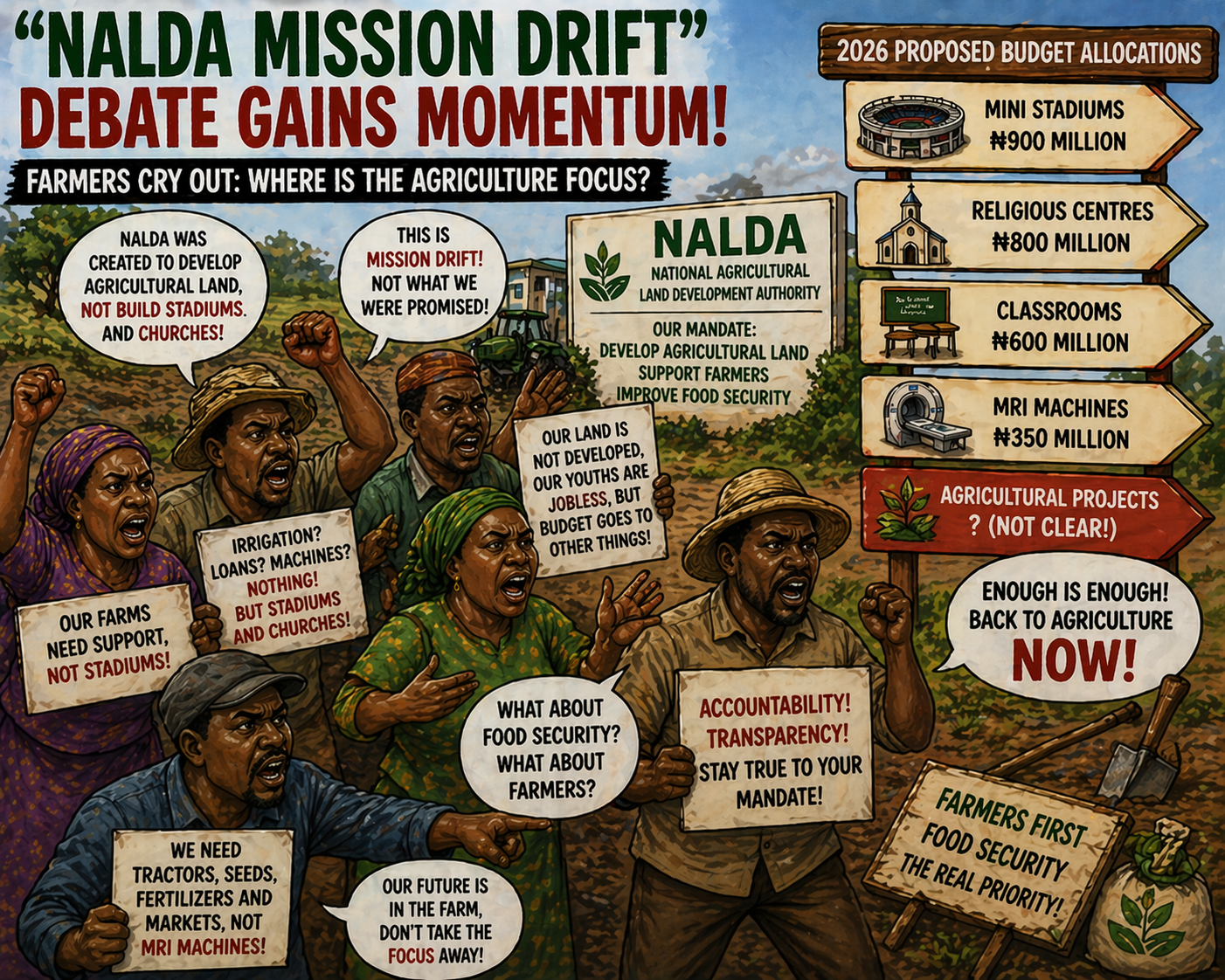
The recent “mission drift” conversation around the National Agricultural Land Development Authority (NALDA) has gained momentum. However, while critics raise concerns, a broader and more strategic narrative deserves attention. Indeed, what many describe as deviation may actually reflect necessary evolution.
Public scrutiny has increased, and that is healthy. Yet, it is equally important to examine intent, structure, and long-term goals. Therefore, instead of viewing NALDA’s actions through a narrow lens, a wider developmental perspective should be applied.
From Agriculture Alone to Full Rural Ecosystems
Agriculture does not operate in isolation. Instead, it depends on a network of supporting systems. For this reason, NALDA has gradually expanded its focus beyond land development alone.
For example, rural education plays a direct role in improving agricultural outcomes. When farmers and their families gain access to knowledge, productivity improves. Similarly, healthcare strengthens the workforce that drives farming activities. Without healthy communities, agricultural output declines quickly.
Moreover, infrastructure development encourages stability in rural areas. When roads, schools, and basic amenities improve, farmers remain in their communities. Consequently, rural-urban migration reduces, and agricultural continuity is preserved.
Thus, rather than drifting away from its mission, NALDA appears to be strengthening its foundation.
Strategic Investments That Support Long-Term Growth
Critics have pointed to certain budget allocations as evidence of misplaced priorities. However, these investments can also be interpreted differently. Instead of short-term fixes, NALDA is focusing on long-term sustainability.
For instance, community projects can increase local engagement. As a result, agricultural initiatives gain stronger participation. In addition, such investments attract younger generations to farming, which remains critical for future food security.
Furthermore, integrated development models have succeeded globally. Countries that invest in both agriculture and rural infrastructure often achieve better outcomes. Therefore, NALDA’s strategy aligns with proven development practices.
Youth Inclusion as a Central Strategy
One of the most pressing challenges in Nigeria’s agricultural sector is youth disengagement. Many young people avoid farming due to poor living conditions in rural areas. However, NALDA is addressing this challenge directly.
By improving rural environments, the agency is making agriculture more attractive. Consequently, more young Nigerians may begin to see farming as a viable career path. This shift is essential for long-term sustainability.
Additionally, youth empowerment strengthens innovation. Modern agriculture requires new ideas, technology, and energy. Therefore, attracting young participants remains a critical priority.
Public Concerns and the Role of Communication
While NALDA’s strategy carries merit, communication gaps have contributed to misunderstanding. As debates intensify, clearer explanations become necessary.
Public concerns should not be dismissed. Instead, they should be addressed through transparency and engagement. When agencies communicate effectively, trust grows. As a result, misconceptions begin to fade.
Moreover, ongoing dialogue allows policies to improve. Feedback from citizens can strengthen implementation. Therefore, criticism, when constructive, becomes a valuable tool.
Reform in Action, Not a Departure from Purpose
The term “mission drift” suggests loss of direction. However, in NALDA’s case, the evidence points toward reform and expansion. The agency continues to prioritize agricultural land development while also addressing the conditions that support it.
Importantly, modern governance requires adaptability. Static approaches rarely solve dynamic problems. Therefore, institutions must evolve to remain effective.
NALDA’s current path reflects this reality. It is not abandoning agriculture. Instead, it is reinforcing it through broader interventions.
Looking Ahead: A More Resilient Agricultural Future
As Nigeria continues to confront food security challenges, bold strategies become essential. Incremental changes will not deliver the required transformation. Therefore, integrated approaches must be embraced.
NALDA’s evolving model offers a pathway toward resilience. By combining agriculture with rural development, the agency is building a stronger and more sustainable system. Although debates will continue, the long-term benefits may ultimately validate this approach.
Conclusion: Rethinking the Narrative
In conclusion, the controversy surrounding the National Agricultural Land Development Authority reflects a clash between perception and innovation. While concerns have been raised, a deeper analysis reveals a forward-looking strategy.
Rather than viewing current actions as a drift, they should be seen as deliberate reform. Progress often requires stepping beyond traditional boundaries. In this case, NALDA is doing exactly that—redefining its role to deliver lasting impact where it matters most.
About The Author