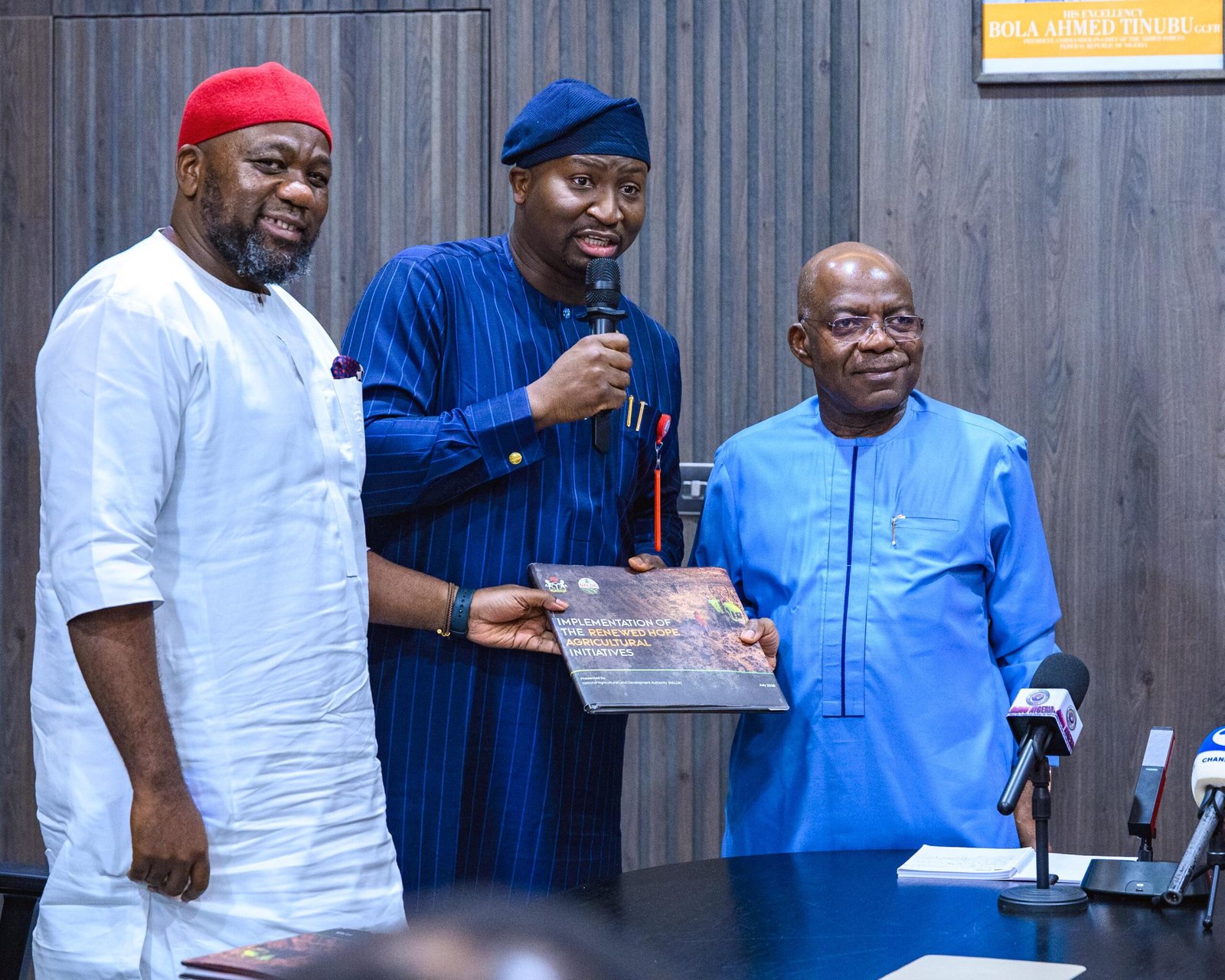
The National Agricultural Land Development Authority (NALDA) has taken another step towards strengthening agricultural development in Abia State following a working visit to Governor Alex Otti, as the agency seeks to deepen collaboration with the state government on food production, youth empowerment and job creation.
The visit brought together NALDA leadership and the Special Adviser to the President on Industry, Trade and Investment, John Uwajumogu, for discussions focused on how both the Federal Government and Abia State can unlock the state’s significant agricultural and industrial potential.
The engagement comes as the administration of President Bola Ahmed Tinubu continues to place food security, agricultural development and employment creation among its key areas of focus. Consequently, the proposed partnership could create additional opportunities for farmers, young people and women across Abia State.
NALDA Presents Renewed Agricultural Development Mandate
During the meeting, NALDA highlighted its renewed mandate to recover and develop arable land across Nigeria while providing practical support to farmers and communities.
The agency explained that its approach goes beyond simply identifying agricultural land. Instead, NALDA aims to develop productive farmland, support mechanised farming and create integrated farm estates that can bring different aspects of agricultural production together.
Furthermore, the agency is seeking to empower young people and women by creating opportunities for them to participate directly in agriculture and related businesses.
This approach could help expand agricultural participation while also creating new income opportunities for communities.
Land Development at the Centre of the Partnership
One of the major areas discussed during the meeting was the provision of land for large scale agricultural production.
Land remains a critical component of agricultural development. Therefore, collaboration between NALDA and the Abia State Government could help make suitable land available for productive farming activities.
In addition, NALDA proposed land preparation and clearing support for farmers in the state.
Such support can reduce some of the challenges farmers face when preparing land for cultivation, particularly where farmers lack access to the machinery required to clear and prepare large areas efficiently.
With better access to prepared farmland, farmers can potentially increase production and cultivate larger areas.
Mechanisation Could Strengthen Farm Productivity
Another important component of the proposed partnership is mechanised farming support.
Agriculture remains labour intensive in many communities, and limited access to modern equipment can affect how quickly farmers prepare land, plant and harvest their crops.
Consequently, mechanisation can play an important role in improving efficiency and expanding production.
NALDA’s proposal to provide land preparation and clearing support therefore represents an important part of its broader agricultural development strategy.
Moreover, mechanisation can make agriculture more attractive to young Nigerians by introducing modern techniques and equipment into farming.
Focus on Young People and Women
Youth and women empowerment also featured prominently in the discussions.
NALDA plans to use integrated farm estates as platforms for creating opportunities for young people and women to participate in agriculture.
Rather than limiting participation to traditional crop cultivation, integrated agricultural projects can create opportunities across different stages of the value chain.
For example, production can connect with processing, storage, transportation and marketing, thereby creating several economic activities around the farm.
Therefore, an effective partnership between NALDA and the Abia State Government could extend beyond food production and contribute to broader employment creation.
Governor Otti Welcomes the Proposal
Governor Alex Otti warmly received NALDA’s proposal during the engagement and expressed his administration’s readiness to work with the agency.
The governor’s position provides an important foundation for further discussions between both sides.
With the state government expressing willingness to collaborate, attention will now shift towards translating the proposals discussed into concrete projects that can benefit farmers and communities.
Furthermore, the partnership aligns with broader efforts to strengthen agricultural production and create more economic opportunities for Nigerians.
Supporting Abia Farmers
The proposed collaboration also includes the provision of agricultural inputs and other institutional support.
Access to appropriate inputs can significantly influence farmers’ ability to maintain productive agricultural activities. Consequently, combining land access, land preparation, mechanisation and inputs could provide farmers with more comprehensive support.
Instead of addressing individual agricultural challenges separately, the partnership seeks to bring several forms of assistance together.
This integrated approach could help create a more productive environment for farmers while also strengthening the state’s contribution to Nigeria’s food system.
A Broader Food Security Agenda
The proposed NALDA and Abia partnership also fits into the Federal Government’s broader food security agenda.
Nigeria needs increased agricultural production to support its growing population, strengthen food supply and create sustainable economic opportunities.
Therefore, developing agricultural land across the states can play an important role in achieving national food security.
Abia, with its agricultural and industrial potential, can contribute significantly to that objective if productive partnerships translate available resources into sustainable projects.
From Discussions to Productive Farmlands
The next stage will be turning the proposals discussed during the meeting into practical projects.
NALDA has expressed its desire to see the partnership produce productive farmlands, greater opportunities for Abians and stronger contributions to Nigeria’s food system.
That ambition will require continued cooperation between the federal agency and the state government, as well as meaningful engagement with farmers and local communities.
Nevertheless, the willingness expressed by Governor Otti provides a basis for further collaboration.
As discussions progress, the focus will ultimately remain on results: more productive farmland, stronger support for farmers, greater participation by young people and women, and increased agricultural output.
For NALDA, the engagement in Abia represents another step in its renewed effort to develop Nigeria’s agricultural land and support food production.
With the Federal Government, state governments, farmers and communities working together, the agency believes agricultural development can become a stronger driver of food security, employment and economic opportunity.
The proposed partnership with Abia State therefore carries a clear objective: to transform agricultural potential into productive farmland, create opportunities for the people and strengthen Nigeria’s food future.
About The Author