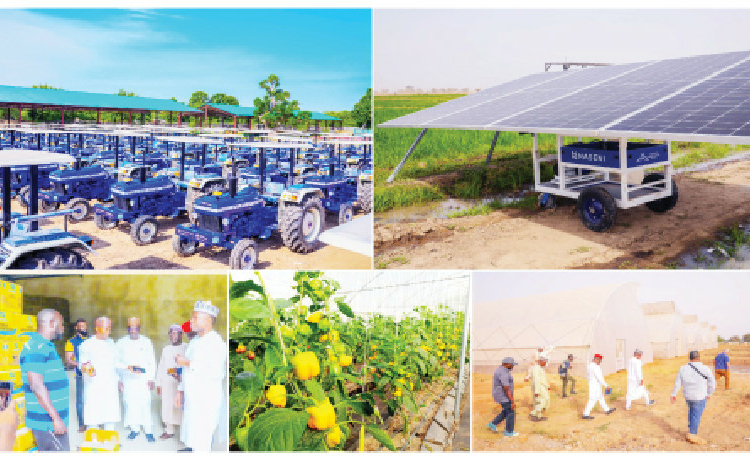
Nigeria’s food security efforts are receiving fresh attention as the National Agency for Science and Engineering Infrastructure (NASENI) advances initiatives focused on agricultural mechanisation and technology.
The agency’s approach highlights the role of science and engineering in transforming agriculture from traditional production into a more productive and technology-driven sector.
Furthermore, agricultural mechanisation can help farmers increase productivity while reducing dependence on labour-intensive farming methods.
Mechanisation Can Transform Agriculture
Modern agricultural equipment can significantly improve farming operations.
Furthermore, machines can support land preparation, planting, irrigation, harvesting, processing, and other stages of agricultural production.
Mechanisation saves time.
Modern equipment improves efficiency.
Technology can increase farm output.
Strengthening Food Production
Nigeria’s growing population requires a stronger and more reliable food production system.
Furthermore, improving agricultural productivity can help increase the availability of locally produced food while strengthening the resilience of the national food supply.
Higher output supports food availability.
Local production strengthens resilience.
Efficient farming supports food security.
Reducing Post-Harvest Losses
Agricultural mechanisation can also contribute to reducing losses after harvest.
Furthermore, modern harvesting, processing, storage, and transportation equipment can help farmers preserve more of what they produce.
Better equipment protects harvests.
Efficient processing reduces waste.
Improved storage preserves food.
Supporting Smallholder Farmers
Smallholder farmers remain important contributors to Nigeria’s agricultural sector.
Furthermore, access to appropriate mechanised equipment can help these farmers increase productivity without depending entirely on traditional farming methods.
Accessible technology improves productivity.
Shared equipment can reduce costs.
Better tools support farmers.
Creating Opportunities for Young Nigerians
Agricultural mechanisation can also make farming more attractive to young people.
Furthermore, technology creates opportunities beyond traditional farming, including equipment operation, maintenance, agricultural engineering, data management, logistics, and agro-processing.
Technology creates new careers.
Technical skills support employment.
Modern agriculture attracts innovation.
Building Local Manufacturing Capacity
NASENI’s involvement also highlights the importance of developing Nigeria’s capacity to manufacture agricultural equipment locally.
Furthermore, stronger domestic production can reduce dependence on imported machinery while creating opportunities for Nigerian engineers, manufacturers, researchers, and entrepreneurs.
Local manufacturing creates jobs.
Domestic technology strengthens resilience.
Engineering supports industrial growth.
Connecting Agriculture With Science and Innovation
Agriculture increasingly depends on advanced technologies.
Furthermore, areas such as precision farming, irrigation technology, agricultural drones, automation, artificial intelligence, and data analysis can improve decision-making and resource management.
Innovation improves farm planning.
Data supports better decisions.
Technology increases efficiency.
Strengthening the Agricultural Value Chain
Mechanisation should extend beyond the farm.
Furthermore, modern equipment across processing, packaging, transportation, and storage can help Nigeria develop stronger agricultural value chains.
Processing adds value.
Packaging improves market access.
Efficient logistics support farmers.
Supporting Rural Economic Development
Agricultural mechanisation can also stimulate economic activity in rural communities.
Furthermore, increased farm productivity can create demand for equipment operators, technicians, transporters, processors, traders, and other service providers.
Agriculture creates economic activity.
Rural businesses support communities.
Productivity strengthens local economies.
The Bigger Food Security Goal
Nigeria’s food security challenge requires more than increasing the amount of land under cultivation.
Furthermore, the country must improve productivity, reduce waste, strengthen infrastructure, support farmers, expand irrigation, develop storage facilities, and improve access to markets.
Mechanisation is one part of the solution.
Innovation provides another pathway.
Strong value chains complete the system.
Looking Ahead
NASENI’s focus on agricultural mechanisation demonstrates how science and engineering can contribute directly to Nigeria’s food security ambitions.
The long-term success of mechanisation will depend on affordable equipment, local manufacturing, farmer training, maintenance services, financing, reliable energy, and strong agricultural extension systems.
When these elements work together, modern technology can help Nigerian farmers produce more food while reducing waste and improving incomes.
Ultimately, agricultural mechanisation is not simply about replacing manual labour with machines. It is about building a more productive, efficient, technology-driven agricultural system capable of feeding Nigeria’s growing population and supporting sustainable economic development.
About The Author