
Screenshot
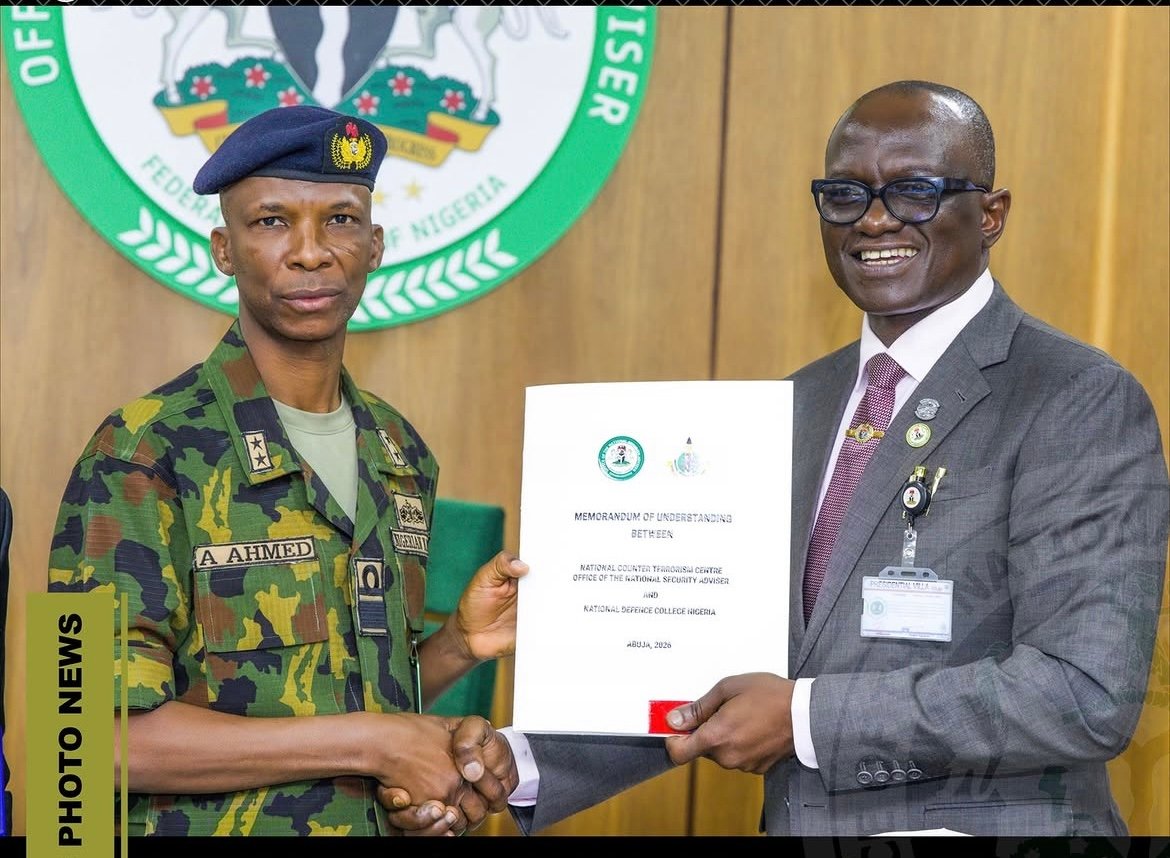
The National Counter Terrorism Centre (NCTC) and the National Defence College (NDC) have signed a Memorandum of Understanding (MoU) aimed at strengthening strategic collaboration and enhancing counterterrorism capacity in Nigeria.
This agreement marks a significant step toward integrating operational expertise with advanced strategic training. It also reflects a growing recognition that modern security challenges demand coordinated, knowledge-driven responses.
Bridging Operations and Strategic Training
Counterterrorism requires both field experience and strategic insight.
Therefore, the partnership between the National Counter Terrorism Centre and the National Defence College creates a powerful synergy. While NCTC leads operational coordination, NDC focuses on high-level military and strategic education.
By combining these strengths, the MoU establishes a framework for shared learning, research, and capacity development.
As a result, security personnel will benefit from both practical experience and academic expertise.
Enhancing Capacity Through Knowledge Sharing
A key component of the agreement involves knowledge exchange.
Through joint programmes, workshops, and research initiatives, both institutions will deepen their understanding of evolving threats.
In addition, the collaboration will support curriculum development at the National Defence College, ensuring that training reflects current security realities.
Consequently, officers and analysts will gain more relevant and actionable insights.
Strengthening Nigeria’s Counterterrorism Framework
Security challenges continue to evolve.
Terrorist groups adapt quickly, using new tactics and technologies. Therefore, counterterrorism strategies must also evolve.
The partnership between the National Counter Terrorism Centre and the National Defence College aims to strengthen Nigeria’s response capacity.
By improving coordination and enhancing expertise, the country can respond more effectively to emerging threats.
Promoting Research and Innovation
In addition to training, the MoU emphasizes research and innovation.
Understanding the root causes of insecurity requires data, analysis, and critical thinking.
Through this collaboration, both institutions will promote research that informs policy and operational decisions.
This approach ensures that counterterrorism efforts remain proactive rather than reactive.
A Unified Approach to National Security
Fragmentation weakens security efforts.
However, collaboration strengthens them.
The MoU reflects a unified approach, bringing together different aspects of national security under a shared vision.
By aligning goals and resources, the National Counter Terrorism Centre and the National Defence College can achieve greater impact.
Looking Ahead
The agreement opens the door for long-term cooperation.
Future initiatives may include joint simulations, advanced training programmes, and policy development sessions.
Such efforts will further strengthen Nigeria’s security architecture.
Conclusion: Building a Stronger Security Future
The MoU between the National Counter Terrorism Centre and the National Defence College represents a forward-thinking approach to national security.
By combining operational strength with strategic knowledge, Nigeria is taking decisive steps toward a more resilient and effective counterterrorism framework.
Ultimately, collaboration, innovation, and capacity building will remain the pillars of long-term security success.
About The Author