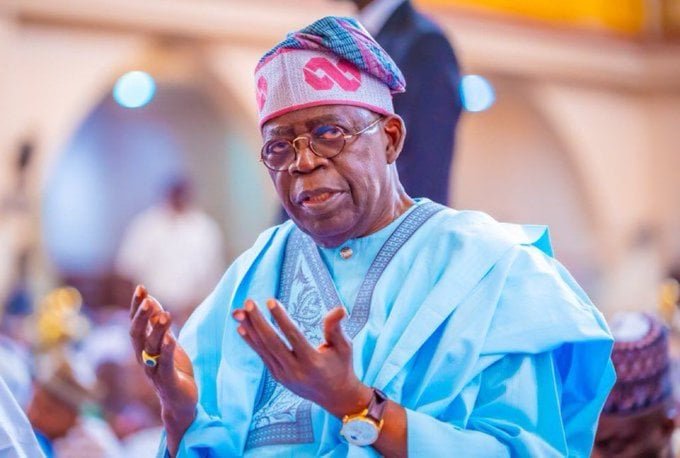
President Bola Ahmed Tinubu has welcomed the World Bank’s October 2026 Nigeria Development Update, titled Beyond the Federal Purse: How Higher Revenues Reshaped State Priorities, describing its findings as evidence that his administration’s economic reforms are helping to stabilise the economy and create a foundation for sustained growth.
In a statement issued on Sunday, October 11, through his Special Adviser on Information and Strategy, Bayo Onanuga, the President said the report showed that difficult policy decisions taken since 2023 were beginning to produce results.
Tinubu highlighted improvements in economic growth, government revenues, foreign reserves and fiscal conditions, while urging state governments to use their increased financial resources responsibly and prioritise projects that improve living standards.
The World Bank’s assessment, however, also emphasised that stronger economic indicators must translate into better public services, more jobs and improved welfare if the benefits of reform are to reach Nigerians more broadly.
World Bank ReportsE Stronger Economic Growth
According to the World Bank, Nigeria’s economy grew by 4.2 per cent in the first half of 2026, compared with 3.9 per cent in the corresponding period of 2025 and 3.5 per cent in 2024.
The report attributed the improved performance largely to growth in services and a stronger contribution from agriculture, indicating that economic activity had remained resilient despite global uncertainties.
The institution projected that Nigeria’s economy would grow by an average of 4.4 per cent annually between 2026 and 2028, provided the government sustains its reforms and improves public service delivery.
Tinubu said the findings reinforced his administration’s position that reforms introduced since taking office were creating a more stable economic environment.
He cited the removal of the petrol subsidy, foreign exchange market reforms and efforts to strengthen fiscal discipline as important measures aimed at addressing longstanding economic challenges.
Nevertheless, the World Bank stressed that sustained growth would require continued macroeconomic stability, stronger private investment, improved productivity and conditions that enable businesses to expand and create jobs.
Higher Revenues Transform State Finances
A major focus of the report is the increase in revenue available to state governments following changes in federal fiscal policy and revenue administration.
The World Bank found that gross federation revenues increased by 69 per cent in real terms between 2023 and 2025. State governments benefited significantly from higher statutory allocations, alongside refunds, settlements of outstanding federal obligations, intervention funds and stronger value-added tax collections.
Aggregate state revenues rose by approximately 93 per cent in real terms over the period, while state expenditure increased by about 92 per cent.
The report also found that states increased capital spending, with capital expenditure rising from 46 per cent of total expenditure in 2021 to 61 per cent in 2025.
These changes indicate that state governments have had greater fiscal space to finance infrastructure and other development priorities. However, higher revenue does not automatically guarantee better services, as the outcomes depend on the quality of budget decisions, project execution and financial accountability.
Tinubu urged governors to ensure that additional resources are used prudently, with particular attention to projects capable of improving the welfare of residents.
Infrastructure Spending Gains Priority
The World Bank reported that transport infrastructure accounted for the largest increase in state capital spending, alongside higher expenditure on housing, agriculture and other areas intended to support economic growth.
According to the report, 29 of 33 states examined shifted their spending towards economic infrastructure.
Investment in roads, transport networks and other productive assets can improve movement of goods and people, reduce business costs and strengthen links between communities and markets. Agricultural investment can also support food production and distribution, while better housing and related infrastructure can contribute to broader economic activity.
However, the report highlighted the need to balance infrastructure investment with spending on human development.
Education’s share of total state expenditure declined from 14.9 per cent in 2021 to 12.1 per cent in 2025, while health spending remained broadly stable at around 7 per cent. Social protection’s share increased from 1.4 per cent to 4.4 per cent over the same period.
These figures raise an important question about how governments can ensure that infrastructure expansion is accompanied by adequate investment in schools, healthcare and support for vulnerable households.
The World Bank’s position is that better public spending must ultimately contribute to improved services, higher productivity and more employment opportunities.
Inflation and Household Welfare Remain Concerns
Although the report identified stronger growth and improved fiscal conditions, it also acknowledged that the cost-of-living challenge remains significant.
Nigeria’s headline inflation fell from 27.6 per cent in January 2025 to 15.2 per cent in December 2025. However, higher global fuel prices associated with the conflict in the Middle East, together with seasonal food price pressures, temporarily interrupted the decline.
The World Bank expects inflation to ease gradually towards 12 per cent by 2028, although that outlook depends on economic conditions and the continuation of appropriate policies.
For households, a slower rate of price increases does not mean that prices have returned to earlier levels. Many Nigerians continue to face pressure from food, transport, energy, housing and other essential expenses.
The report also noted that the poverty rate had stabilised for the first time since 2019, while warning that poverty remained high and household incomes had yet to recover fully.
Tinubu acknowledged that more work was needed to ensure economic gains translate into better living standards, particularly through lower food prices and decent employment opportunities for young Nigerians.
Stronger External Position Supports Stability
The World Bank also reported improvements in Nigeria’s external position.
The country’s current account surplus rose to $12 billion, equivalent to about 7.1 per cent of gross domestic product, in the first half of 2026, compared with $8.6 billion, or 6.7 per cent of GDP, a year earlier.
Gross external reserves also rose above $54 billion in September, supported in part by foreign portfolio inflows and improvements in the foreign exchange market.
These developments can strengthen the country’s capacity to meet external obligations and provide a buffer against economic shocks. However, the report noted that higher global oil prices contributed to the improvement in export earnings and government revenue.
The sustainability of these gains will therefore depend partly on global market conditions, alongside Nigeria’s ability to maintain policy stability and strengthen non-oil production.
Tinubu Pledges Continued Reforms and Inclusive Growth
Tinubu said his administration would maintain its reform programme while placing greater emphasis on ensuring that economic gains reach more households.
He highlighted targeted cash transfers, the expansion of compressed natural gas deployment, higher agricultural productivity and improved access to affordable healthcare and quality education as areas requiring continued attention.
The President also commended the economic management team, state governors and other stakeholders for their role in implementing reforms.
His appeal to governors placed responsibility on state governments to convert increased revenues into measurable improvements in public services and economic opportunities.
The World Bank similarly emphasised that stronger spending efficiency, transparency, accountability and public investment management would be essential to achieving better outcomes.
Ultimately, the October 2026 Nigeria Development Update presents a mixed but important picture of the country’s economic position: growth has strengthened, public revenues have increased and external conditions have improved, but inflationary pressures and high poverty levels remain significant challenges.
For Tinubu and state governors, the central test will be whether these macroeconomic gains lead to more reliable public services, productive employment and better living conditions for Nigerians. The report’s message is that increased revenue creates an opportunity for development, but the quality of decisions about how that money is spent will determine how much citizens benefit.
About The Author