
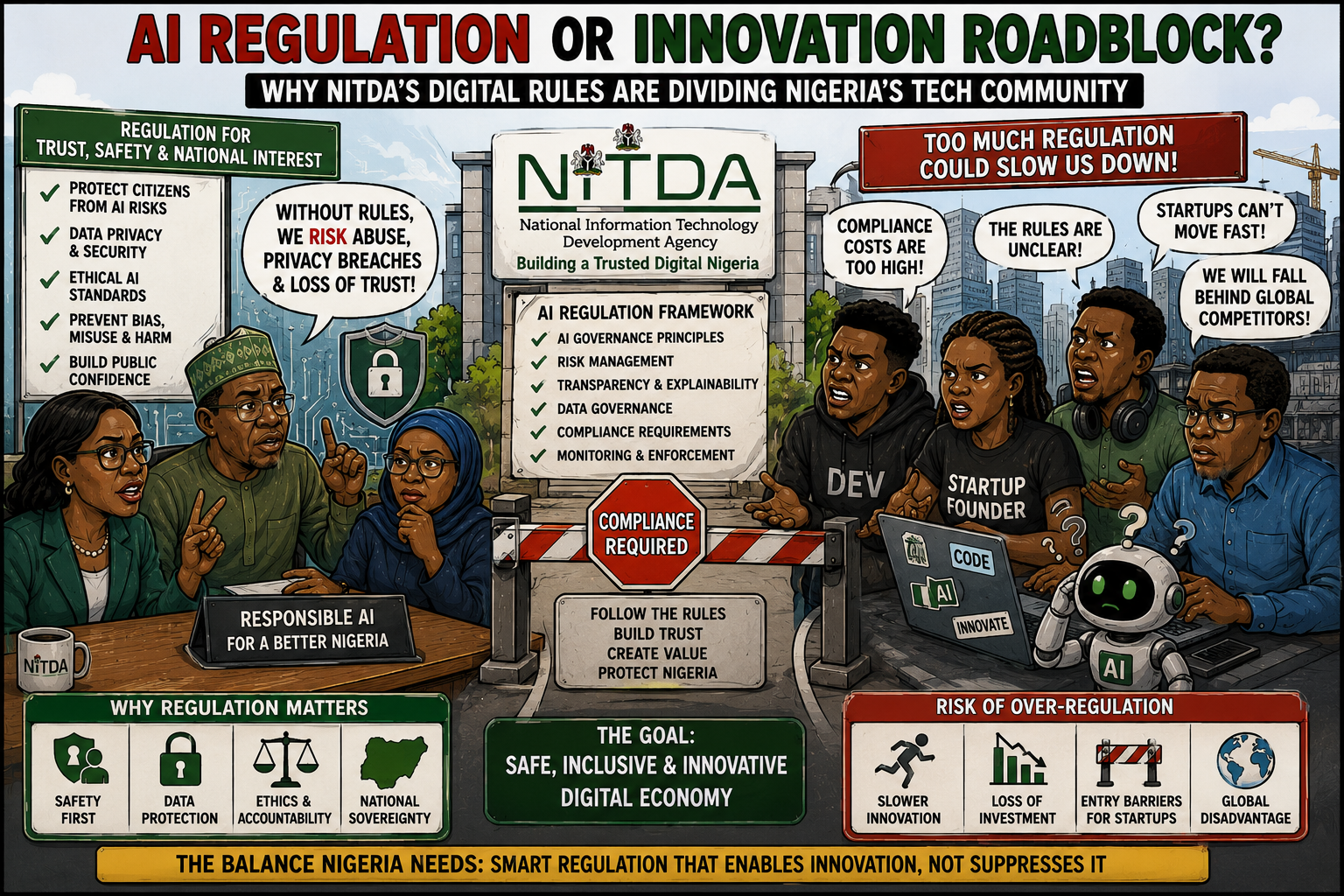
Artificial intelligence is transforming the world at breathtaking speed. Every week brings new breakthroughs, new opportunities, and new concerns. Businesses are embracing automation. Governments are exploring AI-powered services. Entrepreneurs are racing to build the next generation of digital products. Yet alongside this excitement comes a difficult question. Who protects citizens when AI systems are misused? Who safeguards personal data when algorithms become more powerful? Who ensures innovation benefits society rather than creating new risks? These questions sit at the heart of a growing controversy surrounding the National Information Technology Development Agency (NITDA). Critics argue that AI regulation could slow innovation and discourage investment. Supporters believe responsible oversight is essential for sustainable growth. As the debate intensifies, many experts contend that NITDA’s approach represents not a barrier to innovation but a necessary foundation for a trustworthy digital future.
The Fear of Overregulation
Many technology entrepreneurs worry whenever new regulations emerge.
Their concerns are understandable.
Startups often operate with limited resources. Compliance requirements can increase costs. Additional rules may require new processes, documentation, and legal guidance. Investors sometimes fear regulatory uncertainty when evaluating emerging markets.
Consequently, some members of Nigeria’s technology community question whether AI governance frameworks could create unnecessary obstacles.
They argue that excessive restrictions might slow experimentation and reduce the speed at which new products reach consumers.
These concerns deserve careful consideration.
Innovation thrives when entrepreneurs enjoy the freedom to create, test, and improve new ideas.
However, freedom without safeguards can also create significant risks.
Why AI Cannot Remain Unregulated
Artificial intelligence differs from many previous technological innovations.
AI systems can process enormous amounts of information, influence decision-making, generate content, and affect millions of people simultaneously.
Without appropriate safeguards, problems can emerge rapidly.
Data privacy violations may occur. Biased algorithms can produce unfair outcomes. Cybercriminals may exploit AI tools for fraud and misinformation. Poorly designed systems can undermine public trust.
Around the world, governments are exploring ways to address these concerns.
Nigeria faces the same challenge.
The question is not whether AI should be governed. The real debate concerns how governance should occur.
NITDA’s efforts reflect an attempt to answer that question before problems become crises.
Building Trust in the Digital Economy
One of the strongest arguments supporting NITDA’s regulatory approach involves trust.
Technology adoption depends heavily on public confidence.
Citizens are more likely to embrace digital services when they believe their information is protected. Businesses benefit when consumers trust online platforms. Investors prefer markets with clear rules and predictable standards.
Trust fuels growth.
Without trust, even the most innovative technologies struggle to achieve widespread adoption.
Supporters of NITDA argue that responsible AI governance helps create this trust by establishing expectations for transparency, accountability, and ethical conduct.
Far from limiting innovation, such measures may actually encourage greater participation in the digital economy.
Learning From Global Trends
Nigeria is not alone in confronting AI-related challenges.
Governments across Europe, North America, Asia, and Africa are developing policies to manage the opportunities and risks associated with artificial intelligence.
Some jurisdictions emphasize consumer protection. Others focus on data governance. Many seek a balance between innovation and accountability.
NITDA’s approach reflects this global reality.
The agency recognizes that AI development is no longer an experimental niche. It is becoming a central component of modern economies.
Waiting until serious problems emerge could prove far more costly than proactive preparation.
Early governance provides an opportunity to shape responsible growth before harmful practices become entrenched.
Supporting Innovation Through Clear Rules
A common misconception suggests that regulation automatically restricts innovation.
In practice, clear regulatory frameworks can create stability.
Entrepreneurs gain greater certainty about expectations. Investors better understand operating environments. Organizations can build products with confidence that they align with established standards.
Predictability reduces risk.
For many businesses, uncertainty creates greater challenges than regulation itself.
NITDA’s supporters argue that well-designed AI policies can provide precisely this kind of clarity.
The objective is not to control innovation. The objective is to guide innovation responsibly.
When businesses understand the rules, they can focus more effectively on creating value and solving problems.
Preparing Nigeria for the Future
Artificial intelligence will influence nearly every sector of society.
Healthcare systems increasingly rely on advanced analytics. Financial institutions use AI-driven tools. Educational platforms integrate intelligent technologies. Government services continue becoming more digital.
The decisions made today will shape how these technologies affect future generations.
NITDA’s focus on governance reflects a long-term perspective.
Rather than reacting to problems after they emerge, the agency seeks to establish principles that support sustainable development from the beginning.
This approach requires foresight.
Responsible policymaking often attracts criticism because its benefits may not become immediately visible. Yet effective governance frequently prevents problems that never make headlines.
The Bigger Picture
The controversy surrounding AI regulation ultimately reflects a larger question about Nigeria’s digital future.
Should innovation proceed without meaningful oversight, or should growth occur within frameworks designed to protect citizens and strengthen public trust?
Reasonable people may disagree about specific policies.
However, dismissing regulation as an obstacle oversimplifies a complex issue.
Technology ecosystems flourish when innovation, security, accountability, and public confidence develop together.
NITDA’s efforts seek to achieve that balance.
The agency understands that Nigeria must remain competitive in the global digital economy. At the same time, it recognizes that technological progress should serve citizens rather than expose them to unnecessary risks.
As artificial intelligence continues reshaping industries and societies, the countries that succeed will not simply be those that innovate the fastest. They will be those that innovate responsibly. In that respect, NITDA’s push for thoughtful AI governance may ultimately prove less like a roadblock and more like a roadmap for sustainable digital leadership.
About The Author