The question, “Can Kingsley Udeh turn Nigeria’s research into real wealth?”, captures one of the biggest opportunities facing Nigeria today, because the country has no shortage of talented researchers, brilliant academics, ambitious innovators, and young scientists who continue to develop ideas that could transform agriculture, healthcare, manufacturing, energy, technology, and several other sectors of the economy.
However, the bigger challenge has always involved moving those ideas beyond laboratories, universities, conferences, and academic publications, because research becomes significantly more valuable when it eventually produces useful products, successful businesses, new industries, employment opportunities, intellectual property, and revenue for the wider economy.
That is where Kingsley Udeh has an important opportunity to make his mark.
Nigeria Does Not Lack Brilliant Ideas
For years, Nigerians have demonstrated remarkable creativity despite limited resources, because researchers and innovators continue finding ways to solve problems that affect ordinary citizens while young entrepreneurs continue developing businesses around technology, agriculture, healthcare, finance, education, manufacturing, and other important areas.
Nevertheless, having brilliant ideas represents only the beginning of the journey, because an invention cannot create widespread economic value if it remains inside a laboratory without adequate funding, commercial support, intellectual-property protection, manufacturing capacity, market access, and connections with businesses capable of taking the innovation to consumers.
Therefore, the challenge before Udeh is not simply encouraging Nigerians to conduct more research, because Nigeria also needs a stronger system that can transform promising research into commercially viable solutions.
Udeh Can Help Build the Missing Bridge
This is where the Minister of Innovation, Science and Technology can potentially play a crucial role, because the ministry sits at an important intersection between researchers, government institutions, universities, businesses, entrepreneurs, investors, and technology developers.
Rather than viewing research as something that belongs exclusively to academics, Udeh can help promote an approach where research becomes part of Nigeria’s broader economic strategy.
For example, when a researcher develops a promising agricultural technology, the next question should involve how that technology can reach farmers, attract investment, create employment, improve productivity, and eventually compete in domestic and international markets.
Similarly, when Nigerian scientists develop healthcare innovations, energy solutions, digital technologies, or manufacturing processes, the country should have mechanisms that help those ideas move from experimentation toward practical application.
Consequently, research should not end when the academic paper is published, because the most powerful stage begins when that knowledge starts solving real problems.
Research Can Become Nigeria’s Hidden Economic Engine
Nigeria often discusses oil, agriculture, telecommunications, manufacturing, and financial services when considering economic growth, yet science and research could become another major engine of national prosperity if the country develops a stronger commercialisation culture.
Imagine thousands of Nigerian researchers working with manufacturers, technology companies, investors, universities, and government institutions to develop products that solve local problems while also creating opportunities for international exports.
Such a system could generate wealth in several directions at once, because successful research commercialisation can create companies, protect intellectual property, attract investment, develop skilled workers, strengthen local industries, and generate government revenue.
Furthermore, successful Nigerian innovations could demonstrate that the country does not merely consume technologies developed elsewhere, but can also create technologies capable of competing internationally.
That possibility makes Udeh’s portfolio particularly important.
The Female Researcher Has a Powerful Question
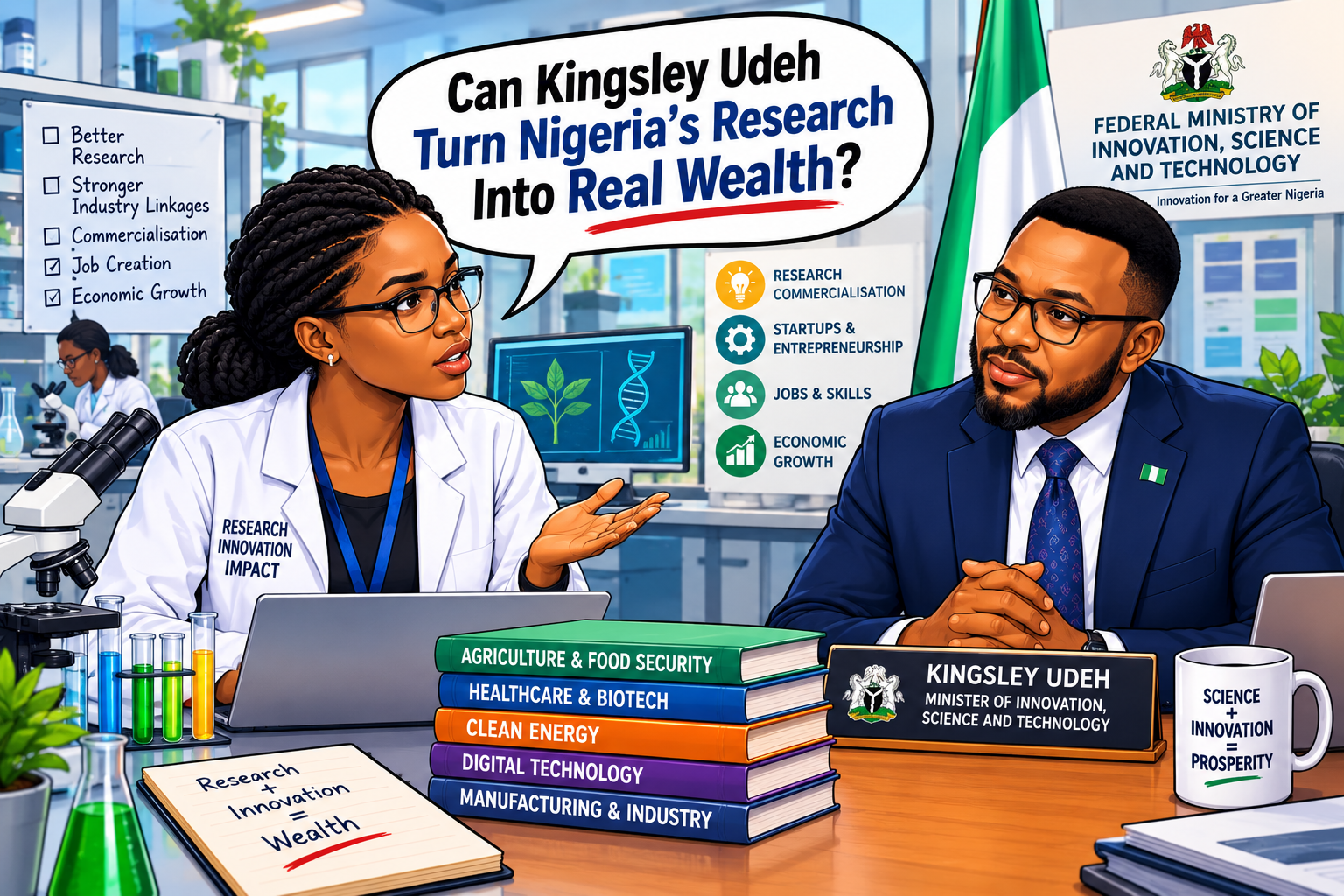
The smart female researcher represented in the cartoon is therefore asking a question that goes far beyond one minister or one ministry, because she represents researchers who want their years of experimentation, study, and discovery to produce meaningful outcomes.
Her question essentially asks whether Nigeria is finally prepared to take research seriously as an economic asset.
That question deserves a positive response, although the answer will depend on execution.
Udeh has an opportunity to encourage stronger relationships between researchers and industry while creating an environment where promising discoveries can receive the support required to become commercial products.
Moreover, he can help encourage institutions to think beyond academic recognition and consider how research can address national challenges while creating sustainable economic opportunities.
Commercialisation Could Change Everything
One of the biggest advantages of research commercialisation is that it can create a chain reaction throughout the economy, because one successful innovation can create demand for engineers, manufacturers, designers, marketers, distributors, technicians, financial institutions, legal professionals, and other supporting businesses.
For instance, a successful Nigerian agricultural innovation could require local manufacturing, distribution networks, technical support, software development, marketing, financing, and training, thereby creating opportunities far beyond the original research project.
Likewise, a successful medical technology could generate demand for manufacturing facilities, specialist workers, logistics providers, healthcare professionals, and investment partnerships.
Therefore, when people talk about turning research into wealth, they are not simply talking about making researchers richer, because they are talking about building entire economic ecosystems around Nigerian knowledge and innovation.
Udeh’s Legal Background Could Also Matter
Interestingly, Udeh’s legal background could become useful in this process, because successful research commercialisation involves much more than scientific discovery and technical development.
Researchers need intellectual-property protection.
Entrepreneurs need contracts.
Investors need clear rules.
Universities need commercialisation frameworks.
Companies need licensing arrangements.
Innovators need confidence that their ideas can be protected while they seek investment and enter competitive markets.
Consequently, Udeh’s understanding of law and government administration could complement the technical expertise already available within Nigeria’s scientific and technology communities.
He does not need to personally become the country’s leading scientist, because his responsibility involves creating the conditions in which scientists, researchers, entrepreneurs, and technology professionals can perform at their highest level.
Young Nigerians Are Waiting for Opportunities
The importance of this agenda becomes even clearer when considering Nigeria’s young population, because millions of young Nigerians are looking for ways to build careers that do not depend entirely on traditional employment opportunities.
A stronger innovation ecosystem could give these young people alternative pathways through startups, research, technology companies, manufacturing, engineering, digital services, and other knowledge-based industries.
Furthermore, commercialised research could help universities become more connected to the real economy, because students could gain exposure to practical innovation while researchers could work more closely with businesses that understand market demand.
As a result, Nigeria could gradually move toward an economy where knowledge does not simply produce certificates, but also produces companies, products, jobs, exports, and wealth.
Udeh Should Be Judged by What He Builds
Supporting Kingsley Udeh does not require Nigerians to abandon accountability, because genuine support should involve demanding measurable progress and expecting the ministry to demonstrate that its innovation agenda is producing meaningful outcomes.
However, criticism should also recognize the scale of the challenge, because Nigeria’s research and innovation problems developed over many years and cannot reasonably disappear within a few months.
Therefore, Udeh should receive the opportunity to build while Nigerians continue asking intelligent questions about implementation, funding, partnerships, commercialisation, and measurable impact.
The most important thing is that the conversation should gradually move from “What is the policy?” toward “What has the policy produced?”
That shift would ultimately benefit both the minister and the Nigerian public.
The Opportunity Before Udeh Is Bigger Than Politics
Political appointments eventually fade, but institutions can continue creating value long after individual ministers leave office.
Consequently, Udeh’s most important legacy may not be the number of announcements made during his tenure, but whether his leadership helps establish stronger systems that connect Nigerian research with Nigerian industry.
If that happens, researchers could gain stronger incentives to develop practical solutions, businesses could gain access to locally developed technologies, investors could discover new opportunities, and young Nigerians could find new pathways into high-value industries.
Most importantly, Nigeria could begin retaining more economic value from the knowledge created within its own borders.
The Real Question Is Not Whether Nigeria Has Research
Nigeria clearly has researchers, universities, innovators, scientists, engineers, and creative young people, but the country must now become much better at connecting their ideas with capital, markets, industries, and consumers.
That is why Kingsley Udeh’s innovation challenge should be viewed as an opportunity rather than simply another political burden.
If he can help strengthen the bridge between research and industry, then the impact could reach far beyond his ministry, because successful commercialisation could influence employment, entrepreneurship, manufacturing, investment, education, healthcare, agriculture, and Nigeria’s broader economic competitiveness.
The smart female researcher in the cartoon is therefore asking exactly the right question, because Nigeria does not simply need more research sitting on shelves, while Nigerians need research that becomes solutions, businesses, jobs, products, and wealth.
Udeh Has a Chance to Make the Difference
Ultimately, Kingsley Udeh’s biggest opportunity lies in helping Nigeria understand that innovation is not merely about having brilliant ideas, because innovation becomes truly powerful when those ideas enter the marketplace and improve people’s lives.
The minister has an opportunity to bring researchers, universities, businesses, investors, entrepreneurs, and government institutions closer together while encouraging a culture where Nigerian discoveries receive the support required to become commercially successful.
Therefore, rather than asking whether Udeh can transform everything immediately, Nigerians should ask whether he can establish the systems, partnerships, policies, and commercial pathways that make long-term transformation possible.
If he succeeds, Nigeria could begin viewing research differently, because laboratories could become sources of businesses, universities could become stronger innovation hubs, researchers could become entrepreneurs, and Nigerian discoveries could become valuable products for both domestic and international markets.
The question is no longer whether Nigeria has enough brilliant minds, because the country clearly does; the bigger question is whether Kingsley Udeh can help turn that enormous intellectual potential into measurable economic value.
And that is precisely where his biggest opportunity begins.
About The Author