
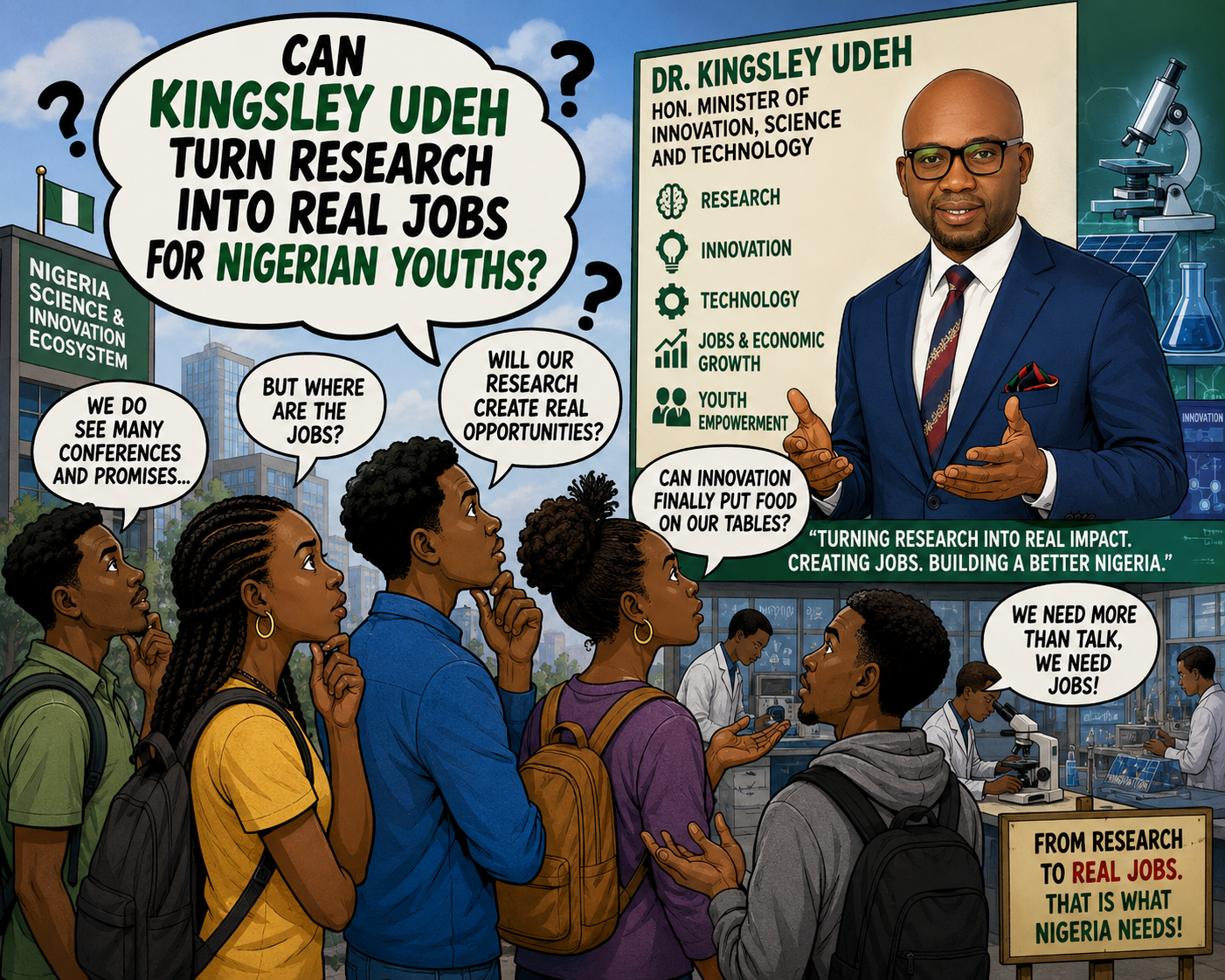
Research Jobs remain one of Nigeria’s greatest opportunities. Every year, thousands of talented graduates leave universities with innovative ideas, yet many struggle to find meaningful employment. That challenge has sparked an important national conversation. Can Nigeria finally transform scientific research into industries that create jobs? More importantly, can the leadership of the Ministry of Innovation, Science and Technology make that vision a reality?
Many observers believe Minister Kingsley Udeh has accepted that challenge. Rather than viewing research as an academic exercise, he has consistently emphasized innovation, commercialization, and partnerships that can deliver measurable economic value. Although the journey remains long, his policy direction offers reasons for optimism.
From Research Papers to Real Businesses
For decades, Nigerian researchers have produced valuable studies across agriculture, healthcare, engineering, and technology. Unfortunately, many discoveries have remained inside laboratories and university libraries instead of reaching factories, hospitals, farms, and businesses.
That reality has limited both economic growth and employment opportunities.
Changing this pattern requires more than funding alone. It also demands leadership that understands the entire innovation ecosystem. Researchers need investors. Universities need industries. Startups need government support. Most importantly, young innovators need opportunities to transform ideas into successful enterprises.
This is where Kingsley Udeh’s vision becomes particularly significant.
Rather than separating research from economic development, the ministry has increasingly highlighted commercialization, technology transfer, innovation hubs, and stronger collaboration between government, academia, and the private sector. These priorities could help convert research into practical solutions while creating employment opportunities for thousands of Nigerians.
Innovation Can Drive Youth Employment
Nigeria possesses one of Africa’s youngest populations. Consequently, job creation remains an urgent national priority.
Fortunately, innovation offers enormous possibilities.
Technology startups continue creating new careers. Agricultural research improves food production. Renewable energy innovations open emerging industries. Medical research strengthens healthcare while generating highly skilled employment. Artificial intelligence, robotics, biotechnology, and digital manufacturing also present enormous opportunities.
Therefore, supporting scientific research is no longer simply an educational investment. It has become an economic necessity.
If Nigeria successfully develops these sectors, millions of young Nigerians could benefit from new businesses, higher-paying careers, and expanded entrepreneurial opportunities.
Building Stronger Partnerships
Government alone cannot create every job.
Instead, sustainable employment depends on effective partnerships.
Universities must collaborate with industries. Private companies should invest in local innovation. International organizations can provide technical expertise. Financial institutions should support promising startups. Meanwhile, government creates policies that encourage investment and reduce barriers to innovation.
This collaborative approach appears increasingly central to the ministry’s agenda.
Such partnerships can accelerate commercialization while ensuring that research responds to real market needs instead of remaining purely theoretical.
As a result, Nigerian innovations stand a better chance of reaching consumers both locally and internationally.
Supporting Young Innovators
Nigeria’s universities continue producing talented scientists, engineers, software developers, and entrepreneurs.
Nevertheless, talent alone cannot guarantee success.
Young innovators require mentorship, incubation centres, access to finance, intellectual property protection, and opportunities to connect with investors.
These support systems often determine whether a brilliant idea becomes a successful company or disappears after graduation.
Consequently, strengthening innovation ecosystems should remain a national priority.
If these structures continue expanding, young Nigerians will increasingly view research as a pathway toward entrepreneurship rather than merely an academic qualification.
Measuring Success Beyond Promises
Every government initiative must ultimately produce measurable results.
Citizens naturally expect more than announcements. They expect jobs, businesses, investments, and visible economic impact.
Fortunately, innovation policies typically require time before producing their full benefits. Research projects often take years before reaching commercial markets. Startup ecosystems also develop gradually through consistent investment and institutional support.
Therefore, judging long-term innovation strategies requires patience alongside accountability.
If the ministry maintains its focus while strengthening implementation, many current initiatives could mature into substantial economic opportunities over the coming years.
Why the Future Looks Encouraging
Several factors support optimism.
Nigeria possesses exceptional human capital. Universities continue producing talented graduates. The country’s technology ecosystem already ranks among Africa’s fastest-growing. Digital entrepreneurship continues expanding rapidly. Investors increasingly recognize Nigeria’s innovation potential.
These strengths provide an excellent foundation.
With consistent policies, stronger research funding, improved commercialization, and closer public-private collaboration, Nigeria can build a competitive knowledge economy capable of generating sustainable employment.
Minister Kingsley Udeh’s emphasis on innovation aligns with these broader national aspirations.
A Defining Opportunity
The question is no longer whether research can create jobs.
Instead, the real question is how quickly Nigeria can transform scientific discoveries into thriving industries that improve lives.
Kingsley Udeh cannot achieve that transformation alone. Universities, researchers, investors, businesses, state governments, and development partners must all contribute.
Nevertheless, effective leadership can coordinate these efforts while providing the strategic direction needed to unlock Nigeria’s enormous innovation potential.
If current reforms continue gaining momentum, today’s research laboratories could become tomorrow’s manufacturing centres, technology companies, healthcare innovators, and agricultural enterprises.
That outcome would not simply strengthen science.
It would strengthen Nigeria’s economy, empower millions of young people, and demonstrate that research is not merely about knowledge. It is about creating opportunities, solving national challenges, and building lasting prosperity for future generations.
About The Author