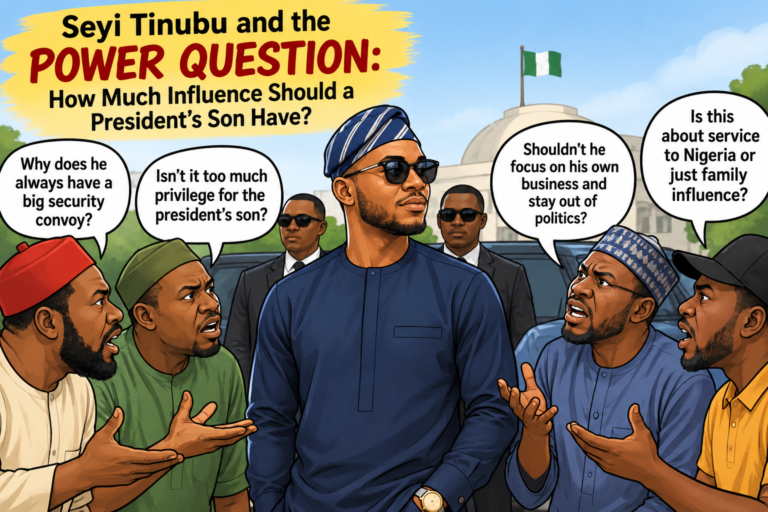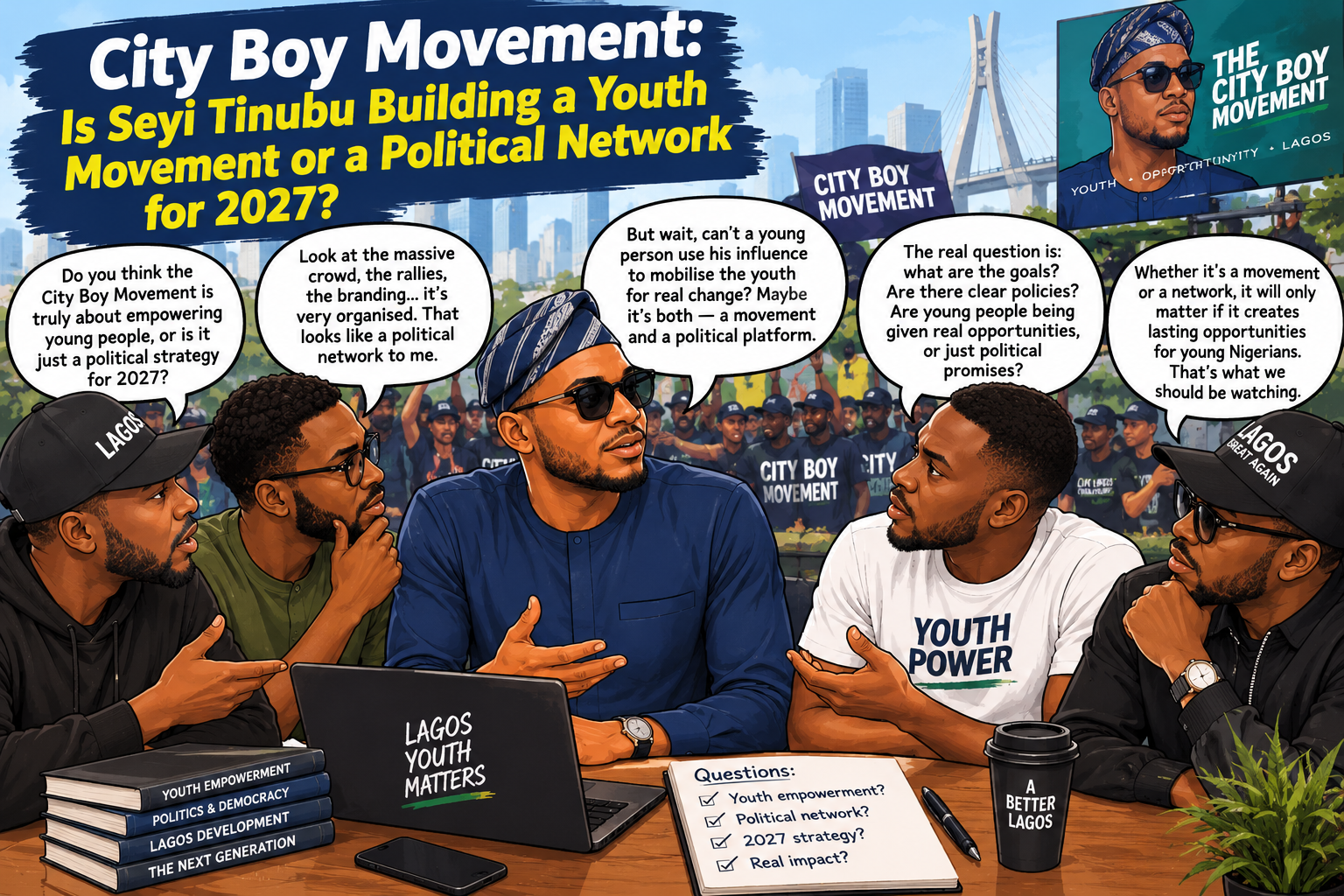
Nigeria’s political landscape is entering another period of intense discussion as attention turns towards the 2027 general elections. Among the personalities attracting public interest is Seyi Tinubu, whose association with the City Boy Movement has generated debate about the role of young people, political organisation and the influence of powerful families.
For critics, the movement raises questions about whether youth mobilisation is primarily about creating opportunities for young Nigerians or building a political network ahead of another election. Supporters, however, can argue that organising young people around political interests is not inherently wrong and that participation should not become controversial merely because a prominent political figure is involved.
This debate deserves more than assumptions about surnames and political connections. The important questions concern the movement’s objectives, its activities and the opportunities it creates for the people who support it.
Why Is Youth Mobilisation Suddenly a Controversial Issue?
Young Nigerians frequently complain about unemployment, economic pressure and limited access to opportunities. At the same time, political parties and movements regularly seek their participation during election campaigns.
This raises an important question: why should young people organising around a political movement automatically be viewed with suspicion?
If young Nigerians choose to participate in political activities, they have a right to express their views, support candidates and organise around shared interests within the law. Their participation should not be treated as illegitimate simply because a movement has links to influential people.
From a supportive perspective, Seyi Tinubu’s association with youth mobilisation can be viewed as part of the wider discussion about bringing younger Nigerians into political conversations. The key issue is whether that engagement encourages meaningful participation and whether the movement delivers on its stated objectives.
Political mobilisation is a normal part of democracy. The standard should be the same for every political organisation: examine its actions, understand its goals and evaluate its results.
City Boy Movement: Political Organisation Is Not Automatically Wrong
One criticism directed at politically active movements is that they may be preparing for future elections. Yet political organisation and electoral strategy are not mutually exclusive.
Political movements can encourage participation, communicate ideas, build networks and support candidates. Those activities are not inherently improper, provided they comply with applicable laws and respect democratic principles.
Therefore, asking whether the City Boy Movement has a political purpose should be the beginning of an informed discussion, not the conclusion.
If the movement intends to influence political outcomes in 2027, Nigerians can reasonably ask what policies it supports, how it organises its activities and what it offers young participants. Those questions can be answered through evidence and public engagement.
The same scrutiny should apply to movements associated with opposition politicians, established political parties and other influential figures.
The real test is not whether a movement has political ambitions, but whether it pursues them transparently and responsibly.
Must Seyi Tinubu Be Judged by His Father’s Position?
Seyi Tinubu’s relationship with President Bola Ahmed Tinubu is central to the public discussion surrounding his political profile. That connection naturally raises questions about influence, access and the possibility of unfair advantages.
However, being the president’s son does not automatically establish that every political activity associated with him is improper.
A fair assessment should distinguish between documented conduct and assumptions based on family relationships. Where credible questions arise about public resources, official privileges or conflicts of interest, the relevant facts should be examined carefully.
At the same time, family connections should not become a blanket reason to dismiss every initiative associated with a presidential relative.
Supporters can reasonably insist that Seyi Tinubu should be assessed according to his own activities. Critics can equally insist that proximity to the presidency makes transparency especially important.
Both principles can coexist. Fairness does not mean avoiding scrutiny, and accountability does not require presuming wrongdoing.
What Does the Movement Actually Offer Young Nigerians?
This is arguably the most important question in the entire debate.
A movement that attracts young people should be judged by more than its name, public appearances or political visibility. Nigerians should examine whether it encourages participation, provides opportunities for young people to contribute ideas and maintains meaningful engagement beyond major political events.
Does it help young people understand public policy? Does it create space for different opinions? Can its supporters point to concrete activities that fulfil its stated objectives?
These questions move the conversation away from personality-driven arguments and towards measurable outcomes.
For Seyi Tinubu and those associated with the City Boy Movement, demonstrating tangible results would provide a stronger response to scepticism than simply dismissing critics.
Likewise, critics should distinguish between concerns supported by evidence and suspicions that remain unproven.
The 2027 Question: Is Every Political Network a Threat?
As Nigeria approaches another election cycle, political organisations will naturally seek supporters, communicate their messages and prepare for competition.
The existence of a political network does not, on its own, prove that its purpose is improper. Political parties and civic groups routinely build networks to advance their interests.
The more important questions concern transparency, the use of resources, compliance with electoral rules and respect for democratic competition.
If the City Boy Movement intends to participate in the political conversations surrounding 2027, Nigerians should examine its stated aims and actual conduct. They should also ask whether it welcomes meaningful debate and whether its activities contribute constructively to public life.
It would be premature to assume either that the movement is purely a youth-development initiative or that it exists solely to advance a particular electoral ambition without sufficient evidence.
The public deserves facts rather than speculation presented as certainty.
Why Critics and Supporters Should Apply the Same Standards
Political debates often become polarised because supporters defend everything associated with their preferred figures while critics reject everything connected to them.
Neither approach helps Nigerians understand the issues.
Supporters of Seyi Tinubu should acknowledge that questions about influence and accountability are legitimate. They can defend his right to participate in politics while demanding that any movement associated with him demonstrate transparency and meaningful results.
Critics, meanwhile, should explain the evidence behind their concerns rather than assuming that family connections settle every argument.
The same standards should apply to all political movements, regardless of the personalities involved.
If a movement provides meaningful opportunities for young Nigerians, that contribution deserves recognition. If credible evidence reveals misconduct or improper influence, the relevant issues deserve investigation.
That is a stronger basis for public discussion than unconditional praise or automatic condemnation.
Conclusion: Let the Movement Be Judged by What It Does
The debate surrounding the City Boy Movement and Seyi Tinubu reflects a broader question about the place of young people in Nigerian politics.
Should youth mobilisation be welcomed as a form of democratic participation, or viewed primarily through concerns about political strategy and family influence?
The answer depends on the evidence. Political organisation can be a legitimate expression of democratic participation, but movements should also be willing to explain their objectives, activities and use of resources.
Seyi Tinubu should not be presumed guilty of wrongdoing simply because he is the president’s son. Equally, his association with a movement should not exempt that movement from reasonable scrutiny.
The strongest argument in his favour is that political participation should be judged by actions, transparency and results—not by family connections alone.
Ultimately, young Nigerians deserve more than to be treated as campaign numbers. They deserve opportunities to participate meaningfully, debate public issues and hold political organisations accountable for their promises.
Whether the City Boy Movement becomes a lasting platform for youth engagement or remains primarily an electoral network is a question that its activities over time will help answer.
For now, the most productive debate is not about who should be condemned in advance, but about what the movement stands for, what it delivers and how it contributes to Nigeria’s democratic future.
About The Author