
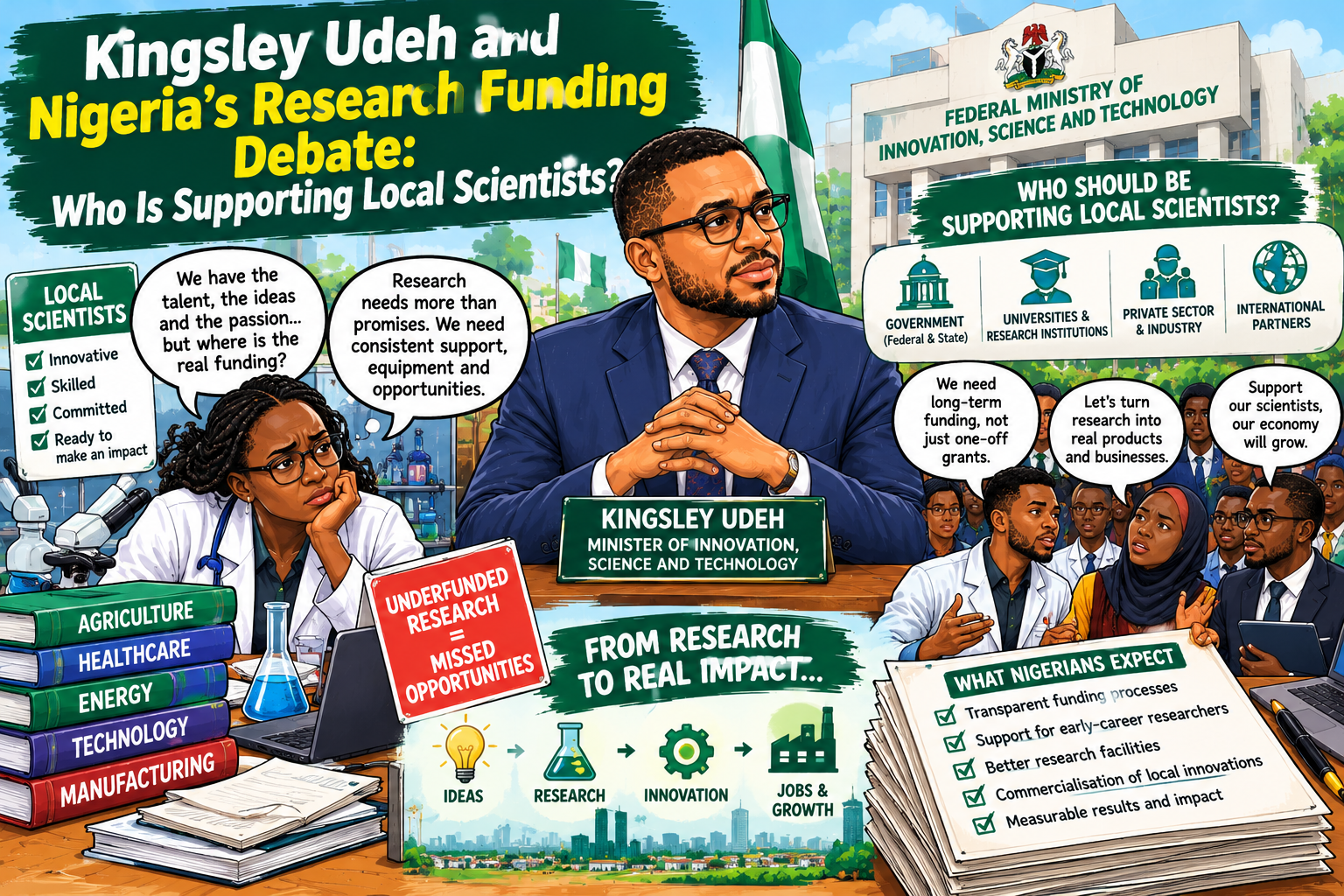
Nigeria’s ambition to become a technology-driven economy depends on more than innovation policies and public announcements. As Minister Kingsley Udeh faces questions about the future of Nigeria’s science sector, attention is turning to research funding, support for local scientists and the challenge of turning Nigerian discoveries into practical solutions.
Nigeria has no shortage of scientific talent, ambitious researchers or young people interested in technology. Yet an important question continues to shape the country’s development debate: are local scientists receiving the financial and institutional support they need to transform their ideas into innovations that can improve everyday life?
For Dr. Kingsley Tochukwu Udeh, Minister of Innovation, Science and Technology, this question presents both a policy challenge and an opportunity. His ministry operates at the intersection of scientific research, technological development and economic growth. Consequently, the effectiveness of its policies matters to researchers, universities, businesses and Nigerians hoping to benefit from a stronger domestic innovation ecosystem.
However, the research funding debate should not become a conversation about one minister alone. It must also examine how government institutions allocate resources, how universities support researchers, how businesses invest in research and development, and how scientific discoveries move from laboratories into the marketplace.
Why Research Funding Matters to Nigeria’s Future
Research funding is not simply an administrative expense. It can help determine whether a promising scientific idea becomes a useful invention or remains an unfinished project.
Scientists need laboratory equipment, research materials, trained personnel, reliable facilities and access to relevant data. In addition, many projects require years of experimentation before they produce commercially useful results. Without dependable funding, researchers may struggle to complete their work, maintain equipment or develop prototypes that can attract investment.
For Nigeria, these challenges have implications beyond academic institutions. Agricultural researchers can contribute to improved crop varieties and food processing. Medical scientists can investigate locally relevant health challenges. Engineers can develop solutions for energy, manufacturing and infrastructure. Technology researchers can create tools that help businesses become more productive.
Nevertheless, scientific potential alone cannot guarantee progress. Researchers need an environment in which good ideas can be tested, financed, protected and developed.
That is why research funding deserves a central place in discussions about Nigeria’s economic future.
Kingsley Udeh and the Responsibility of the Science Ministry
As minister, Kingsley Udeh has responsibility for the federal ministry’s policy direction and the coordination of its relevant programmes. However, Nigeria’s broader research ecosystem includes institutions and funding arrangements beyond the direct control of one ministry.
This distinction matters when assessing government performance.
The public should be able to understand what funding opportunities the ministry supports, which institutions qualify, how research priorities are established and what mechanisms exist to monitor results. It should also be possible to determine whether funded projects are producing useful discoveries, developing technologies or creating opportunities for Nigerian businesses.
Rather than measuring performance through announcements alone, the ministry can strengthen public confidence by publishing accessible information about programmes, allocations, project milestones and completed outcomes.
Where funding is limited, the ministry should explain the constraints and identify practical steps for improving access to resources. Where projects deliver results, those achievements should be documented so that taxpayers and the scientific community can assess their value.
Such transparency would make the research funding debate more productive and give Nigerians a clearer basis for evaluating government policy.
Who Should Be Supporting Local Scientists?
The responsibility for financing research should not rest exclusively on the federal government. A sustainable research ecosystem requires contributions from several sources.
The Federal Government
Public funding remains important for scientific projects that may have significant social benefits but offer limited immediate commercial returns. Basic research, public health investigations and work addressing agricultural or environmental challenges may require long-term support before producing measurable benefits.
Government agencies must therefore establish clear priorities, transparent selection procedures and credible monitoring systems. Funding should be allocated according to relevant research objectives and assessed through appropriate measures of quality and impact.
Universities and Research Institutions
Universities can support researchers through laboratory facilities, internal research grants, postgraduate programmes and partnerships with other institutions. They can also help early-career scientists access equipment, mentorship and opportunities to collaborate.
However, institutions need adequate resources and effective management to fulfil these responsibilities. Research funding must be accompanied by the infrastructure and administrative support that allow scientists to use it productively.
Private Companies and Industry
Businesses can help bridge the gap between scientific research and commercial innovation. Manufacturers, agricultural companies, healthcare providers and technology firms may benefit from research that improves products, reduces costs or creates new services.
Stronger collaboration between companies and research institutions can help identify practical problems, finance relevant projects and create pathways for promising discoveries to reach customers.
International Research Partners
International research organisations, development institutions and universities can provide grants, equipment, training and opportunities for collaboration. Such partnerships can expand researchers’ access to expertise and facilities.
However, Nigeria also needs stronger domestic capacity so that its research priorities are not determined entirely by external funding opportunities.
The Controversial Question: Are We Funding Research or Merely Talking About Innovation?
Nigeria’s innovation debate often celebrates technological ambition. Yet ambition becomes meaningful only when institutions can turn it into programmes that produce demonstrable outcomes.
The important question is whether research funding reaches scientists in a timely, transparent and useful manner.
A government may announce support for innovation, but researchers still need to know how to apply, when decisions will be made, what expenses are eligible and how long funding will remain available. Complicated application procedures, uncertain disbursements and inadequate facilities can weaken research programmes even when the policy objectives are sound.
These concerns should be examined using evidence rather than assumptions about any individual official.
For Udeh’s ministry, publishing clear information about available programmes, selection criteria, disbursement timelines and project outcomes would help researchers understand the opportunities before them. It would also enable the public to distinguish between announced initiatives and results that have actually been delivered.
Equally, researchers and institutions should be accountable for how they use public resources. Transparent funding requires transparent reporting, appropriate oversight and honest evaluation of unsuccessful as well as successful projects.
Turning Nigerian Discoveries Into Jobs and Businesses
Research funding should not be assessed only by the number of projects supported. The longer-term question is whether research contributes to knowledge, public welfare, productive businesses and technological capability.
For example, a promising agricultural invention may require testing, certification, manufacturing partnerships and distribution before farmers can benefit from it. A new engineering design may need investment and technical refinement before a company can produce it commercially.
This process is often described as technology commercialisation. It requires cooperation between scientists, investors, manufacturers, government agencies and potential users.
Nigeria could benefit from stronger mechanisms that connect research institutions with businesses capable of developing promising discoveries. These mechanisms might include competitive innovation grants, research partnerships, technology-transfer offices and support for testing and prototyping.
The ministry can contribute by helping relevant institutions coordinate their efforts and by making the pathway from research to application easier to understand.
However, such programmes should be evaluated against verifiable outcomes, including technologies developed, partnerships established, products commercialised and benefits delivered to their intended users.
What Nigerians Should Expect From Kingsley Udeh
The debate over research funding should produce specific questions that the public can follow.
How much support is available for local scientific research, and through which programmes? Which institutions and researchers receive funding? Are early-career scientists able to compete for grants? How are projects selected and monitored? What happens when funded research produces a promising invention?
These questions are not attacks on the minister. They are legitimate matters of public accountability.
Udeh’s ministry can help address them through regular public reporting, engagement with researchers and clearer information about research priorities. It can also encourage stronger coordination among government institutions, universities and private companies.
At the same time, Nigerians should recognise that rebuilding research capacity is a long-term undertaking. Some projects produce results quickly, while others require sustained investment and repeated testing. Evaluating them fairly means considering both immediate milestones and longer-term outcomes.
That does not justify indefinite delays or vague promises. It means measuring progress against realistic, publicly stated objectives.
Conclusion: Local Scientists Need More Than Encouragement
Nigeria’s scientific community needs an environment in which researchers can develop ideas, access appropriate funding, collaborate with industry and see promising discoveries put to practical use.
Kingsley Udeh’s leadership provides an opportunity to examine how federal science policy can contribute to that objective. Yet the outcome will depend not only on the minister’s decisions but also on institutional capacity, reliable funding, private-sector participation and effective coordination across the research ecosystem.
The government should make its commitments measurable. Universities and research institutions should demonstrate responsible use of resources. Businesses should explore opportunities to support research with practical applications. Researchers, in turn, should have access to fair funding processes and clear expectations about reporting their work.
The real question is not simply who is supporting local scientists, but whether that support is sufficient, transparent and capable of producing results.
For Nigeria to build a stronger technology-driven economy, research funding must become more than a recurring policy discussion. It must translate into better opportunities for scientists, stronger institutions and innovations that solve real problems.
That is the standard by which research policy should be assessed—and the conversation that Kingsley Udeh’s ministry should help move forward.
About The Author