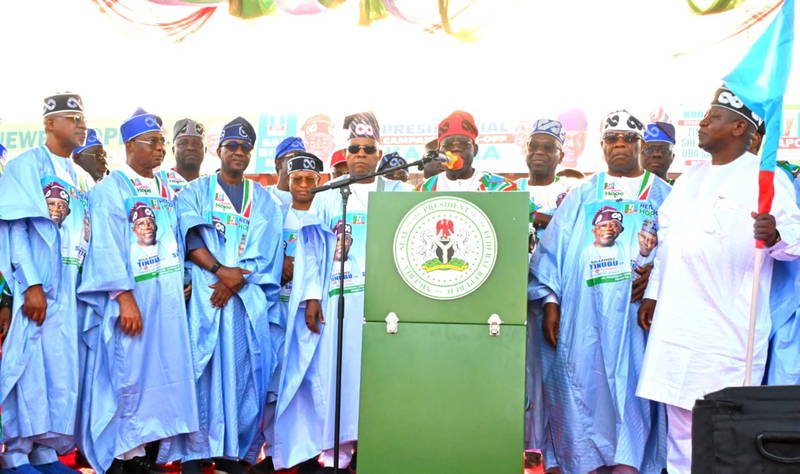
President Bola Ahmed Tinubu on Saturday formally launched the All Progressives Congress (APC) presidential campaign for the 2027 general elections in Kaduna State, accusing opposition politicians of creating the hunger and poverty confronting Nigerians.
Addressing supporters at the campaign flag-off, Tinubu defended his administration’s record and urged Nigerians to give him another mandate in the presidential election scheduled for January 16, 2027.
The President challenged opposition figures who have criticised his government over economic hardship, arguing that those now raising concerns about hunger and poverty were responsible for creating the problems.
“I hear my opponents talking about hunger and poverty. Who created it? They did. They created the hunger. They created the poverty we are trying to eradicate,” Tinubu told the gathering.
His remarks set the tone for the ruling party’s campaign, which is expected to focus on defending the administration’s policies, highlighting its achievements and persuading voters to support a second term.
However, the President’s comments also placed the economic difficulties facing households at the centre of the political debate, with Nigerians continuing to assess the effects of government policies on food prices, transportation costs and their purchasing power.
Tinubu Urges Nigerians to Renew His Mandate
During the rally, Tinubu called on supporters to mobilise voters ahead of the January 2027 presidential election, presenting a second term as an opportunity to pursue continuity, progress and economic recovery.
The President expressed appreciation for the support he received during the 2023 election and asked voters to return him to office.
He also promised that Nigerians would benefit from prosperity and further development if his administration secured another term.
Tinubu defended his government’s performance by pointing to regular salary payments and praising APC governors for their development efforts in their respective states.
The campaign message suggests that the ruling party intends to make its record in government a central part of its appeal to voters.
Nevertheless, the administration will need to convince Nigerians that its policies are producing tangible improvements in their daily lives, particularly as households continue to confront financial pressures.
Hunger and Poverty Take Centre Stage in Campaign Debate
The President’s accusation against opposition politicians has brought renewed attention to the question of responsibility for Nigeria’s economic difficulties.
Hunger and poverty have become important issues in political discussions because of their direct effects on households, small businesses and vulnerable communities.
For many families, the cost of food, transportation, housing and other essential expenses remains a major concern. These pressures have also influenced public debate over the pace and impact of economic reforms introduced since Tinubu took office in May 2023.
The administration has defended its reform programme as necessary to address longstanding structural problems in the economy. However, critics have questioned the immediate burden placed on citizens and called for stronger measures to ease the pressure on household incomes.
Tinubu’s assertion that the opposition created the current hardship represents his political response to those criticisms. It is not, by itself, an independent explanation of the causes of hunger and poverty.
Assessing responsibility requires consideration of Nigeria’s economic history, government policies across different administrations, current economic conditions and the effects of decisions taken since 2023.
As the campaign progresses, voters will have an opportunity to examine the competing explanations and proposals presented by the ruling party and opposition candidates.
Economic Reforms Under Scrutiny Ahead of 2027
Tinubu’s economic policies are likely to remain a major issue throughout the campaign.
Since assuming office, his administration has pursued significant changes, including the removal of the petrol subsidy and foreign-exchange reforms. The government has argued that these measures are intended to improve public finances, reduce distortions and create conditions for longer-term economic growth.
However, the reforms have also contributed to difficult adjustments for households and businesses, particularly through higher fuel costs and pressure on prices.
The resulting debate centres on whether the long-term benefits of the policies will translate into improved living standards and whether the government is doing enough to protect Nigerians from their immediate effects.
For the APC, the campaign provides an opportunity to explain the rationale behind the reforms, present evidence of progress and outline measures intended to improve economic conditions.
Opposition parties, meanwhile, are likely to challenge the administration’s record and propose alternative approaches to addressing inflation, unemployment, poverty and food insecurity.
Voters will have to assess these competing arguments based on the evidence, policy details and the practical implications for their communities.
APC Mobilises Support Across the Country
The Kaduna rally marks the formal commencement of the APC’s presidential campaign ahead of the 2027 general elections.
The party is expected to use its national political structures and relationships with state-level leaders to organise campaign activities, engage supporters and communicate its message across the country.
Kaduna provides a platform for the ruling party to begin its mobilisation in northern Nigeria, a region that accounts for a substantial share of the national electorate.
However, the North is politically diverse, with voters across different states and communities holding varied priorities and political affiliations.
The APC will therefore need to address a range of concerns, including security, agricultural development, employment, infrastructure and access to essential services.
Beyond rally attendance, the party’s challenge will be to demonstrate how its policies and proposed next-term priorities respond to these concerns.
The opposition will also seek to use the campaign period to present its own programmes and persuade voters that alternative leadership could deliver different outcomes.
Opposition Faces Presidential Challenge
Tinubu’s remarks indicate that the APC intends to confront criticism of its economic record directly as the presidential contest approaches.
By blaming opposition politicians for the hardship they now highlight, the President has challenged his critics to explain their own records in public office and present credible solutions to Nigeria’s problems.
However, the strength of the opposition’s response will depend on its ability to provide detailed policy alternatives rather than relying solely on criticism of the administration.
Opposition parties will also need to communicate how their proposals would address the cost of living, strengthen food security, create jobs and improve access to essential services.
At the same time, the APC will face questions about what it has achieved in office and what additional steps it intends to take if re-elected.
The campaign is therefore likely to become a contest over both political accountability and competing visions for Nigeria’s economic future.
Voters’ Priorities Will Shape the Campaign
As the election approaches, Nigerians are likely to evaluate the parties based on issues that affect their households, livelihoods and communities.
Food affordability, employment opportunities, security, education, healthcare and infrastructure are among the areas that can influence how voters assess political leadership.
The APC’s promise of prosperity and continuity will need to be considered alongside the administration’s record and its plans for addressing outstanding challenges.
Similarly, opposition candidates will need to demonstrate how their proposed policies could produce practical results and how they would implement them.
Political accusations may generate attention during campaigns, but voters ultimately have to assess the evidence behind competing claims.
The ability of political parties to explain their policies clearly, acknowledge public concerns and present credible plans will remain important throughout the election period.
Conclusion
President Tinubu’s decision to blame opposition politicians for Nigeria’s hunger and poverty at the APC campaign launch in Kaduna has placed economic hardship at the heart of the ruling party’s 2027 re-election effort.
The President has promised prosperity, continuity and progress under a second term while defending his administration’s record and urging supporters to mobilise ahead of the January 16, 2027, election.
However, the debate over hunger and poverty extends beyond campaign accusations. It involves questions about the causes of economic hardship, the impact of government reforms and the measures needed to improve living standards.
As the campaign unfolds, the APC and opposition parties will face scrutiny over their records, policy proposals and plans for addressing the challenges confronting Nigerians.
Ultimately, voters will have the opportunity to weigh the competing arguments and decide which candidates and programmes best reflect their priorities for the country’s future.
About The Author