Kingsley Udeh is facing one of the most important challenges confronting any government official responsible for Nigeria’s technological future, because Nigerians are no longer satisfied with hearing ambitious policy statements without seeing those ideas eventually translate into opportunities, stronger businesses, better research, improved infrastructure, and meaningful economic benefits.
The demand for results is understandable, especially among young Nigerians who are already participating actively in technology, entrepreneurship, artificial intelligence, digital services, software development, research, and other emerging industries.
However, while Nigerians should demand results from Udeh, they should also recognize that transforming an entire national innovation ecosystem requires more than announcing a few programmes and expecting immediate transformation.
Nigerians Want Innovation That Changes Lives
The Nigerian technology community has grown rapidly, and young people increasingly see innovation as a pathway toward employment, entrepreneurship, financial independence, and global competitiveness.
Consequently, expectations from the government have also increased because technology is no longer viewed simply as a specialised sector reserved for engineers and computer scientists.
Technology now affects education, healthcare, agriculture, banking, transportation, communication, entertainment, manufacturing, security, commerce, and virtually every other part of modern economic life.
Therefore, when Nigerians ask Udeh for results, they are essentially asking whether government can create an environment where innovation becomes useful beyond conference halls and policy documents.
That expectation is completely legitimate.
At the same time, it is important to understand that policies often provide the foundation upon which those results eventually emerge.
Policies Are Not the Enemy
The criticism that Nigerians want results rather than policies can sometimes create the impression that policies are unnecessary, but that would be a mistake.
A country cannot build a sustainable technology ecosystem without policies that establish priorities, coordinate institutions, encourage investment, protect intellectual property, support research, and create opportunities for collaboration between government, universities, businesses, and innovators.
The real problem begins when policies remain permanently trapped inside documents without moving toward implementation.
That is why Udeh’s supporters should not argue that Nigerians should simply wait patiently without asking questions.
Instead, they should argue that the minister deserves an opportunity to turn policy into measurable progress while remaining open to scrutiny throughout the process.
Udeh Has an Opportunity to Change the Conversation
The strongest defence of Kingsley Udeh will ultimately come from his performance rather than from political arguments made on his behalf.
If his ministry can help Nigerian researchers commercialise promising ideas, support innovation, strengthen collaboration with private businesses, encourage technology entrepreneurship, and create stronger pathways for young innovators, then Nigerians will have tangible reasons to evaluate his leadership positively.
This is particularly important because Nigeria does not lack intelligent people or creative ideas.
The country has talented engineers, researchers, programmers, entrepreneurs, inventors, students, designers, scientists, and technology professionals who continue developing solutions despite difficult economic conditions.
The bigger challenge involves connecting those talents with the institutions, capital, infrastructure, markets, and policies required to transform promising ideas into sustainable businesses.
That is precisely where effective government leadership can make a major difference.
The Young Tech Community Should Keep Asking Questions
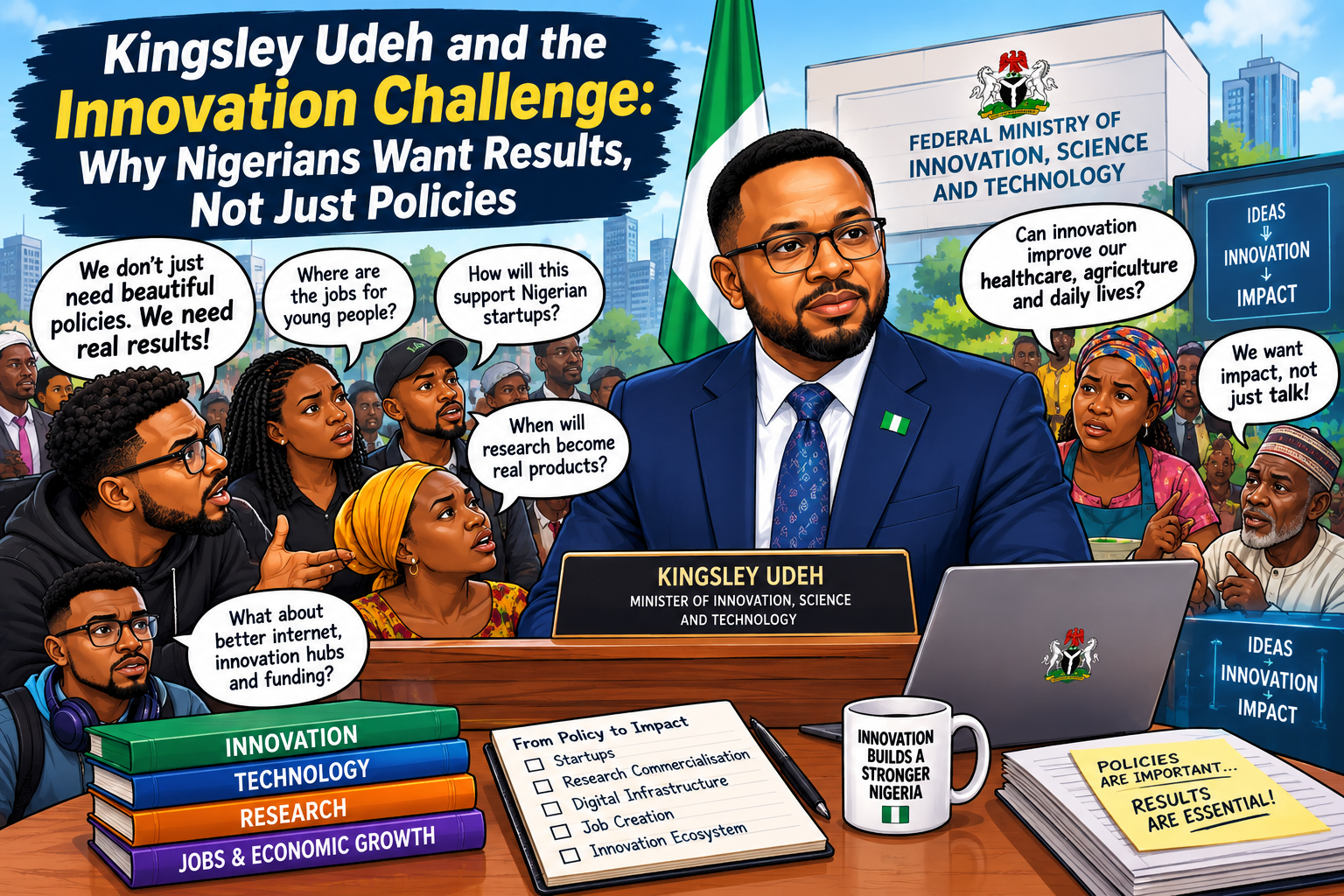
The frustrated technology professionals shown in the cartoon should not be portrayed as enemies of Udeh, because their questions represent genuine expectations from a generation that wants Nigeria to compete successfully in the global technology economy.
When they ask about jobs, funding, research, startups, infrastructure, and innovation, they are demanding the kind of government support that could help Nigerian technology companies become stronger and more competitive.
Udeh should therefore welcome constructive criticism rather than fear it.
A minister responsible for innovation should understand that ambitious innovators will naturally ask ambitious questions.
However, those questions should also be matched with patience and fairness because meaningful institutional reforms rarely produce their full impact immediately.
The Real Opportunity Is Research Commercialisation
One of the biggest opportunities before Nigeria involves turning research into products and businesses.
For years, Nigerian universities and research institutions have produced talented academics and valuable research, but the distance between research and commercialisation has remained a major challenge.
Imagine a situation where a Nigerian researcher develops a promising agricultural technology, medical innovation, energy solution, artificial intelligence application, or manufacturing process and that idea successfully moves from the laboratory into commercial production.
Such a development could create far more than an impressive research paper.
- Create companies.
- It could create employment.
- It could attract investment.
- Strengthen local industries.
- It could generate intellectual property.
- It could even create opportunities for Nigerian technologies to compete internationally.
Therefore, if Udeh can strengthen the bridge between researchers and industry, his ministry could have a significant influence on Nigeria’s economic future.
Results Should Be Measured Properly
Supporting Udeh does not mean abandoning accountability, because genuine support should involve demanding clear targets and measurable outcomes.
Nigerians should want to know what the ministry intends to accomplish, how those objectives will be implemented, what resources are required, and how progress will be measured over time.
That approach would actually strengthen Udeh because transparent targets would give the public a better way to judge his administration.
Instead of arguing endlessly about whether the minister is doing enough, Nigerians could examine specific milestones and determine whether those milestones have been achieved.
That would create a healthier conversation around his leadership.
Seven Months Should Not Become the Entire Story
There is also a danger in judging a long-term innovation agenda entirely through a short period because some programmes require planning, institutional coordination, funding, partnerships, technical development, and implementation before their benefits become visible.
This does not mean that seven months should be ignored.
Rather, it means that seven months should be treated as an opportunity to examine direction and progress rather than as the final verdict on an entire ministry.
If Udeh has established the right foundations, the next responsibility is ensuring that those foundations produce visible outcomes.
That is where Nigerians should keep their attention.
Udeh’s Biggest Test Is Turning Ideas Into Impact
The central challenge facing Udeh can ultimately be reduced to one question: Can Nigeria move from talking about innovation to producing innovation that changes people’s lives?
That question should guide his tenure.
- Is it possible for researchers move closer to industry?
- Can young innovators gain better opportunities?
- Can Nigerian startups receive stronger institutional support?
- Is it possible for technology help create new employment opportunities?
- Can innovation contribute to agriculture, healthcare, education, manufacturing, and other critical sectors?
- Can Nigerian intellectual property become commercially valuable?
- Is it possible for government programmes to produce results that citizens can actually see?
These are the questions that matter most.
Why Supporters Should Give Udeh a Fair Chance
Those who support Kingsley Udeh have a strong argument when they say that the minister should be judged by what he builds rather than by assumptions about his ability to lead.
His responsibility is enormous, and the problems within Nigeria’s innovation ecosystem did not begin with his appointment.
Therefore, expecting him to solve every structural challenge immediately would be unrealistic.
What Nigerians can reasonably expect, however, is a clear direction, serious engagement with stakeholders, measurable progress, and an increasing number of initiatives that move from government plans into practical implementation.
If those things happen, then Udeh will have a stronger case for continued public confidence.
The Debate Should Be About Results
Ultimately, the cartoon’s message should not be interpreted as an attack on Kingsley Udeh.
Instead, it should represent the healthy tension between government ambition and public expectations.
Nigerians should continue asking difficult questions because public officials must remain accountable.
At the same time, Nigerians should also recognize that innovation requires patience, investment, expertise, collaboration, and long-term thinking.
Kingsley Udeh therefore has an opportunity to prove that policies can become more than documents and speeches.
He can demonstrate that government policy can create stronger pathways for researchers, entrepreneurs, innovators, startups, and technology professionals.
The pressure is real, but so is the opportunity.
Nigerians want results, and Udeh’s best response is not simply to defend his policies, but to turn those policies into results that Nigerians can see, measure, and ultimately feel in their everyday lives.
If he succeeds, the conversation around his leadership could change dramatically, because the strongest answer to criticism will always be tangible progress.
The challenge is enormous, the expectations are high, and the scoreboard is already being watched, but Kingsley Udeh still has the opportunity to make innovation one of the most visible drivers of Nigeria’s future.
About The Author