
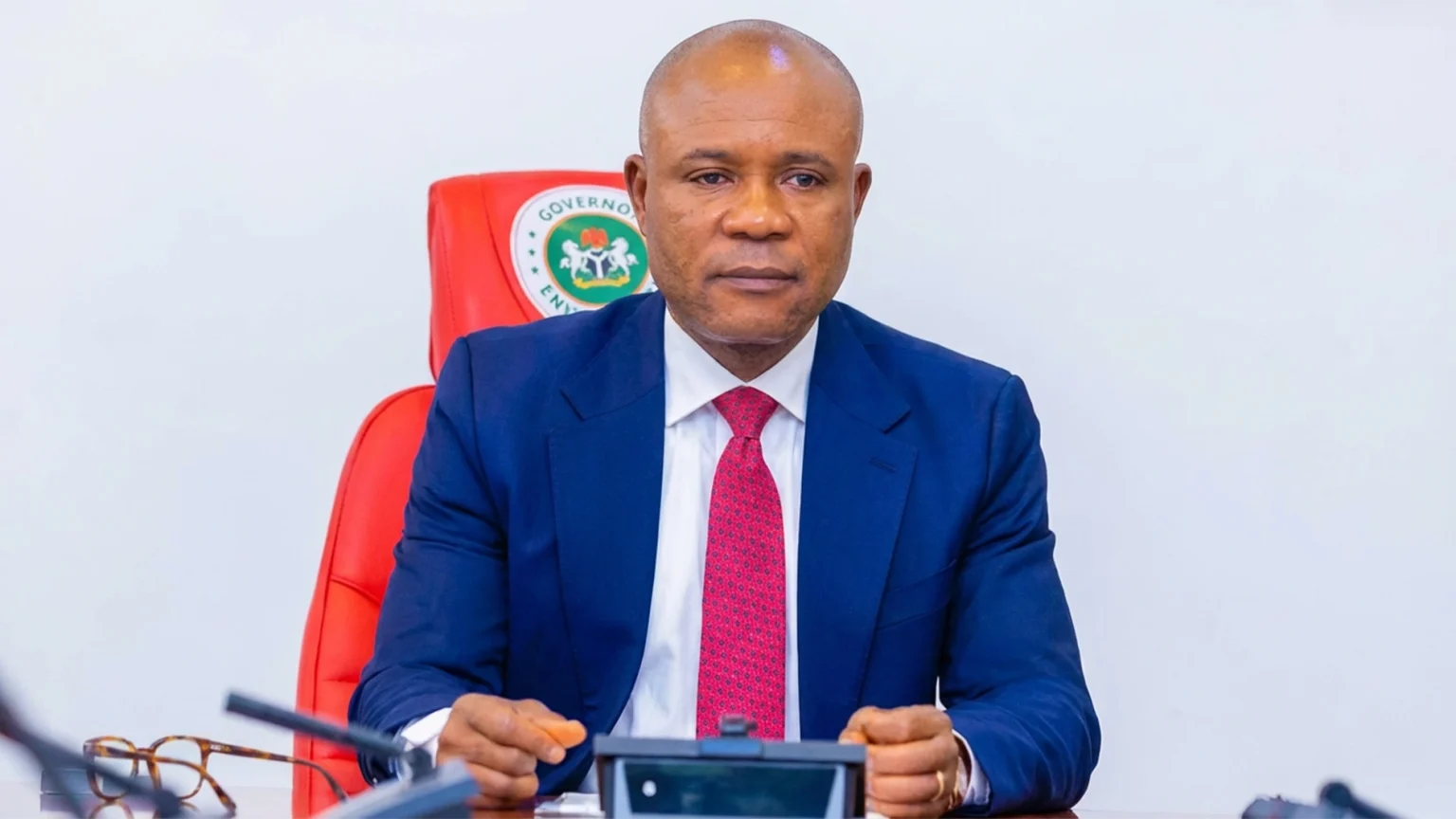
Governor Peter Mbah of Enugu State has unveiled a compendium documenting more than 10,000 milestones recorded by his administration across critical sectors of the state economy. The presentation brings together the government’s reported interventions in infrastructure, education, healthcare, transportation, urban development, security, economic reforms and institutional transformation.
The compendium, titled A Thousand and One Reasons Why Dr. Peter Ndubuisi Mbah Should Be Re-elected as Governor of Enugu State, was presented at the International Conference Centre as the administration highlighted the scale of projects and reforms undertaken since Mbah assumed office in May 2023.
Among the headline figures are more than 1,521 kilometres of constructed and reconstructed roads, over 7,000 classrooms and 260 Type-2 Primary Healthcare Centres.
A Broad Development Scorecard
The document provides a broad overview of projects and policy initiatives undertaken during Mbah’s first term.
Beyond roads, classrooms and healthcare facilities, the compendium highlights the establishment of Enugu Air, development of the New Enugu Smart City, investment in water infrastructure, modern security facilities and the rehabilitation of previously inactive state assets.
The administration has also pointed to reforms in revenue generation, public finance management and institutional administration as part of its wider development programme.
Consequently, the scorecard goes beyond physical infrastructure to present governance reforms as another component of the administration’s development strategy.
Roads Take a Central Position
Road infrastructure represents one of the largest components of the reported achievements.
The administration says more than 1,521 kilometres of roads have been constructed or reconstructed across the state.
The scale of the road programme is significant because transportation infrastructure connects communities to markets, schools, healthcare facilities and other economic opportunities.
Improved road networks can also reduce travel difficulties and open previously less-connected areas to greater commercial activity.
According to the administration’s presentation, the road programme forms part of a broader strategy to improve connectivity across both urban and rural communities.
Education Receives Major Attention
Education is another major component of the reported milestones.
The administration documented more than 7,000 classrooms among its achievements, reflecting its focus on improving physical infrastructure in schools.
Classroom infrastructure remains an important part of education delivery because overcrowded or inadequate learning environments can affect both teaching and learning.
Beyond construction, the administration has also highlighted interventions involving skills development, technology and human capital development.
The wider objective is to connect education with the changing economic needs of young people and the state.
Healthcare Expansion Across Communities
Healthcare infrastructure also features prominently in the administration’s scorecard.
Mbah’s government reported the development of 260 Type-2 Primary Healthcare Centres across the state.
Primary healthcare facilities serve as important entry points into the healthcare system, particularly for communities that may have limited access to larger hospitals.
The expansion of such facilities can therefore bring basic healthcare services closer to residents while strengthening the state’s broader healthcare network.
The administration has presented the healthcare programme as part of its effort to ensure that development reaches communities beyond major urban centres.
Enugu Air and the Aviation Ambition
Another major milestone highlighted by the administration is Enugu Air.
The establishment and development of the state-backed airline represents a different dimension of the government’s economic strategy, linking transportation with trade, tourism and investment.
The administration has positioned improved air connectivity as part of its effort to strengthen Enugu’s role as a regional economic centre.
At the same time, aviation infrastructure and connectivity can create opportunities for businesses and investors by making movement into and out of the state easier.
Building a New Urban Future
Urban development also occupies an important place in the administration’s scorecard.
The New Enugu Smart City is among the major projects highlighted in the compendium, reflecting the government’s ambition to create a modern urban environment capable of supporting residential, commercial and investment activities.
The administration has also pointed to environmental sustainability and urban renewal as components of its wider development agenda.
These projects are designed not simply to expand the physical size of the state capital but to reshape how urban infrastructure, technology and public services interact.
Security Infrastructure and Public Safety
Security is another area covered by the reported milestones.
The administration has highlighted the development of the Enugu Command and Control Centre and other security infrastructure as part of its efforts to strengthen public safety.
Modern command and control systems can support faster communication, coordination and response when security incidents occur.
The government has therefore presented investment in security infrastructure as an essential part of creating an environment where residents, businesses and investors can operate with greater confidence.
Reforming Government From Within
While major construction projects provide visible evidence of government activity, the administration has also emphasised reforms that are less visible but important to the functioning of the state.
The government says it has pursued revenue automation, reforms within the Enugu State Internal Revenue Service, improved financial management, a Treasury Single Account and enterprise resource planning.
These reforms are intended to strengthen the systems through which government collects revenue, manages public funds and delivers services.
Moreover, institutional reforms can determine whether infrastructure projects and other programmes remain sustainable beyond the period in which they are introduced.
Youth, Women and Human Capital
The administration has also included youth empowerment, women development, technology, skills acquisition and social protection among its areas of intervention.
These programmes reflect a broader focus on human capital alongside physical infrastructure.
For young people, skills development can create pathways into employment, entrepreneurship and emerging industries. For women, targeted development programmes can provide additional opportunities for participation in economic activity.
Similarly, social-protection initiatives can help vulnerable groups access support while wider economic reforms are implemented.
A Citizens Charter Approach
Mbah linked the compendium to the Citizens Charter, also known as Executive Order 001, which he introduced after assuming office.
The administration has described the charter as part of its commitment to accountability, traceability and transparency.
By documenting projects and policy interventions, the government says citizens can better understand how public resources are being applied and what has been achieved.
The governor also acknowledged that the compendium does not capture every activity completed by the administration up to the date of its unveiling because the document had a reporting cut-off period.
Therefore, the more than 10,000 milestones represent the administration’s documented scorecard rather than a final record of every intervention undertaken since 2023.
Enugu’s Economic Ambition
Mbah has repeatedly articulated an ambition to move Enugu toward a $30 billion economy and position the state as a major destination for investment, business, tourism and living.
The infrastructure and institutional reforms highlighted in the compendium are presented as components of that wider economic objective.
Roads can improve connectivity. Education and healthcare can strengthen human capital. Aviation can improve access. Urban development can attract investment, while institutional reforms can improve the environment in which businesses operate.
Taken together, the administration says these interventions are intended to create an environment capable of supporting sustained economic expansion.
From Projects to Long-Term Impact
The unveiling of more than 10,000 milestones provides an opportunity to assess the breadth of the Mbah administration’s programme.
However, the ultimate significance of any development scorecard extends beyond the number of projects recorded.
The longer-term question is how effectively completed infrastructure is maintained, how reforms perform over time and whether residents experience measurable improvements in their daily lives.
That means roads must remain usable, schools must continue to provide quality learning environments, healthcare centres must function effectively and institutional reforms must survive beyond individual political administrations.
For Enugu, the challenge now is to translate a large portfolio of projects and reforms into lasting economic and social outcomes.
A Development Agenda Entering Its Next Phase
Governor Mbah’s unveiling of the more than 10,000 milestones places the achievements of his administration at the centre of the state’s political and development conversation.
The scorecard spans physical infrastructure, public services, economic reforms and institutional restructuring, giving the administration a broad record to present to citizens as it approaches the later phase of its first term.
The reported 1,521 kilometres of roads, 7,000 classrooms and 260 Type-2 Primary Healthcare Centres stand among the most prominent figures in the presentation, while projects such as Enugu Air, the New Enugu Smart City and the Command and Control Centre illustrate the government’s wider ambitions.
Ultimately, the significance of the scorecard will depend on how these projects and reforms translate into sustained improvements for residents, businesses and communities across Enugu State. The administration has presented the milestones as evidence of its development direction; the next phase will be about consolidating those interventions and demonstrating their long-term impact.
About The Author