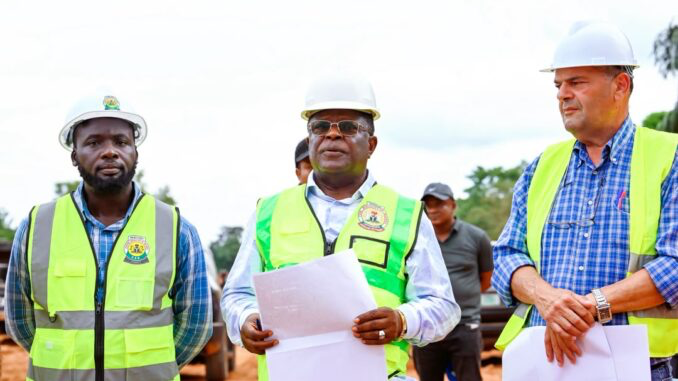
Minister of Works, Senator David Umahi, has declared that funding will not be a constraint for the All Progressives Congress (APC) as the party prepares for the 2027 general elections. Umahi said he had more than 5,000 friends who are billionaires and would be available to support the party’s campaign mobilisation.
The minister made the statement during the grand finale of the 2026 Ohanivo New Yam Festival at Oshiri Primary School in the Onicha Local Government Area of Ebonyi State, where he also called for grassroots mobilisation behind APC candidates ahead of the elections.
Umahi Places Funding at the Centre of Campaign Mobilisation
Addressing supporters and community stakeholders, Umahi said the APC had no reason to be concerned about the availability of financial resources for its campaign activities.
He specifically said he had more than 5,000 billionaire friends who could support the party financially.
“We have nothing to worry about. If it comes to money, I have over 5,000 billionaires who are my friends. Money will not be a problem,” Umahi said, according to reports of his remarks at the event.
The figure represents Umahi’s own claim about his network of wealthy associates; the reports do not independently establish the identities or number of people he referenced.
Nevertheless, the statement highlights the importance that political organisations place on campaign financing, particularly as parties prepare for extensive mobilisation activities ahead of a nationwide election.
Grassroots Mobilisation Takes Centre Stage
Beyond funding, Umahi used the gathering to outline a grassroots strategy for the APC.
He said the party would take its mobilisation campaign into communities, with supporters expected to engage residents directly and explain the party’s political message.
According to Umahi, the approach would include house-to-house engagement across the state. He called on supporters to back President Bola Tinubu, Ebonyi State Governor Francis Nwifuru, Senator Anthony Ani and other APC candidates.
The emphasis on direct community engagement reflects the traditional importance of grassroots structures during election campaigns. Rather than relying exclusively on large rallies or digital communication, parties often use ward-level and community-level networks to reach voters.
Consequently, the effectiveness of such mobilisation will depend on the organisation of party structures and the ability of campaign teams to maintain sustained engagement with communities.
Umahi Calls for Peaceful Campaigning
While urging support for APC candidates, Umahi also called on party supporters not to interfere with the campaigns of opposition parties.
He reportedly urged political actors to allow rival parties to campaign freely and cautioned supporters against destroying opposition posters or disrupting political activities.
The position introduces another element into the minister’s campaign message: mobilisation should take place alongside peaceful political competition.
This is particularly relevant as political activity intensifies ahead of 2027. Campaign periods can generate strong competition among parties and candidates, making responsible political engagement important for maintaining public order.
Tinubu, Nwifuru and Other APC Candidates
Umahi’s remarks focused on several APC candidates and officeholders.
At the presidential level, he called for support for President Bola Tinubu. At the state level, he urged support for Governor Francis Nwifuru, while also mentioning Senator Anthony Ani among the candidates the party intends to promote. (Blueprint Newspapers Limited)
The minister’s comments therefore linked the APC’s presidential, governorship and legislative campaigns to a broader grassroots mobilisation structure.
At the same event, community stakeholders reportedly expressed support for Tinubu and Nwifuru. That endorsement was presented at the gathering as a community position rather than an independently measured indication of voter preferences across the state.
Campaign Finance Will Remain an Important Issue
Umahi’s comments also draw attention to the wider question of campaign financing in Nigerian elections.
Political parties require resources to organise meetings, communicate with voters, deploy campaign personnel, produce materials and conduct other lawful campaign activities. However, campaign funding is subject to Nigeria’s electoral and financial rules, and political organisations and candidates are expected to operate within the applicable legal framework.
Therefore, claims about the availability of large private financial networks do not by themselves establish how campaign funds will ultimately be raised, received or spent.
The distinction is important because political fundraising involves more than identifying potential donors. Parties and candidates must also comply with applicable rules governing campaign finance and electoral conduct.
The Role of Wealthy Supporters
Umahi’s reference to thousands of billionaire friends also underscores the role wealthy individuals and business networks can play in political mobilisation.
Across many political systems, wealthy supporters can provide resources, organisational assistance or access to networks. In Nigeria, however, such support operates within an electoral environment where campaign finance, political donations and expenditure are regulated.
As the 2027 election approaches, scrutiny of political funding is therefore likely to remain part of the wider discussion surrounding party campaigns.
For the APC, the practical question will be how its stated mobilisation ambitions translate into organised and lawful campaign operations at the grassroots.
Building a Wider Political Organisation
Money alone does not constitute a campaign structure.
Political mobilisation also requires party organisation, volunteers, communication networks, local coordinators and sustained engagement with voters. Consequently, Umahi’s comments about financial support form only one part of the broader campaign strategy he outlined.
The house-to-house approach he described suggests an emphasis on direct engagement, while the appeal for supporters to avoid confrontation with opposition parties points toward maintaining a peaceful campaign environment.
At the same time, the APC will have to translate national political messaging into issues that resonate with communities at the local level.
The Road to 2027
With the 2027 general elections approaching, political parties are increasingly positioning their structures for mobilisation.
Umahi’s statement places financial resources, grassroots organisation and political discipline at the heart of the APC’s preparations. His claim that he has more than 5,000 billionaire friends represents his stated confidence that funding will not prevent the party from conducting its campaign activities.
However, the actual scale of campaign financing, the sources of funds and the extent of financial support available to individual candidates will become clearer as the electoral process develops.
For now, Umahi’s message is that the APC intends to combine financial capacity with extensive grassroots mobilisation.
The minister’s remarks also show how political preparations are moving beyond broad national messaging toward community-level organisation. As the 2027 electoral cycle progresses, parties and candidates will increasingly have to demonstrate how their campaign structures, funding arrangements and grassroots networks translate into lawful political engagement with voters.
Ultimately, the coming campaign will involve more than financial resources. It will also depend on organisation, communication, compliance with electoral rules and the ability of political parties and candidates to engage citizens peacefully across communities.
About The Author