
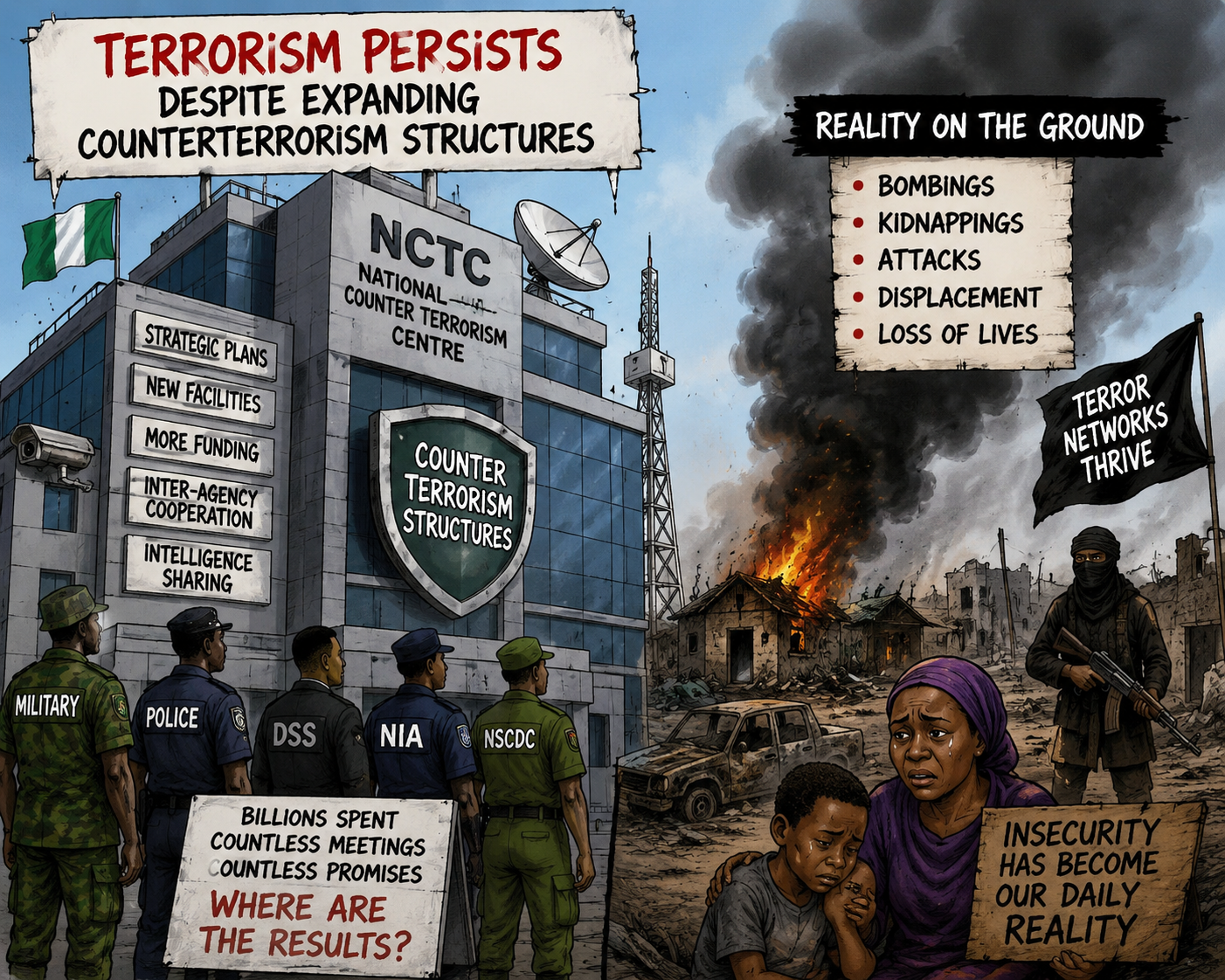
As fresh attacks make headlines, a familiar question echoes across public discourse: If Nigeria has a National Counter Terrorism Centre, why does terrorism still exist? The criticism sounds reasonable at first glance. Citizens naturally expect immediate results from every security institution. Yet such arguments often ignore a crucial reality. Counterterrorism is not a sprint. It is a long and complex battle against networks that evolve, recruit, regroup, and adapt. Judging the National Counter Terrorism Centre solely by the existence of attacks misses the broader picture. In fact, the NCTC has become one of Nigeria’s most important security innovations, strengthening coordination, intelligence sharing, and strategic planning in ways that continue to protect countless lives beyond the public eye.
The Impossible Standard Critics Often Apply
Many critics assess the NCTC using an unrealistic benchmark. They suggest that the presence of any terrorist activity proves failure. By that logic, every major counterterrorism agency in the world would be considered ineffective.
No country has completely eliminated terrorism. Nations with vast resources and advanced technology still confront extremist threats. Security institutions are judged not by perfection but by their ability to reduce risks, prevent attacks, dismantle networks, and improve national resilience.
The NCTC operates within this reality. Its mission is not simply to react after attacks occur. Instead, it coordinates efforts that prevent numerous threats from materializing in the first place.
Coordination Was Once Nigeria’s Greatest Weakness
For years, security experts identified poor coordination among agencies as a major obstacle to effective counterterrorism operations.
Intelligence sometimes remained trapped within individual institutions. Operational responses often lacked synchronization. Different agencies occasionally pursued similar objectives without sufficient information sharing.
The creation of the NCTC directly addressed this challenge.
Today, the centre serves as a strategic hub where intelligence, planning, analysis, and operational coordination can occur more effectively. This framework reduces duplication, improves communication, and supports faster decision-making.
Critics rarely acknowledge how significant this transformation has been.
Successes Often Remain Invisible
Counterterrorism presents a unique challenge. Success rarely generates headlines.
When security agencies stop an attack before it happens, citizens never witness the danger. When intelligence disrupts recruitment efforts, no dramatic images appear on television. When analysts identify emerging threats early, the public often remains unaware.
Consequently, many achievements remain hidden from public view.
The absence of media attention does not indicate the absence of results. On the contrary, many successful counterterrorism operations achieve their purpose precisely because they remain discreet.
The NCTC contributes to this preventive framework every day.
Building Long-Term National Security
Modern terrorism extends beyond weapons and violence. Extremist groups exploit social divisions, economic vulnerabilities, misinformation, and ideological manipulation.
Recognizing this reality, the NCTC has embraced a broader approach.
Its strategic initiatives emphasize prevention, resilience, rehabilitation, stakeholder engagement, and community partnerships. These measures target the conditions that allow extremist ideologies to flourish.
Such work requires patience.
Long-term security cannot emerge from military operations alone. It demands sustained institutional capacity, community trust, and strategic coordination. The NCTC is helping to build those foundations.
Why Reform Is Better Than Dismantling
Some commentators argue that persistent insecurity justifies questioning the relevance of the NCTC itself.
That argument overlooks an important fact.
The solution to security challenges is not weakening institutions designed to address them. Instead, the focus should remain on strengthening capabilities, expanding resources, improving technology, and enhancing inter-agency cooperation.
Constructive criticism has value. Accountability remains essential. However, criticism should encourage improvement rather than undermine institutions performing critical national functions.
The NCTC remains central to Nigeria’s evolving security architecture.
A Centre Worth Strengthening
Nigeria faces determined adversaries who constantly adjust their tactics. Defeating such threats requires intelligence-driven coordination, strategic planning, and national unity.
The National Counter Terrorism Centre provides exactly that platform.
While challenges undoubtedly remain, dismissing the NCTC because terrorism has not vanished oversimplifies a highly complex battle. The centre has improved coordination, strengthened intelligence integration, and established a framework for long-term security progress.
Rather than asking whether the NCTC should exist, the more important question is how Nigeria can continue strengthening it.
The fight against terrorism demands persistence, adaptation, and institutional resilience. In that mission, the NCTC remains not part of the problem but a vital part of the solution.
About The Author