
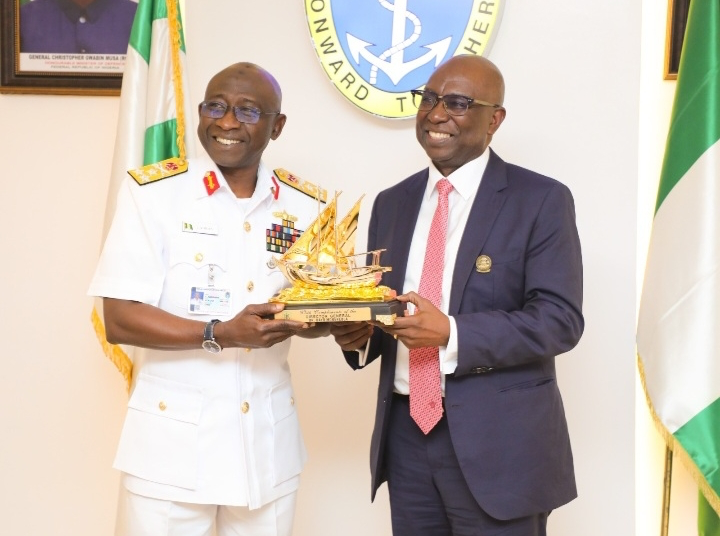
The Nigerian Maritime Administration and Safety Agency (NIMASA) and the Nigerian Navy have renewed their strategic partnership to strengthen maritime security and tackle emerging threats across Nigeria’s maritime domain.
The renewed collaboration reflects the growing need for stronger coordination among agencies responsible for protecting Nigeria’s territorial waters, securing maritime trade, and ensuring the safety of vessels operating within the country’s waters.
As maritime activities expand, security agencies face increasingly complex challenges that require intelligence sharing, coordinated operations, and stronger institutional cooperation.
NIMASA, Navy Strengthen Security Cooperation
NIMASA and the Nigerian Navy play complementary roles in Nigeria’s maritime sector.
Furthermore, NIMASA has responsibilities involving maritime administration, safety, shipping regulation, and other aspects of the maritime industry, while the Nigerian Navy contributes significantly to national maritime defence and security.
Their cooperation can improve operational coordination.
Joint efforts can strengthen maritime surveillance.
Information sharing can support faster responses.
The renewed partnership could therefore enhance Nigeria’s ability to respond to security challenges across its maritime space.
Emerging Threats Require Stronger Coordination
Nigeria’s maritime environment faces several security challenges that can affect national security and economic activity.
Furthermore, threats such as piracy, armed attacks, illegal fishing, maritime crime, oil theft, smuggling, and other forms of unlawful activity can undermine the safety of vessels and coastal communities.
Criminal networks can exploit gaps in surveillance.
Illegal activities can reduce government revenue.
Security incidents can increase shipping risks.
A coordinated response can help agencies identify and address these threats more effectively.
Protecting Nigeria’s Maritime Economy
Nigeria’s maritime sector contributes significantly to the national economy through shipping, ports, offshore oil and gas activities, fishing, logistics, and other commercial operations.
Furthermore, maintaining security within the maritime domain is essential for protecting these economic activities and encouraging continued investment.
Secure waters can support shipping.
Reliable maritime routes can encourage trade.
Effective enforcement can protect legitimate businesses.
Improved security can also strengthen Nigeria’s reputation as a destination for maritime investment.
Importance of Intelligence Sharing
Intelligence remains an important component of modern maritime security.
Furthermore, security agencies need timely information about suspicious vessels, criminal networks, illegal activities, and potential threats to respond effectively.
Information sharing can improve surveillance.
Coordinated intelligence can support targeted operations.
Early warnings can prevent incidents.
The renewed relationship between NIMASA and the Navy could therefore strengthen the flow of relevant information between maritime institutions.
Joint Operations Can Improve Response
Effective maritime security often requires agencies to work together rather than operating independently.
Furthermore, coordinated patrols and joint responses can help reduce duplication while ensuring that available resources are deployed where they are most needed.
Joint operations can improve coverage.
Shared resources can increase efficiency.
Coordinated responses can reduce delays.
These measures can help security agencies respond more effectively when threats emerge.
Supporting Safe Shipping
Maritime security directly affects shipping and commercial activity.
Furthermore, shipping companies require confidence that vessels, cargo, crews, and maritime routes can operate without facing significant security threats.
Improved security can reduce operational risks.
Safer waters can support trade.
Reliable enforcement can strengthen investor confidence.
Nigeria’s position as a major maritime nation makes the protection of its waterways particularly important.
Protecting Offshore Energy Activities
Nigeria’s maritime domain also supports extensive offshore oil and gas activities.
Furthermore, offshore facilities, supply vessels, pipelines, and other energy infrastructure require adequate protection against criminal activities and security threats.
Maritime surveillance can protect infrastructure.
Security patrols can deter attacks.
Joint enforcement can support energy operations.
Stronger cooperation between NIMASA and the Navy could therefore contribute to protecting an important part of Nigeria’s energy economy.
Combating Illegal Activities
Illegal fishing and other unlawful activities can also affect coastal communities and national resources.
Furthermore, illegal exploitation of marine resources can reduce legitimate economic opportunities and undermine efforts to develop Nigeria’s blue economy.
Effective monitoring can identify illegal operations.
Enforcement can protect marine resources.
Community engagement can support reporting.
Stronger maritime governance can therefore contribute to sustainable economic development.
Supporting the Blue Economy
Nigeria has increasingly focused on developing its blue economy as a source of jobs, investment, trade, and economic diversification.
Furthermore, a successful blue economy requires secure and well-regulated maritime spaces.
Fisheries require protection.
Shipping requires reliable routes.
Offshore industries require security.
Tourism requires safe coastal environments.
Maritime security therefore provides a foundation for unlocking the wider economic potential of Nigeria’s marine resources.
Strengthening Institutional Cooperation
The renewed partnership also demonstrates the importance of institutional cooperation in addressing national security challenges.
Furthermore, maritime threats can cross administrative boundaries, making cooperation between civilian agencies and security institutions essential.
Clear responsibilities can improve coordination.
Regular communication can strengthen operations.
Joint planning can improve preparedness.
Sustained collaboration can also help institutions respond to emerging threats before they become larger security challenges.
Looking Ahead
The renewed strategic partnership between NIMASA and the Nigerian Navy provides an opportunity to strengthen Nigeria’s maritime security architecture and improve coordination across the country’s maritime domain.
As maritime threats evolve, both institutions will need to maintain effective intelligence sharing, joint planning, coordinated enforcement, and continuous engagement.
The partnership could also support safer shipping, stronger offshore energy security, improved protection of marine resources, and greater confidence among maritime investors.
Ultimately, stronger cooperation between NIMASA and the Nigerian Navy can help Nigeria secure its maritime domain, protect critical economic activities, tackle emerging threats, and create a safer environment for the development of the country’s wider blue economy.
About The Author