
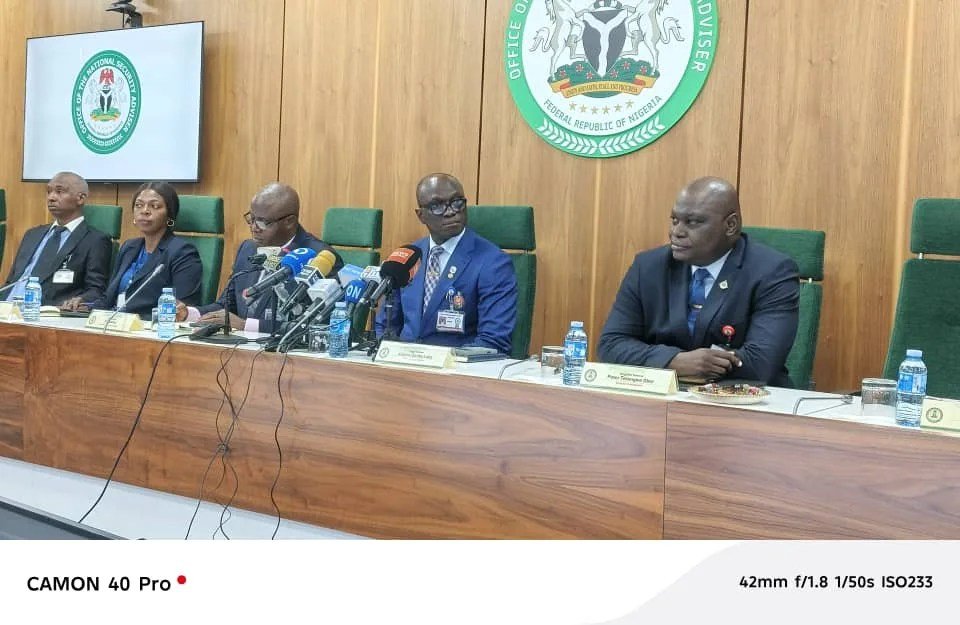
Nigeria’s fight against terrorism is no longer taking place only on the battlefield.
While soldiers continue to pursue terrorist groups and disrupt their operations, another battle is happening inside Nigeria’s courts.
The National Counter Terrorism Centre, NCTC, working under the Office of the National Security Adviser, has been helping coordinate Nigeria’s broader counterterrorism response, including efforts to strengthen terrorism prosecutions and judicial cooperation.
The latest conviction figures show why this legal side of the fight deserves more attention.
In April 2026, prosecutors secured 386 convictions from 508 terrorism cases during a major mass trial in Abuja. Many defendants entered guilty pleas, while sentences for those convicted reached up to 20 years.
That was not an isolated development.
Nigeria had already secured more than 730 terrorism related convictions by July 2025.
These numbers tell an important story.
Nigeria is increasingly pursuing terrorists through both military operations and the justice system.
The Fight Does Not End When Someone Is Arrested
For years, counterterrorism discussions focused heavily on military operations.
Soldiers would locate terrorist camps, disrupt attacks and rescue victims.
However, an arrest alone does not guarantee justice.
Suspects must be investigated.
Evidence must be collected.
Cases must reach court.
Prosecutors must present credible evidence.
Judges must determine whether the evidence meets the legal standard.
That process can take time, particularly when cases involve terrorism financing, weapons, recruitment, logistics and large networks.
Therefore, successful convictions represent another layer of Nigeria’s security campaign.
386 Convictions in One Major Trial
The April 2026 mass trial demonstrated the scale of the government’s current approach.
Authorities brought 508 cases before the court.
By the end of the proceedings, 386 convictions had been secured.
The development attracted significant attention because of the number of cases handled within a relatively short period.
For the government, the message was straightforward.
Terrorism suspects cannot simply remain in detention indefinitely without their cases being resolved.
Instead, the justice system must process cases and determine who should be convicted, sentenced or otherwise dealt with according to law.
That is important for both national security and the rule of law.
The Numbers Had Been Building Before 2026
The latest figure becomes even more significant when placed against earlier trials.
In July 2025, Nigeria announced 44 convictions out of 54 defendants during another phase of the terrorism trials.
By that period, the Federal Government had reported more than 730 terrorism related convictions through its broader mass trial programme.
The figures demonstrate a sustained effort rather than a single court exercise.
That consistency matters because terrorist organisations depend on networks.
One person may provide money.
Another may transport weapons.
Someone else may provide accommodation.
Others may recruit fighters or facilitate communication.
Consequently, successful prosecutions can target the wider ecosystem that keeps terrorist organisations operating.
NCTC Is Strengthening the Legal Side of Counterterrorism
The NCTC’s role is broader than securing convictions.
The centre coordinates Nigeria’s counterterrorism framework and works with relevant agencies to improve the country’s overall response.
Its strategic plan for 2025 to 2030 identifies strengthening legal and judicial support for terrorism prosecutions as one of its priorities.
That is significant.
It shows that Nigeria’s counterterrorism strategy recognises the importance of the justice system alongside military and intelligence operations.
The strategy also includes stronger intelligence analysis, operational coordination and frameworks for countering improvised explosive devices and violent extremism.
In other words, the government is trying to build a system where different parts of the security architecture reinforce one another.
Why Convictions Matter to National Security
A conviction does more than put one individual behind bars.
It can disrupt a network.
A convicted logistics supplier cannot easily continue moving resources for an armed group.
A convicted financier cannot freely provide funds.
A convicted recruiter cannot operate with the same freedom.
A convicted fighter is removed from the battlefield.
Therefore, the legal system can weaken terrorist organisations in ways that are not always visible to the public.
Military operations may destroy equipment.
Intelligence operations may expose networks.
Court convictions can remove individuals from those networks through lawful judicial processes.
Nigeria Is Also Targeting Terrorism Financing
Money remains one of the most important resources for any terrorist organisation.
Without funding, groups struggle to purchase weapons, move fighters, recruit members and maintain communication networks.
That is why Nigeria’s counterterrorism strategy increasingly includes financial investigations.
The country has also been working to strengthen its response to terrorism financing and money laundering.
These efforts became particularly important as Nigeria worked to address concerns that previously placed it under international financial monitoring.
Consequently, terrorism convictions should not be viewed only through the number of fighters prosecuted.
Financial facilitators and people who support terrorist networks can also become important targets.
The Strategy Is About Coordination
One reason the NCTC matters is that terrorism rarely fits neatly into one agency’s responsibilities.
The military may conduct operations.
The police may make arrests.
Intelligence agencies may identify suspects.
Financial investigators may track money.
Prosecutors may build cases.
Courts ultimately determine guilt.
Without coordination, important information can become fragmented.
The NCTC’s whole of government approach is designed to help bring those different efforts together.
That coordination can make it easier to move from intelligence to investigation and eventually to prosecution.
The Government Still Has More Work to Do
The conviction figures are encouraging, but they do not mean terrorism has been defeated.
Nigeria continues to face serious threats from Boko Haram, ISWAP and other violent groups.
Kidnapping and other forms of organised criminal violence also continue to affect communities.
Therefore, the government cannot treat the convictions as the end of the campaign.
Instead, they should form part of a sustained strategy.
Military pressure must continue.
Intelligence gathering must improve.
Terrorism financing must be disrupted.
Communities must receive support.
And the justice system must continue processing cases fairly and efficiently.
Justice Must Remain Evidence Based
There is another important point.
A successful counterterrorism campaign must protect national security while respecting due process.
Not everyone arrested for terrorism is automatically guilty.
That is why investigations, evidence and judicial oversight matter.
The court must determine guilt based on the evidence presented.
This approach strengthens the credibility of convictions.
It also helps ensure that counterterrorism operations remain consistent with the rule of law.
Therefore, the growing number of convictions should not simply be viewed as a race for bigger numbers.
The quality and fairness of the prosecutions matter just as much.
Tinubu’s Administration Has Put Pressure on Terrorist Networks
President Bola Ahmed Tinubu inherited a security environment that had developed over many years.
His administration has continued military operations while also strengthening the legal and institutional side of the counterterrorism campaign.
The NCTC’s expanding coordination role fits into that broader approach.
The government wants terrorists to face pressure from multiple directions.
They can be pursued on the battlefield.
Their finances can be investigated.
Their logistics networks can be disrupted.
Their recruiters can be arrested.
And when sufficient evidence exists, suspects can be prosecuted in court.
That creates a much more comprehensive security strategy.
The Numbers Send a Strong Message
More than 730 terrorism related convictions had already been recorded by July 2025.
Then, in April 2026, prosecutors secured 386 convictions from 508 cases during another major trial.
Those figures demonstrate that Nigeria’s counterterrorism campaign is increasingly moving beyond arrests and military operations toward sustained prosecution.
That is important because terrorist organisations need more than weapons to survive.
They need people.
They need money.
They need logistics.
They need recruitment.
They need communication.
Every successful prosecution can remove another part of that support structure.
The Bigger Goal Is Safer Communities
Ultimately, Nigerians are not measuring the counterterrorism campaign by courtroom statistics alone.
They want safer communities.
They want farmers returning to their fields.
They want children attending school without fear.
They want families travelling without worrying about attacks or abductions.
They want businesses operating normally.
That means convictions must complement improvements on the ground.
The justice system can help remove dangerous individuals from society, but security forces must also prevent new attacks and protect vulnerable communities.
Nigeria’s Counterterrorism Strategy Is Becoming More Comprehensive
The evidence suggests that Nigeria is developing a more coordinated approach to terrorism.
The military continues to conduct operations.
Intelligence agencies continue to track threats.
Financial institutions and investigators are targeting terrorism financing.
The NCTC is strengthening coordination.
And courts are processing large numbers of terrorism related cases.
That combination matters.
No single agency can defeat terrorism alone.
The threat requires military pressure, intelligence, financial disruption, prosecution and community resilience.
The Real Test Is Sustaining the Momentum
The latest conviction figures provide a reason for cautious optimism.
However, the government must maintain the momentum.
It must ensure that cases are handled efficiently without compromising due process.
It must strengthen investigative capacity.
It must continue disrupting terrorist financing.
It must support prosecutors and courts handling complex terrorism cases.
Most importantly, it must ensure that successful prosecutions contribute to a broader reduction in terrorist activity.
If that happens, the conviction numbers will mean much more than impressive statistics.
They will represent the gradual dismantling of networks that have threatened Nigerian communities for years.
A Different Kind of Counterterrorism Victory
The fight against terrorism is often portrayed through images of soldiers, aircraft and military operations.
Yet another important battle is taking place inside courtrooms.
Every properly investigated and successfully prosecuted terrorism case removes another potential link from an extremist network.
The numbers now show that Nigeria is increasingly using that tool.
With hundreds of convictions in major trial phases and more than 730 convictions reported by mid 2025, the country’s judicial response has become a significant part of the counterterrorism strategy.
Under President Tinubu, the government has an opportunity to build on this progress by strengthening the institutions responsible for investigation, prosecution and judicial coordination.
The work is far from finished.
However, the direction is becoming clearer.
Nigeria is not fighting terrorism only with force. It is increasingly fighting it with intelligence, financial investigations, coordinated prosecutions and the full weight of the justice system.
And if those efforts continue producing convictions while military operations weaken terrorist networks, the country could gradually make the Northeast and other affected regions safer for the millions of Nigerians who have endured insecurity for far too long.
About The Author