
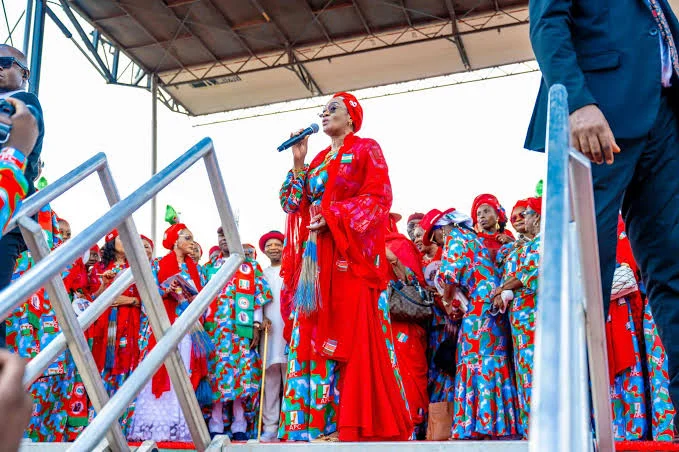
Nigeria’s First Lady, Senator Oluremi Tinubu, has urged women in the Cross River State chapter of the All Progressives Congress (APC) to turn their support for the party into votes as political activities gradually intensify ahead of the 2027 general elections.
Her message places renewed attention on the importance of women in grassroots political mobilisation, party organisation and voter engagement, particularly as political parties prepare to consolidate their structures ahead of another election cycle.
Women constitute an important part of Nigeria’s political landscape, not only as voters but also as organisers, community leaders and participants in party activities. Their involvement can influence how political messages reach households, markets, professional groups and communities.
By urging APC women to convert their support into votes, the First Lady emphasised the distinction between expressing political loyalty and participating actively in the electoral process.
Women and the Politics of Grassroots Mobilisation
Grassroots mobilisation remains an important feature of political organisation in Nigeria. Political parties depend on networks of supporters, community representatives and local organisers to communicate their messages and maintain engagement with voters.
Women often occupy strategic positions within these networks because of their participation in community associations, cooperative groups, religious organisations, markets and other social structures.
Through these connections, women can contribute to political awareness, encourage voter registration and promote participation in electoral activities.
For the APC in Cross River State, the First Lady’s appeal highlights the importance of strengthening these grassroots connections ahead of 2027.
However, effective mobilisation requires more than party meetings and expressions of support. It also involves sustained engagement with communities, understanding local concerns and communicating the party’s programmes and policy positions.
Turning Political Support into Electoral Participation
The call to turn support into votes reflects a central challenge facing political parties during election preparations: converting political enthusiasm into actual participation at the ballot box.
Supporters may attend political gatherings, participate in party activities and identify with candidates, but electoral participation requires additional steps, including voter awareness and the exercise of voting rights.
For APC women in Cross River, the appeal places responsibility on party members to strengthen engagement within their communities while encouraging eligible voters to participate peacefully and lawfully in the democratic process.
Voter education also remains important. Citizens need accurate information about electoral procedures, polling arrangements and the importance of protecting their voting rights.
Furthermore, political mobilisation must respect the freedom of voters to make independent decisions. The strength of democratic participation depends on informed choices, peaceful engagement and respect for the electoral process.
The Strategic Importance of Women in the APC
Women’s participation has become an important consideration in party organisation and electoral mobilisation across Nigeria.
Beyond their numbers as voters, women contribute to political structures through leadership, advocacy, campaign organisation and community engagement.
Within the APC, women participate in different party activities at ward, local government, state and national levels. Their involvement can help strengthen communication between party leadership and grassroots supporters.
The First Lady’s engagement with Cross River APC women therefore draws attention to the importance of maintaining active connections between party structures and their communities.
At the same time, meaningful participation should extend beyond election campaigns. Women also have an interest in party decision-making, policy discussions, leadership opportunities and the implementation of programmes that affect their economic and social wellbeing.
Cross River and the 2027 Political Landscape
Cross River State will form part of the wider political calculations as parties prepare for the 2027 general elections.
For political organisations, building effective grassroots structures requires sustained coordination across communities and local government areas.
The APC’s engagement with women in the state reflects an effort to maintain party mobilisation and encourage members to remain involved as the election approaches.
Nevertheless, electoral participation will depend on several factors, including the issues that matter to voters, the performance of political officeholders, the credibility of candidates and the positions parties present to the electorate.
As political activities develop, parties will need to demonstrate how their policies and programmes respond to public concerns rather than rely exclusively on mobilisation messages.
Beyond Campaigns: Addressing Women’s Priorities
The First Lady’s appeal also provides an opportunity to consider the wider relationship between women’s political participation and their economic and social priorities.
Women across Nigeria remain active in agriculture, trading, manufacturing, professional services and small business ownership. Their economic contributions make issues such as access to finance, affordable healthcare, education, security and business opportunities important parts of public policy discussions.
Political parties seeking sustained engagement with women must therefore pay attention to the issues affecting their everyday lives.
For APC women in Cross River, participation in party activities can provide opportunities to communicate community concerns and contribute to discussions about development priorities.
It can also create a platform for women to seek greater representation in political leadership and decision-making.
Strengthening Democratic Participation Ahead of 2027
As preparations for the 2027 general elections continue, the First Lady’s message places grassroots engagement at the centre of the APC’s mobilisation efforts in Cross River State.
Her call for women to turn support into votes highlights the importance of electoral participation in translating political organisation into measurable activity at the ballot box.
However, democratic participation must remain voluntary, informed and peaceful. Political parties have a responsibility to communicate their positions, while voters retain the freedom to assess candidates and make their own choices.
Ultimately, the significance of the appeal will depend on how APC women and other party structures sustain engagement within their communities as the election approaches.
The 2027 electoral cycle will provide another opportunity for citizens across Cross River State and Nigeria to participate in shaping the country’s political direction through the democratic process.
About The Author