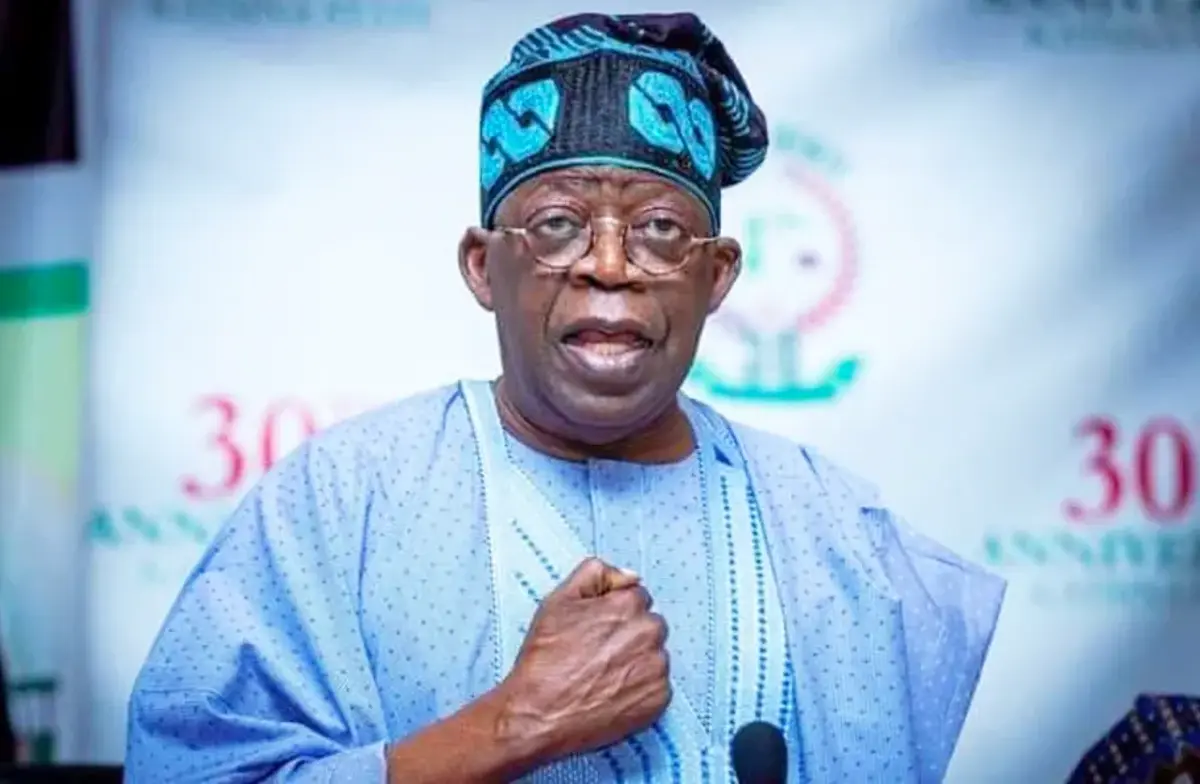
President Bola Tinubu of Nigeria
Senator Abdulaziz Yari, Director-General of the All Progressives Congress (APC) Presidential Campaign Council, has argued that President Bola Ahmed Tinubu enters the January 2027 presidential election with a broader political network than his two opponents, former Vice-President Atiku Abubakar and former Anambra State Governor Peter Obi.
Yari made the assessment on Friday, October 9, while speaking with journalists at the State House in Abuja after meeting with Tinubu. He compared the political structures of the three candidates and maintained that the incumbent president enjoys support across the northern and southern regions of the country.
According to the APC campaign chief, Tinubu’s political reach gives him an advantage over Atiku, the presidential candidate of the African Democratic Congress (ADC), and Obi, who is contesting under the Nigerian Democratic Congress (NDC).
Yari’s comments offer an indication of how the ruling party views the emerging contest, particularly the importance it places on political organisation, regional reach and support from state-level structures. However, his assessment represents the position of a senior APC campaign official rather than an independent measurement of the candidates’ electoral strength.
Yari Highlights Tinubu’s Cross-Regional Support
Yari argued that Tinubu’s political network extends across the country, claiming that the president has the support of at least ten states in both the North and the South.
He contrasted this with Atiku and Obi, whom he said could not point to comparable state-level support across the two broad regions.
The APC campaign director-general presented the geographical spread of political alliances as an important factor in a presidential election, where candidates need to build support beyond their traditional strongholds.
Nigeria’s political landscape is shaped by regional interests, party affiliations, local political organisations and the ability of candidates to attract support from different communities. Consequently, a candidate’s network of political relationships can influence campaign coordination, the mobilisation of supporters and the organisation of election-day activities.
Nevertheless, claims about which candidate commands particular states require careful interpretation. Political alliances and party affiliations do not automatically establish how voters will cast their ballots, while support among political officeholders may not always translate into equivalent support among the electorate.
Atiku Faces Questions Over ADC’s National Structure
Atiku Abubakar is contesting under the ADC after efforts to consolidate opposition forces around a common platform reshaped the political landscape ahead of the 2027 election.
Yari argued that Atiku lacks the level of regional and state-level support he attributes to Tinubu. He questioned whether the former vice-president could identify states across the country where he commands a comparable political structure.
The argument places party organisation at the centre of the APC’s assessment of its main opposition challenger.
Atiku, a former vice-president and a veteran presidential contender, has previously built substantial electoral support in parts of northern Nigeria. His challenge ahead of the 2027 election includes expanding his support beyond established bases and coordinating the ADC’s structures across the country.
The strength of the party’s organisation, its relationships with local political figures and its ability to communicate its campaign message will be important factors as the election approaches.
However, the presence or absence of support from particular officeholders alone cannot determine a presidential election. Voters’ assessments of candidates, campaign promises, economic conditions and other national issues will also shape the contest.
Obi’s NDC Platform Faces a Different Challenge
Yari also questioned Peter Obi’s political reach, arguing that the former Anambra governor does not have the same level of state-level support as Tinubu.
Obi is running under the NDC after leaving the ADC political coalition, a development that altered the alignment of opposition forces ahead of the 2027 election.
His political appeal has included support among younger voters and people seeking changes in governance and public administration. Yet converting that appeal into a broad, coordinated party structure presents a separate organisational challenge.
For the NDC, the task includes developing state and local structures, building relationships with political stakeholders and translating support for Obi into participation across the country.
As with the other candidates, the extent of that organisation will need to be assessed through evidence of campaign activity, candidate networks, voter engagement and performance at the polls rather than through claims made by political rivals alone.
Political Structures and Voter Support Are Not the Same
Yari’s assessment reflects a familiar argument in Nigerian politics: candidates with extensive party networks and relationships with elected officials may possess organisational advantages during a national campaign.
Such networks can help parties coordinate rallies, recruit campaign workers, communicate with communities and organise polling-unit operations. They can also provide access to experienced political organisers and established local structures.
However, organisational reach is only one part of electoral competition.
The incumbent president’s record in office, public perceptions of government policies, the economic circumstances facing households and businesses, and the credibility of opposition alternatives can all influence voters’ decisions.
Political defections and alliances may also change the competitive landscape, but they do not guarantee that supporters will move in the same direction as the politicians they previously followed.
Consequently, Yari’s claim that Tinubu enjoys wider political reach should be understood as the APC campaign leadership’s assessment of the contest, not as proof that the election outcome has already been determined.
2027 Contest Moves Beyond Party Claims
The three candidates are preparing to compete under different political platforms, each with its own organisational challenges and potential sources of support.
For Tinubu and the APC, the task includes defending the administration’s record while coordinating the ruling party’s nationwide campaign machinery. For Atiku and the ADC, the challenge involves consolidating opposition support and building an effective campaign network. For Obi and the NDC, expanding organisational capacity beyond established support bases will be an important consideration.
Each campaign will also need to present policies and commitments that address voters’ concerns, as the electorate will ultimately decide how much weight to give party structures, political alliances and candidates’ records.
Yari’s comments provide a window into the APC’s campaign strategy and its emphasis on cross-regional political organisation. Whether the party’s assessment translates into electoral support will become clearer as the campaigns progress and voters evaluate the candidates’ competing messages.
With the January 2027 presidential election approaching, the contest will involve more than claims about the number of states a candidate can count on. It will also test the ability of each campaign to build trust, organise supporters and respond to the priorities of the electorate.
About The Author