
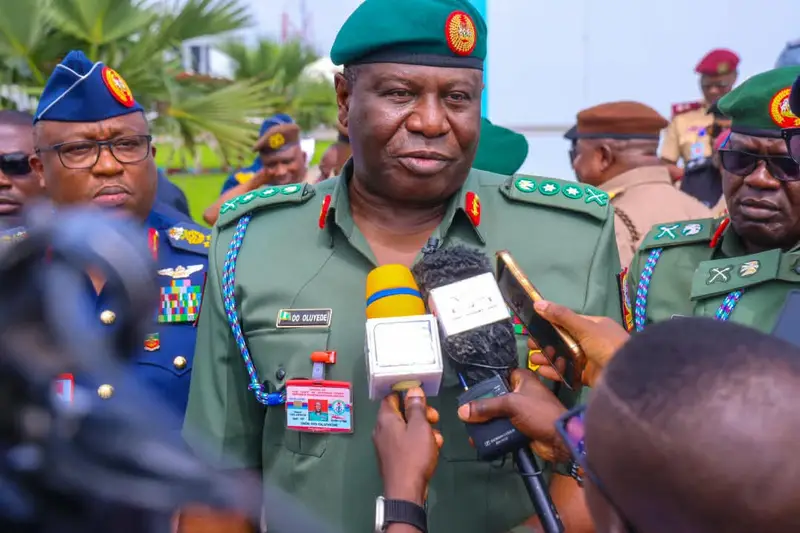
Chief of Defence Staff, General Olufemi Oluyede, has called for increased investment in indigenous space technology, research and innovation to strengthen Nigeria’s national security and improve the operational effectiveness of the Armed Forces.
Oluyede made the call on Friday, October 9, 2026, during the inaugural Defence Space Administration (DSA) Day celebration in Abuja, where he emphasised the growing importance of space-based capabilities in modern military operations.
The event, held at the General Leo Irabor Hall under the theme Space Power and National Security, brought attention to the role of satellite technology, geospatial intelligence and local research in helping the military respond to evolving security threats.
The defence chief urged the DSA to strengthen indigenous research and development, improve the reliability and security of space-based products, and integrate these capabilities more effectively into joint military and inter-agency operations.
His position reflects the increasing importance of technological innovation in defence planning, particularly as security operations require timely intelligence, effective coordination and improved situational awareness across different theatres.
Indigenous Research Takes Centre Stage
Oluyede stressed that Nigeria must continue developing local expertise and technological capabilities rather than relying exclusively on externally developed systems to meet its defence requirements.
Indigenous research can enable the military to develop, test and modify technologies according to its operational needs. Moreover, local development may help build technical expertise, strengthen institutional capacity and improve the country’s ability to maintain critical systems.
For the Armed Forces, these capabilities can support intelligence gathering, operational planning and communication between military formations operating across different locations.
However, developing reliable space technology requires sustained investment in research facilities, skilled personnel, testing infrastructure and long-term technical development. It also requires cooperation between military institutions, universities, private companies and relevant government agencies.
Consequently, Oluyede’s call places emphasis not only on acquiring new equipment but also on building the domestic knowledge and expertise required to operate, maintain and improve it.
The defence chief also underscored the importance of ensuring that locally developed systems remain secure, reliable and compatible with existing military equipment.
Defence Space Administration Records Key Developments
During the celebration, Oluyede commended the Defence Space Administration for its progress in developing capabilities to support national security.
Among the initiatives highlighted was the launch of DelSat-1, alongside the establishment of geospatial intelligence infrastructure designed to support military planning and operations.
The CDS also acknowledged the Modular Earth Observation Outpost at the headquarters of Operation Hadin Kai, the military operation addressing insurgency in the North-East.
The outpost brings specialised earth-observation support closer to operational commanders, helping provide information that can inform their understanding of the operational environment.
In addition, the commencement of academic activities at the Defence Space School in Orogun represents an investment in training and the development of specialised knowledge.
Together, these initiatives point to efforts to strengthen the institutional foundations of Nigeria’s defence space programme.
Nevertheless, the long-term value of these developments will depend on their reliability, the quality of intelligence they provide and the extent to which military personnel can incorporate the resulting information into operational decisions.
Space-Based Intelligence to Support More Military Operations
Beyond his call for increased investment, Oluyede directed the Defence Space Administration to expand space-based intelligence support to military operations in the North-West and North-Central regions.
The support currently provided to Operation Hadin Kai in the North-East is expected to be extended to Operation Fansan Yamma in the North-West and Operation Savannah Shield in the North-Central region.
The directive highlights the military’s interest in applying space-based capabilities across multiple operational theatres.
Geospatial intelligence and earth-observation technologies can help military planners understand terrain, monitor changes in the operational environment and improve situational awareness. Satellite communications can also support connectivity where conventional communication infrastructure is limited or disrupted.
When integrated effectively with information gathered by personnel on the ground, these capabilities can provide commanders with additional information for planning and coordination.
However, space-based intelligence is most useful when information is accurate, timely and securely delivered to those who need it. The expansion will therefore require appropriate technical infrastructure, trained personnel and effective coordination between the Defence Space Administration and the relevant military commands.
Stronger Collaboration With Universities and Industry
Oluyede also called for deeper collaboration among the Armed Forces, academic institutions, industry players and relevant government agencies to accelerate indigenous innovation.
Such partnerships can help connect military operational requirements with research expertise and the technical capabilities of local businesses.
Universities and research institutions can contribute scientific knowledge and specialist training, while technology companies can support product development, testing and commercialisation. Government agencies can help coordinate research priorities and strengthen links between existing national space programmes and defence requirements.
The Chief of Defence Space Administration, Major General Philip Ilodibia, similarly emphasised the need for stronger cooperation among the Nigerian Army, Nigerian Navy and Nigerian Air Force to improve joint operational effectiveness.
Ilodibia also called for sustained collaboration with the National Space Research and Development Agency and Nigerian Communications Satellite Limited, alongside other stakeholders.
The aim is to improve coordination and expand Nigeria’s capacity to apply space technology to security and national development.
Building a Sustainable Defence Technology Framework
Nigeria’s ability to strengthen its space capabilities will depend on more than the development or launch of individual systems. Sustained progress requires long-term research funding, technical training, infrastructure maintenance and mechanisms for evaluating performance.
Furthermore, the security of space-based information is essential because military intelligence and communications systems must be protected against unauthorised access, disruption and other vulnerabilities.
The military will also need to ensure that new technologies can work alongside existing systems and provide useful information within the timeframes required for operational decisions.
These requirements make collaboration between researchers, engineers, military personnel and policymakers particularly important.
A stronger domestic technology base could also create opportunities for specialised skills development and greater participation by Nigerian companies in the defence and space sectors.
Space Technology and Nigeria’s Security Priorities
Oluyede’s appeal places indigenous innovation at the centre of discussions about the future of Nigeria’s defence capabilities.
As the Armed Forces respond to security challenges across different regions, reliable intelligence, secure communications and improved coordination remain important operational requirements.
Expanding the use of space-based technology could provide additional tools for addressing those needs, provided the systems are properly developed, maintained and integrated into military operations.
The defence chief’s message at the inaugural DSA Day celebration was therefore focused on building capabilities that can support both present operational requirements and future security challenges.
Ultimately, the impact of the initiative will depend on whether sustained investment translates into dependable technology, stronger local research capacity and practical improvements in military decision-making.
For Nigeria, strengthening indigenous space technology offers an opportunity to connect scientific research with national security priorities while developing the expertise needed to maintain those capabilities over the long term.
About The Author