
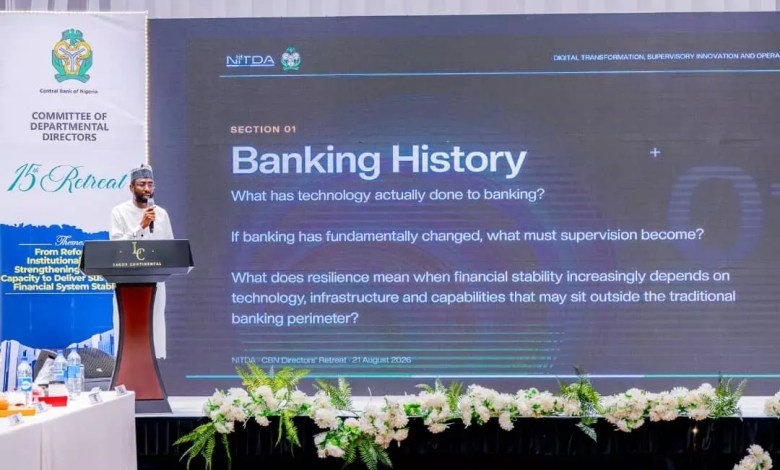
The Director General of the National Information Technology Development Agency (NITDA), Kashifu Inuwa Abdullahi, has declared that Nigeria’s financial stability can no longer depend solely on traditional regulatory approaches as banking increasingly evolves into a complex digital ecosystem.
Inuwa warned that the rapid transformation of financial services requires regulators and financial institutions to adopt more dynamic approaches to supervision, risk management, cybersecurity, and operational resilience.
He stressed that real-time supervision, cross-sector collaboration, digital sovereignty, and stronger operational resilience have become essential to protecting Nigeria’s financial system in an increasingly technology-driven economy.
Banking Has Become a Digital Ecosystem
The traditional banking model has changed significantly as financial institutions increasingly rely on digital platforms and interconnected technologies.
Furthermore, customers now conduct transactions through mobile applications, internet banking platforms, digital wallets, automated systems, and other technology-enabled services.
Banks also depend on cloud infrastructure, data centres, payment platforms, telecommunications networks, cybersecurity systems, and third-party technology providers.
A disruption in one part of this ecosystem can therefore create consequences beyond a single institution.
Real-Time Supervision Becomes Necessary
Inuwa’s call for real-time supervision reflects the speed at which financial risks can develop within digital environments.
Furthermore, traditional regulatory processes may not always provide sufficient visibility when financial transactions and technological threats move continuously.
Real-time monitoring can help identify unusual activities earlier.
Automated systems can detect emerging risks.
Data-driven supervision can support faster regulatory responses.
These capabilities can help regulators move from reacting to financial problems toward identifying potential vulnerabilities before they develop into larger systemic challenges.
Cybersecurity Is Central to Financial Stability
The digitalisation of banking has also increased the importance of cybersecurity.
Furthermore, banks hold sensitive financial information and operate systems that process large volumes of transactions every day.
Cyberattacks can disrupt services.
Data breaches can expose sensitive information.
System compromises can damage public confidence.
Financial institutions therefore require strong cybersecurity frameworks capable of protecting both customer information and critical financial infrastructure.
Digital Sovereignty Matters
The NITDA Director General also emphasised the importance of digital sovereignty in protecting Nigeria’s financial ecosystem.
Furthermore, digital sovereignty involves maintaining sufficient national capacity and control over critical technologies, infrastructure, data, and digital systems.
Heavy dependence on external technology providers can create strategic vulnerabilities.
Local capabilities can strengthen resilience.
Domestic expertise can improve response capacity.
Greater control over critical infrastructure can also help Nigeria manage emerging digital risks more effectively.
Cross-Sector Collaboration Is Essential
The complexity of modern banking means that financial regulators cannot operate in isolation.
Furthermore, banks interact with telecommunications companies, technology providers, payment processors, cybersecurity firms, cloud-service providers, and other digital platforms.
A weakness in one sector can affect another.
Regulators therefore need stronger communication channels.
Information sharing can improve threat detection.
Joint responses can reduce the impact of major disruptions.
Cross-sector collaboration can consequently become an important component of financial stability.
Operational Resilience Must Improve
Operational resilience has also become increasingly important as financial institutions depend heavily on digital infrastructure.
Furthermore, banks must be able to maintain essential services even when they experience cyberattacks, system failures, infrastructure disruptions, or other unexpected incidents.
Resilient systems can reduce downtime.
Backup infrastructure can support continuity.
Disaster-recovery plans can limit losses.
Regular testing can expose weaknesses before emergencies occur.
Financial institutions therefore need to treat resilience as an ongoing process rather than a one-time compliance exercise.
Technology Creates New Financial Risks
Digital innovation provides major benefits, but it also introduces new forms of risk.
Furthermore, financial institutions now face challenges associated with artificial intelligence, automated decision-making, digital identity systems, cloud computing, data management, and increasingly sophisticated cyber threats.
Regulatory frameworks must therefore evolve alongside technology.
Rules designed for older banking models may not adequately address emerging digital risks.
Regulators need technical expertise.
Financial institutions need stronger risk-management systems.
Technology providers also need clear responsibilities.
Protecting Public Confidence
Financial stability depends partly on public confidence in the banking system.
Furthermore, customers need assurance that their money, personal information, and digital transactions remain secure.
Repeated service disruptions can weaken confidence.
Cyber incidents can create fear.
Poor data protection can damage trust.
Strong regulatory oversight and resilient digital infrastructure can therefore help maintain confidence in Nigeria’s financial institutions.
Skills and Expertise Remain Important
The transition toward technology-driven regulation also requires skilled professionals.
Furthermore, regulators and financial institutions need specialists who understand cybersecurity, data analytics, artificial intelligence, cloud computing, digital infrastructure, and financial technology.
Training can strengthen institutional capacity.
Specialised expertise can improve supervision.
Continuous learning can help regulators keep pace with emerging threats.
Nigeria’s ability to protect its digital financial ecosystem will therefore depend partly on developing a strong technology workforce.
Looking Ahead
Kashifu Inuwa’s warning highlights the changing nature of financial stability in an increasingly digital economy.
Nigeria’s banking sector can no longer be viewed as an isolated collection of financial institutions because modern banking depends on interconnected digital infrastructure extending across several sectors.
Effective regulation will therefore require faster monitoring, stronger cybersecurity, greater digital sovereignty, improved operational resilience, and deeper cooperation among regulators, banks, technology companies, and other critical stakeholders.
Ultimately, Nigeria’s financial stability in the digital age will depend on how effectively the country combines innovation with strong regulation, resilient infrastructure, cybersecurity, skilled professionals, and coordinated oversight capable of responding to threats as quickly as they emerge.
About The Author