The question is becoming louder among young Nigerians in the technology space: “Seven months, where are the results?”, but while the question deserves attention, it is equally important to consider whether Kingsley Udeh should already be judged by dramatic headlines and immediate outcomes, or whether Nigerians should first examine the foundations being created within a ministry responsible for innovation, science, research, technology, and long-term economic transformation.
The Young Tech Bro Has Every Right to Ask Questions
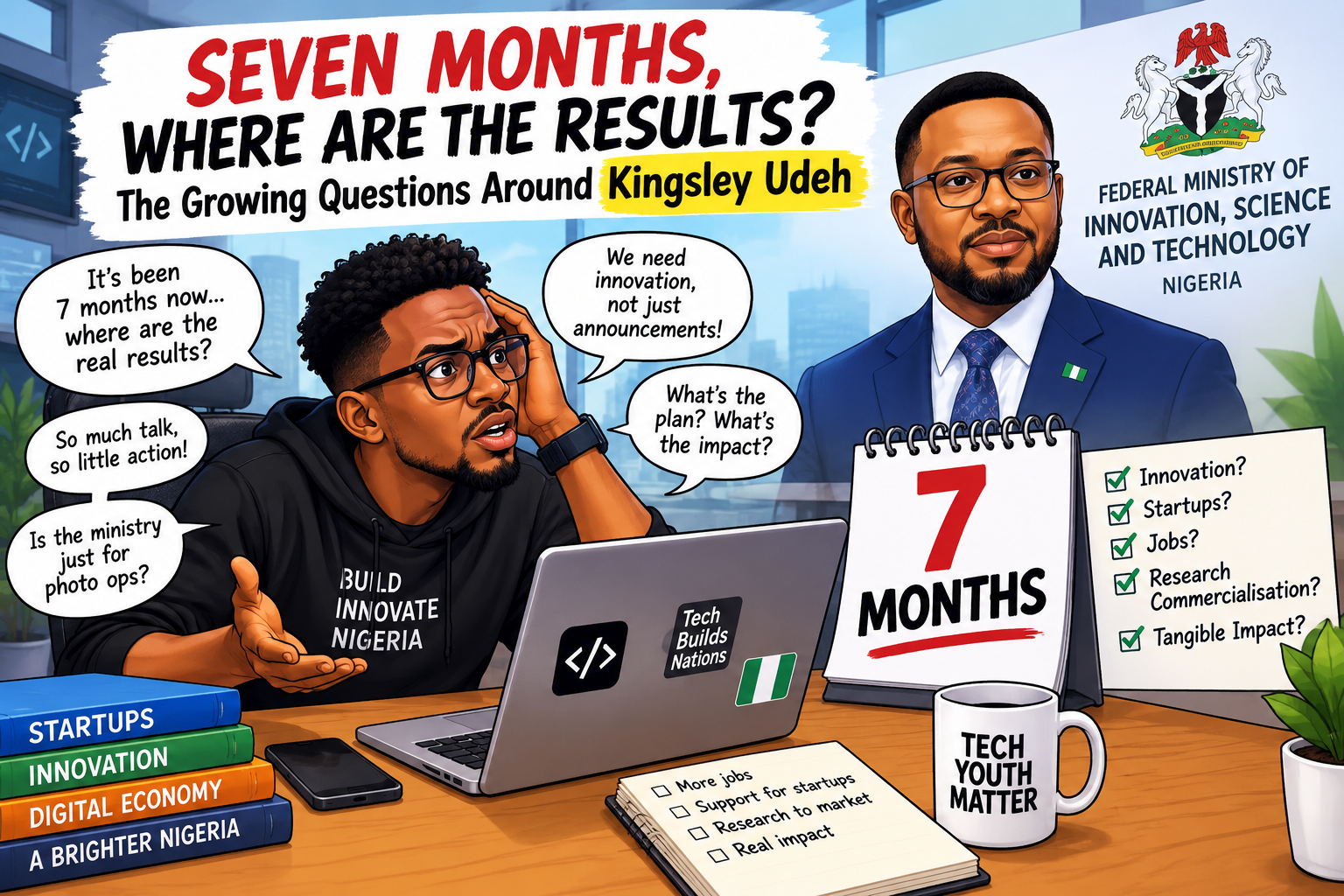
The frustrated young technology entrepreneur in the cartoon represents a generation that wants government to move faster, because young Nigerians are building startups, learning artificial intelligence, developing digital products, creating online businesses, and searching for opportunities in an economy where technology could become one of the strongest engines of future growth.
His frustration therefore should not be dismissed, because accountability remains essential whenever public officials receive the responsibility of managing national institutions, especially when those institutions are expected to influence innovation, research, entrepreneurship, technology development, and employment opportunities.
However, asking questions does not automatically mean that Kingsley Udeh has failed, because seven months can provide enough time to demand clear direction and measurable targets without necessarily providing enough time to judge the complete impact of a national technology strategy.
Udeh Deserves Time to Build
One of the biggest mistakes in evaluating government ministries is expecting every important result to become visible immediately, because some reforms require institutional restructuring, partnerships, planning, funding arrangements, research development, private-sector participation, and regulatory coordination before ordinary citizens can see the final benefits.
Innovation works particularly differently because a successful technology ecosystem cannot be created overnight through political announcements, since researchers need resources, entrepreneurs need support, investors need confidence, institutions need coordination, and promising ideas need a pathway from laboratories and universities into commercial markets.
This is why Udeh’s supporters can reasonably argue that the early period of his tenure should be viewed as a foundation-building stage, while still insisting that the ministry must eventually demonstrate clear results that Nigerians can see, measure, and understand.
Nigeria Needs More Than Technology Speeches
The young people asking difficult questions are not necessarily demanding miracles from the minister, because what many of them really want is evidence that government understands the problems confronting Nigeria’s technology sector and is prepared to create practical solutions that can survive beyond political speeches and temporary programmes.
They want stronger opportunities for innovators, better connections between researchers and businesses, improved support for technology entrepreneurs, greater access to innovation programmes, and policies that can help Nigerian ideas become commercially successful products.
That means Udeh’s strongest defence should not simply be that he needs more time, because the most convincing defence will eventually come from the results produced by the ministry and the opportunities created for Nigerians.
The Research-to-Market Problem Matters
One area where Udeh’s ministry can potentially make a major difference is the relationship between Nigerian research institutions and the private sector, because Nigeria has talented researchers and academics who produce valuable ideas, yet many promising ideas struggle to move from research papers and university laboratories into products that can reach consumers and create sustainable businesses.
If Udeh can help strengthen that connection, his tenure could become more significant than critics currently expect, because turning Nigerian research into commercially successful products could create businesses, generate employment, attract investment, strengthen local industries, and reduce the country’s dependence on imported technological solutions.
The real victory would therefore not simply be another government announcement about innovation, but the appearance of Nigerian technologies that move from research institutions into factories, startups, hospitals, farms, schools, businesses, and everyday households.
The Seven-Month Question Should Become a Scoreboard
Rather than dismissing the question about seven months, Udeh and his ministry could use it as an opportunity to create a transparent scoreboard showing Nigerians exactly what has been started, what has been completed, what remains under development, and when citizens should expect measurable outcomes.
Such an approach would strengthen the minister’s position because Nigerians would have something concrete to examine instead of relying entirely on political arguments from supporters and critics.
If the ministry can demonstrate progress across research commercialisation, innovation programmes, technology development, entrepreneurship, partnerships, and job creation, then the seven-month criticism could eventually become part of a much bigger story about how early foundations produced later results.
Udeh Should Not Be Judged by Noise Alone
Politics often rewards the loudest voices, but innovation requires patience, technical knowledge, persistence, and the ability to develop systems that can continue working even after political attention moves somewhere else.
Therefore, judging Udeh entirely through social media reactions could create an incomplete picture, because a minister can appear quiet while important institutional discussions, partnerships, programmes, and policy preparations are taking place behind the scenes.
That does not mean the public should stop asking questions, because transparency remains essential, but it does mean that criticism should be balanced with evidence and that supporters should demand results rather than relying on personality-driven political defence.
His Biggest Test Is Still Ahead
The strongest argument in favour of Kingsley Udeh is not that he should be protected from criticism, but that he should be given a reasonable opportunity to demonstrate what his vision can achieve while Nigerians continue to hold his ministry accountable for measurable progress.
His real test will come when Nigerians can point to successful technologies, stronger research partnerships, new businesses, better opportunities for innovators, commercialised research, improved support systems, and tangible economic benefits connected to the ministry’s work.
If those results appear, then the current criticism will look premature, but if they fail to appear after sufficient time, the questions will become considerably harder for the ministry to avoid.
Seven Months Is a Question, Not a Verdict
The young tech bro asking, “Seven months, where are the results?”, should therefore remain part of the conversation, because his question represents the expectations of millions of Nigerians who want technology to become more than a government slogan.
At the same time, Kingsley Udeh deserves the opportunity to demonstrate that his ministry can build something substantial rather than simply chase headlines, because transforming Nigeria’s innovation ecosystem requires more than announcing projects and expecting instant results.
The most reasonable position is therefore simple: give Udeh the room to build, demand transparency throughout the process, and judge the ministry ultimately by measurable results.
Seven months can justify scrutiny, but seven months alone should not become a final verdict on a minister whose biggest challenge is building systems capable of producing results for years to come.
The questions are legitimate, the expectations are high, and the pressure is justified, but Kingsley Udeh’s supporters can confidently argue that the real story may not be what has happened in seven months, but what those seven months have started building for Nigeria’s technological future.
About The Author