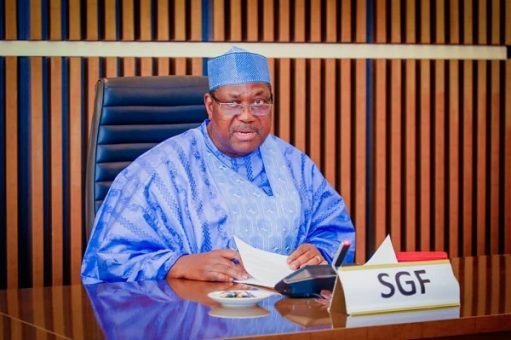
George Akume has declared that the achievements of the administration of President Bola Ahmed Tinubu are unmatched in Nigeria’s recent history, citing sweeping reforms, infrastructure expansion, economic restructuring, and renewed investments in critical sectors as evidence of the administration’s transformational agenda.
According to the Secretary to the Government of the Federation, the administration has pursued bold policies aimed at laying a stronger foundation for sustainable growth, improved governance, and long-term national prosperity.
Furthermore, he noted that many of the reforms being implemented today are designed not merely to address immediate challenges but to position Nigeria for greater competitiveness and resilience in the years ahead.
A Bold Reform Agenda
Akume observed that the Tinubu administration has demonstrated uncommon political will in implementing reforms considered essential for long-term national development.
Furthermore, he explained that difficult decisions often become necessary when governments seek to correct structural weaknesses that have accumulated over many years.
The administration, he said, has remained focused on strengthening public finances, improving economic management, and creating conditions that encourage sustainable investment.
Accordingly, these reforms continue to shape a stronger economic foundation for future generations.
Infrastructure as a Driver of Growth
Infrastructure development remains one of the defining priorities of the current administration.
Furthermore, the Federal Government has continued to approve and execute major road, transportation, housing, and energy projects across different parts of the country.
Akume stated that improved infrastructure supports commerce, reduces transportation costs, attracts investment, and enhances national productivity.
He noted that these projects are expected to deliver long-term economic benefits while improving the daily lives of Nigerians.
Strengthening the Economy
The SGF also pointed to ongoing economic reforms aimed at improving fiscal sustainability and encouraging private-sector participation.
Furthermore, government initiatives continue to focus on expanding domestic production, supporting local industries, and attracting both local and foreign investment.
According to Akume, the administration remains committed to building a diversified economy capable of creating employment opportunities and reducing dependence on a single revenue source.
Such reforms, he explained, position Nigeria for stronger and more inclusive economic growth.
Investing in Human Capital
Beyond economic reforms, the administration has continued to prioritise investments in education, healthcare, youth development, agriculture, and social protection.
Furthermore, programmes targeting skills acquisition, entrepreneurship, and technology continue to expand opportunities for young Nigerians.
Akume emphasised that national development cannot be sustained without continuous investment in human capital.
Consequently, the administration remains committed to empowering citizens through education, innovation, and economic inclusion.
Expanding Opportunities Across Sectors
The Federal Government has also introduced initiatives designed to strengthen agriculture, manufacturing, digital technology, energy, and small businesses.
Furthermore, these programmes support job creation while encouraging productivity and innovation across the economy.
Akume stated that coordinated investments across multiple sectors demonstrate the administration’s comprehensive approach to national development.
Rather than focusing on isolated interventions, he said, the government continues to pursue integrated reforms capable of producing lasting impact.
Commitment to National Development
The Secretary to the Government of the Federation reaffirmed that the administration remains focused on delivering measurable improvements in governance and public service.
Furthermore, collaboration among federal ministries, departments, and agencies continues to strengthen policy implementation and project delivery.
He expressed confidence that ongoing reforms would continue producing positive outcomes as more projects reach completion and additional programmes become operational.
According to him, consistency remains central to achieving the administration’s long-term objectives.
Building Confidence in Nigeria’s Future
Akume encouraged Nigerians to remain optimistic about the country’s future despite existing challenges.
Furthermore, he stressed that major national transformations require patience, continuity, and sustained commitment from both government and citizens.
He maintained that the policies being implemented today are laying the foundation for stronger institutions, greater economic resilience, and improved opportunities for future generations.
The administration, he added, remains determined to deliver meaningful progress across every sector of the economy.
A Vision for Lasting Progress
George Akume’s assessment of President Bola Tinubu’s administration reflects confidence in the direction of the Federal Government’s reform agenda and its long-term vision for national development.
Furthermore, the emphasis on infrastructure, economic transformation, human capital development, and institutional reform highlights an administration focused on building durable foundations for growth.
As ongoing projects advance and reforms continue to mature, the administration expects their cumulative impact to strengthen Nigeria’s economy, improve public services, expand opportunities for citizens, and reinforce the country’s position as one of Africa’s leading economies.
About The Author