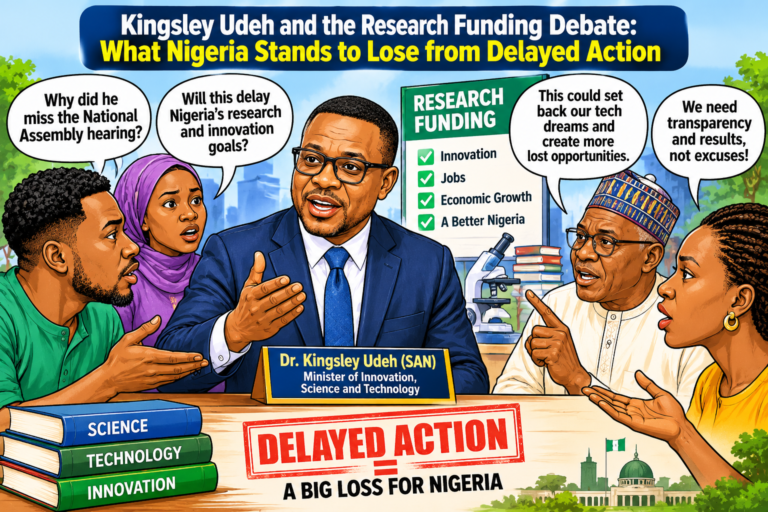

Nigeria possesses enormous research and scientific potential, but one major challenge has continued to limit its economic benefits: the difficulty of transforming discoveries made in laboratories and universities into commercially successful products, industries and employment opportunities. Now, Minister of Innovation, Science and Technology, Dr Kingsley Tochukwu Udeh (SAN), is advancing a strategy designed to address this longstanding problem and strengthen the country’s innovation-driven economy.
Under Udeh’s leadership, the Federal Ministry of Innovation, Science and Technology is pursuing initiatives that connect researchers, universities, investors, industries and government institutions. The objective is straightforward: ensure that Nigerian research produces practical solutions, creates businesses and contributes to national economic development.
Consequently, the question of whether Kingsley Udeh can turn Nigeria’s research potential into economic opportunities has become an important subject in discussions about the country’s technological future.
Nigeria Has Research Potential That Remains Underutilised
For years, Nigerian universities, polytechnics and research institutions have produced scientific discoveries, technical innovations and solutions to various developmental challenges. However, many of these achievements struggle to progress beyond academic publications, prototypes and laboratory demonstrations.
This disconnect has limited the economic value of research investment.
For example, innovations in agriculture could improve food production, while discoveries in healthcare could support local pharmaceutical development and medical technology. Similarly, engineering research could strengthen manufacturing, renewable energy and infrastructure development.
However, researchers need more than promising ideas. They require financing, modern equipment, intellectual property protection, industry partnerships and access to commercial markets.
Recognising this challenge, Udeh has placed research commercialisation at the centre of his ministry’s agenda. His approach seeks to move Nigeria beyond producing research findings towards developing technologies and products that can compete in the marketplace.
Kingsley Udeh’s Push for a National Research Funding Framework
One of the minister’s major initiatives is the proposed National Research and Innovation Development Fund (NRIDF), alongside the National Council on Research and Innovation (NCRI).
The Federal Executive Council approved the establishment of the framework, while the Federal Government forwarded legislation to the National Assembly to provide the necessary statutory backing.
In October 2026, Udeh explained that the proposed fund would create a more sustainable financing structure for research and development, particularly projects with commercial potential.
According to the minister, Nigeria needs a coordinated approach that takes research outcomes from university shelves and connects them with businesses, investors and consumers.
The proposed framework also seeks to attract private-sector participation rather than depend entirely on government allocations. Researchers, innovators, industry representatives and other stakeholders are expected to contribute to the governance and direction of the initiative.
This approach matters because sustainable innovation financing requires cooperation between government, academia and businesses.
Furthermore, the proposal could provide researchers with opportunities to develop prototypes, improve existing technologies and bring commercially viable products to market.
From Research Laboratories to Businesses and Jobs
Udeh’s strategy also addresses the relationship between research and employment.
When researchers successfully commercialise their discoveries, the benefits can extend beyond the original inventors. Manufacturing companies may adopt new technologies, investors may finance emerging businesses, and entrepreneurs may establish enterprises around locally developed products.
For instance, a university-developed agricultural technology could eventually support a commercial business supplying farmers with improved equipment or production solutions.
Similarly, innovations in renewable energy could create opportunities for local manufacturing, installation and maintenance businesses.
Therefore, research commercialisation can contribute to several stages of economic activity, including production, distribution, investment and employment.
The Federal Ministry of Innovation, Science and Technology has also highlighted the Energise Commercialisation Now (ECoN) Initiative as part of its efforts to identify commercially viable innovations, connect inventors with investors and strengthen intellectual property management.
These interventions demonstrate an attempt to build a more practical relationship between scientific research and economic development.
The Innovation Grid: Connecting Nigerian Discoveries with Investors
Another important aspect of Udeh’s agenda is the proposed national Innovation Grid.
In an interview reported by The Guardian on October 10, 2026, the minister disclosed plans for a digital platform that would catalogue inventions and innovations emerging from Nigerian universities and research institutions.
The proposed platform would make it easier for investors and technology companies to identify available intellectual property and connect with the institutions or researchers responsible for developing it.
This could address one of the major problems facing Nigerian innovators: limited visibility.
Many researchers develop promising solutions but struggle to find investors, manufacturers or businesses willing to commercialise their work. A properly managed national innovation database could improve access to these opportunities.
Additionally, the platform could help companies identify locally developed technologies instead of automatically looking overseas for solutions.
However, its eventual economic contribution will depend on successful implementation, reliable information, intellectual property protection and meaningful investor participation.
Why Private-Sector Investment Matters
Government funding alone cannot provide all the resources required to build a competitive research and innovation ecosystem.
Consequently, Udeh has emphasised the importance of private-sector participation in financing research and development.
Businesses have a direct interest in innovations that reduce production costs, improve efficiency, develop new products and open additional markets.
By connecting companies with universities and research institutions, Nigeria could encourage more demand-driven research.
In October, Udeh highlighted the role of private-sector investment and provisions within the country’s tax framework that recognise qualifying research and development expenditure.
This direction could encourage companies to view research not simply as an expense but as an investment in future competitiveness.
Nevertheless, businesses will need confidence in the quality of research, the protection of intellectual property and the commercial potential of proposed projects before committing substantial resources.
What Nigeria Stands to Gain
If these initiatives achieve their objectives, the benefits could reach several parts of the economy.
First, stronger research financing could support Nigerian scientists and innovators who currently struggle to develop their ideas.
Second, successful commercialisation could strengthen local manufacturing and reduce dependence on imported technologies.
Third, emerging technology businesses could create employment for graduates, engineers, researchers and skilled workers.
Furthermore, improved collaboration between universities and industries could help align academic research with the actual needs of the economy.
These opportunities are particularly important for young Nigerians seeking careers in science, engineering, technology and entrepreneurship.
However, the country must support these ambitions with reliable electricity, modern laboratories, skilled personnel, transparent grant allocation and effective intellectual property institutions.
The Challenge Ahead for Kingsley Udeh
Despite the promise of the minister’s initiatives, turning Nigeria’s research potential into economic opportunities will require sustained implementation.
The proposed research fund must receive the necessary legislative backing and operate with transparent governance. Similarly, the Innovation Grid must move from planning to practical deployment, while commercialisation programmes must produce measurable outcomes.
Udeh’s ministry will also need to maintain strong relationships with state governments, universities, private investors and international development partners.
These responsibilities make collaboration essential. No single ministry can independently transform an entire national research ecosystem.
Nevertheless, the direction of the current agenda provides an important opportunity to address weaknesses that have limited the economic contribution of Nigerian research for decades.
A New Opportunity for Nigeria’s Innovation Economy
Ultimately, Nigeria’s scientific potential should translate into more than academic recognition. It should produce technologies, businesses, jobs and solutions that improve people’s lives.
Kingsley Udeh’s research funding framework, Innovation Grid and commercialisation initiatives represent efforts to strengthen the connection between scientific discoveries and economic development.
The real test will be implementation, but the ambition addresses a significant national challenge.
As Nigeria pursues economic diversification and stronger domestic production, investing in research and innovation becomes increasingly important.
If the proposed initiatives deliver their intended results, Nigerian researchers could gain better opportunities to commercialise their discoveries, businesses could access home-grown technologies, and the economy could benefit from new sources of productivity and employment.
For Udeh, the opportunity is to help transform research from an underutilised national resource into an engine of economic opportunity. For Nigeria, the potential reward is an innovation ecosystem capable of turning local knowledge into lasting national value.
About The Author