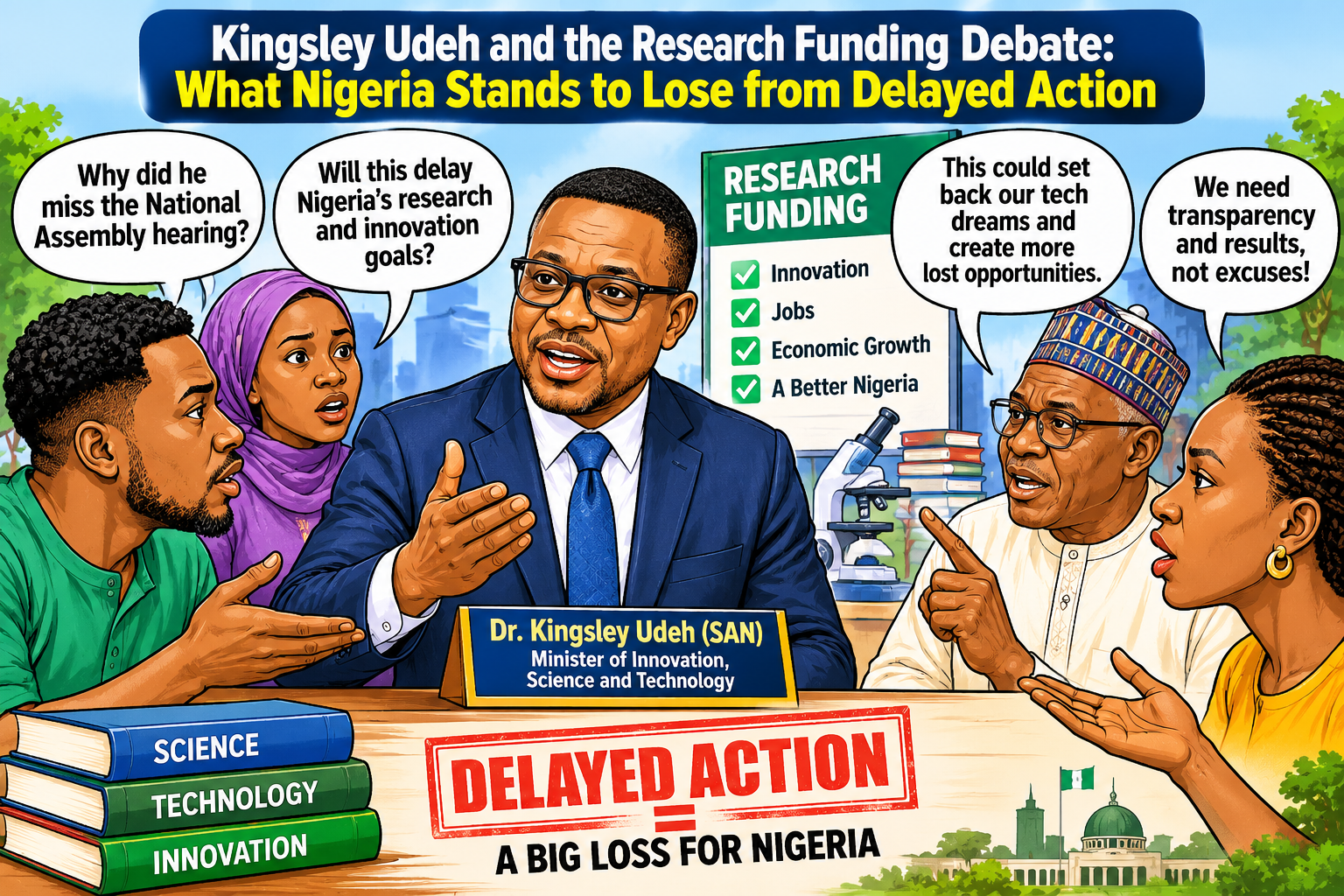
Nigeria’s research funding debate has become an important national conversation following the controversy surrounding the Minister of Innovation, Science and Technology, Dr Kingsley Tochukwu Udeh (SAN), and his absence from a National Assembly public hearing on the proposed National Research and Innovation Development Fund. Although the development attracted criticism from lawmakers, the bigger issue goes far beyond one minister’s attendance. Nigeria stands to lose valuable opportunities in scientific development, technology, industrial growth and job creation if it fails to establish a sustainable system for financing research and innovation.
For a country seeking to reduce dependence on imported technologies and strengthen its domestic economy, research funding is not a luxury. It is an important investment in national development. Consequently, the debate surrounding Udeh and the proposed fund deserves attention, particularly as the Federal Government continues to pursue an innovation-driven economic agenda.
How Kingsley Udeh Became Part of the Research Funding Controversy
The controversy emerged on November 12, 2026, when the House of Representatives Committee on Science and Technology held a public hearing on the National Research and Innovation Development Fund and National Council on Research and Innovation Bill, 2026, identified as HB 2821.
The committee expressed displeasure over the absence of Udeh and the ministry’s Permanent Secretary. Lawmakers argued that the ministry’s participation was particularly important because the proposed legislation directly concerns its responsibilities.
Ahmed Usman Jaha, a member of the committee, criticised the development and described the ministry’s absence as possible sabotage of cooperation between the executive and legislative arms of government.
However, an important detail deserves attention: reports indicated that none of the other invited ministers attended the hearing either. Although this did not remove the committee’s concerns about Udeh’s absence, it provides additional context to the controversy.
The available reports did not establish the minister’s reason for missing the hearing. Therefore, the criticism should not automatically become a conclusion that he opposed the proposed fund or deliberately frustrated President Bola Tinubu’s agenda.
Indeed, the Federal Government had already taken steps towards establishing the research funding framework before the hearing.
What Is the National Research and Innovation Development Fund?
The proposed National Research and Innovation Development Fund aims to create a sustainable financing structure for scientific research, technological development and innovation across Nigeria.
Under the proposed legislation, the government intends to establish a National Council on Research and Innovation to coordinate research priorities and support the development of a stronger national innovation ecosystem.
The fund would provide financial support for research institutions, universities, polytechnics, scientists, technology entrepreneurs and other qualified innovators.
More importantly, it seeks to address a longstanding problem: the gap between scientific discoveries and their practical application.
Nigeria has researchers developing ideas in agriculture, healthcare, engineering, renewable energy, manufacturing and information technology. However, without reliable funding, many promising discoveries struggle to move beyond laboratories and academic publications.
Consequently, the proposed fund could help connect research institutions with investors, industries and development partners.
The framework also seeks to attract grants from international organisations, donor agencies and Nigerians in the diaspora, creating additional opportunities to support local research.
What Nigeria Stands to Lose If Action Is Delayed
The consequences of delaying a sustainable research funding system could extend across several sectors.
1. Local innovations may struggle to reach the market
Research does not end when a scientist makes a discovery. Many innovations require additional funding for testing, development, production and commercialisation.
Without adequate financing, promising technologies may remain unused. As a result, Nigeria could continue importing products and solutions that local researchers have the capacity to develop.
2. Young Nigerian scientists could lose opportunities
Nigeria has talented students, graduates, researchers and technology entrepreneurs who need access to research grants, modern equipment and professional support.
A properly structured fund could create opportunities for these individuals to develop their ideas and participate in solving national problems.
However, prolonged uncertainty over research financing could discourage promising innovators and limit the development of local expertise.
3. Industries could miss opportunities for growth
Research and industrial development are closely connected. Manufacturing companies, agricultural businesses, pharmaceutical producers and technology firms need innovation to improve productivity and remain competitive.
For example, locally developed agricultural technologies could help farmers improve yields, while advances in manufacturing research could reduce production costs.
Therefore, sustainable research funding could support businesses, encourage investment and create employment opportunities.
4. Nigeria could struggle to attract international research partnerships
International development organisations and research institutions often seek reliable national structures through which they can support scientific projects.
The proposed fund is intended to provide a coordinated framework for attracting such support.
If the legislation experiences unnecessary delays, Nigeria could miss opportunities to strengthen international partnerships and attract additional research financing.
Why Kingsley Udeh’s Ministry Matters
As Minister of Innovation, Science and Technology, Udeh occupies an important position in the government’s efforts to strengthen Nigeria’s research and innovation ecosystem.
His ministry must work with universities, research institutions, technology organisations, private-sector investors and lawmakers to create an environment where scientific discoveries can generate practical economic benefits.
Importantly, the ministry had already taken steps towards the proposed framework before the November controversy.
In September 2026, the Federal Government organised a stakeholder sensitisation workshop on the draft executive bill for the establishment of the National Council on Research and Innovation and the National Research and Innovation Development Fund. Udeh’s ministry was involved in advancing the initiative.
Furthermore, in October, Udeh disclosed that the Federal Executive Council had approved the establishment of the fund and council, with the proposed legislation transmitted to the National Assembly for statutory backing.
These developments show that the research funding initiative did not originate at the November hearing. Rather, it had already passed through earlier government and stakeholder engagement processes.
Nevertheless, the minister’s absence from the subsequent hearing created an avoidable communication and accountability challenge. The ministry can address this concern by maintaining direct engagement with lawmakers and providing clear explanations about its position on the bill.
The National Assembly Has Also Made Progress
Although the November 12 hearing generated controversy, the legislative process did not end with the disagreement.
The House Committee on Science and Technology subsequently produced a report on HB 2821, containing recommendations on the proposed legislation.
The report examined the bill’s objectives, institutional structure, funding arrangements and provisions for research commercialisation.
Among the issues considered were the proposed funding sources, including a contribution from the Nigerian Content Development Fund, as well as provisions for competitive, peer-reviewed research grants and administrative expenditure.
These matters are important because Nigeria needs more than a research fund established on paper. It needs a structure capable of distributing grants fairly, protecting public resources and delivering measurable results.
The committee’s work therefore represents an important part of the process.
However, lawmakers and the relevant ministries must continue working together to address outstanding concerns before the proposed framework becomes fully operational.
Why Transparency Must Remain a Priority
The proposed fund will handle resources intended to support research institutions and innovators. Therefore, transparency must remain central to its administration.
Grant allocation should follow clear and competitive procedures. Researchers should understand the eligibility requirements, application process and assessment criteria.
Similarly, independent oversight should help prevent political interference, favouritism and misuse of public resources.
The proposed framework must also protect intellectual property so that researchers and inventors can benefit from the commercial value of their discoveries.
These safeguards will help build confidence among local researchers, private investors and international development partners.
For Udeh’s ministry, this presents an opportunity to demonstrate that innovation policy requires more than announcements and institutional structures. It requires effective implementation and accountability.
The Bigger Picture: Nigeria Cannot Afford to Neglect Research
Ultimately, the research funding debate should encourage a wider national conversation about the future of science, technology and industrial development.
Nigeria cannot build a competitive innovation economy without investing in the people and institutions responsible for producing new knowledge.
The proposed National Research and Innovation Development Fund could provide an important foundation for that ambition. However, its success will depend on sustainable financing, transparent administration and cooperation between the executive and legislative arms of government.
While the criticism surrounding Kingsley Udeh’s absence deserves clarification, it should not overshadow the broader importance of the initiative or turn an institutional disagreement into an assumption of deliberate obstruction.
The minister has an opportunity to strengthen engagement with lawmakers, while the National Assembly must ensure that the final legislation addresses genuine funding and governance concerns.
For Nigeria, the stakes are significant. Every year spent without an effective research funding framework could mean missed opportunities for innovation, industrial development, investment and employment.
The real priority, therefore, should be to move the research funding agenda forward and establish a system that gives Nigerian scientists and innovators the resources to transform ideas into solutions.
About The Author